Marcus Larson
1825 – 1864
In short
Marcus Larson (1825–1864) was a Swedish landscape painter associated with the Düsseldorf school, noted for dramatic depictions of turbulent nature and maritime disaster scenes.
Notable works
.jpg)
Early life Marcus Larson was born in 1825 in the small town of Åtvidaberg, located in the province of Östergötland, Sweden. He grew up in a region characterised by dense woodlands and numerous waterways, an environment that would later inform his fascination with natural scenery. Little is recorded about his family background, but early indications of artistic talent led him to pursue formal training in the visual arts. By his late teens, Larson had moved to Stockholm to study drawing and painting, where he was exposed to the burgeoning Romantic movement that valued emotional intensity and the sublime power of nature.
Career and style In the early 1840s Larson travelled to Germany to join the Academy of Fine Arts in Düsseldorf, a centre of artistic innovation renowned for its rigorous approach to landscape painting. The Düsseldorf school emphasised meticulous draftsmanship, atmospheric perspective, and a narrative quality that often infused ordinary scenes with a sense of drama. Larson absorbed these principles while retaining a distinctly Swedish sensibility, resulting in works that combined technical precision with a heightened emotional charge.
Returning to Scandinavia in the mid‑1850s, Larson quickly established a reputation for large‑scale canvases that portrayed nature in its most volatile states. He favoured subjects such as waterfalls, storm‑tossed seas, and rugged coastlines, often under dramatic skies. His paintings were characterised by a dynamic composition, where foreground elements—rocky cliffs, shattered ships, or cascading water—were juxtaposed against turbulent clouds that dominate the horizon. This visual tension created a palpable sense of danger and awe, aligning him with the Romantic fascination with the sublime.
Signature techniques Larson’s technique rested on a few recurring devices. Firstly, he employed a limited but powerful palette of deep blues, muted greens, and stark whites to convey the cold, unforgiving aspects of his subjects. Atmospheric effects were achieved through layered glazing, allowing light to permeate the upper portions of the canvas while the lower areas remained shrouded in shadow. Secondly, his brushwork varied deliberately: tight, controlled strokes rendered architectural details and distant mountains, whereas broader, gestural strokes captured the movement of water and wind. Finally, Larson often used a compositional diagonal that leads the eye from a point of tension—such as a ship breaking apart—to a distant, storm‑laden horizon, reinforcing the narrative of struggle against nature.
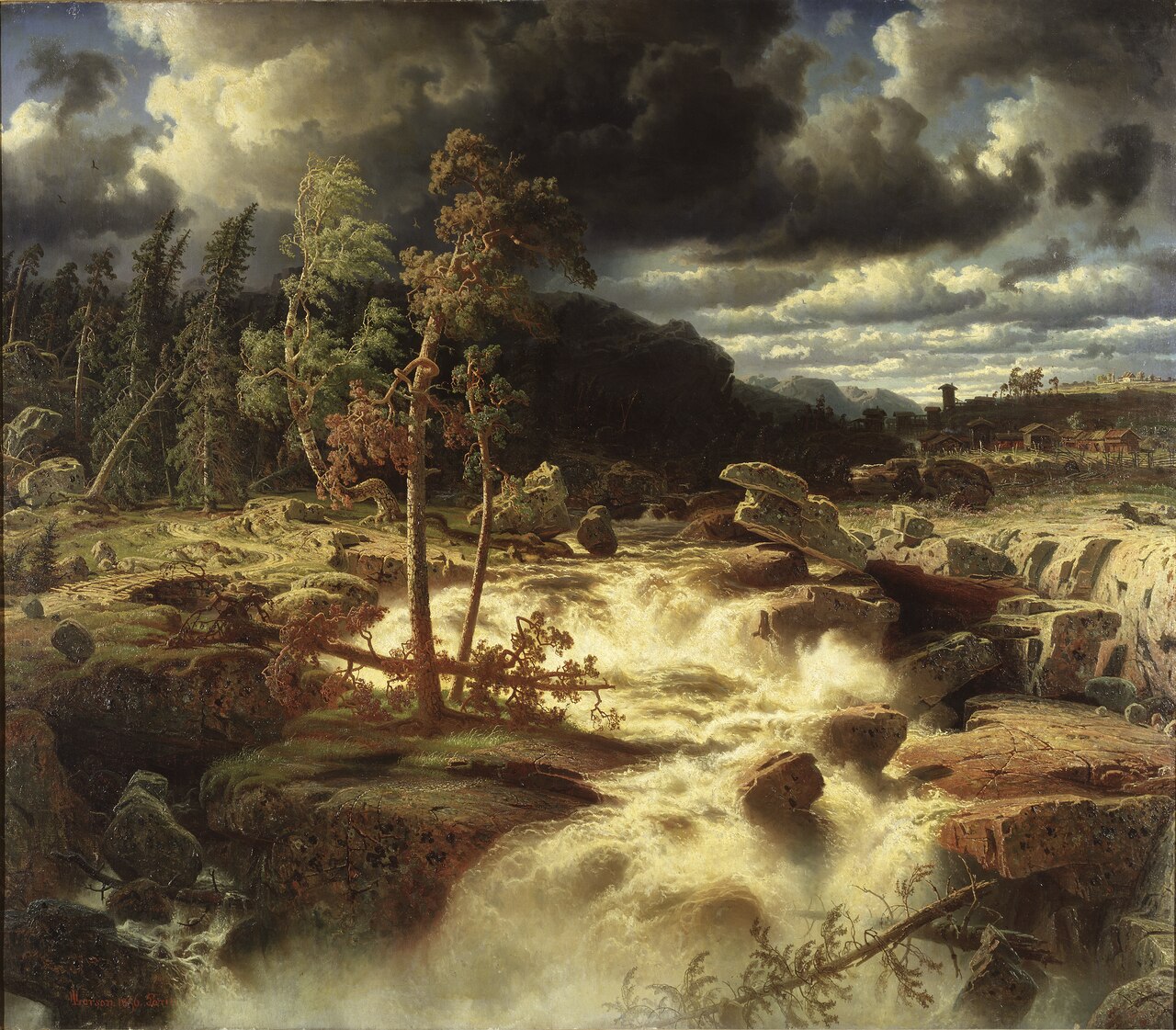
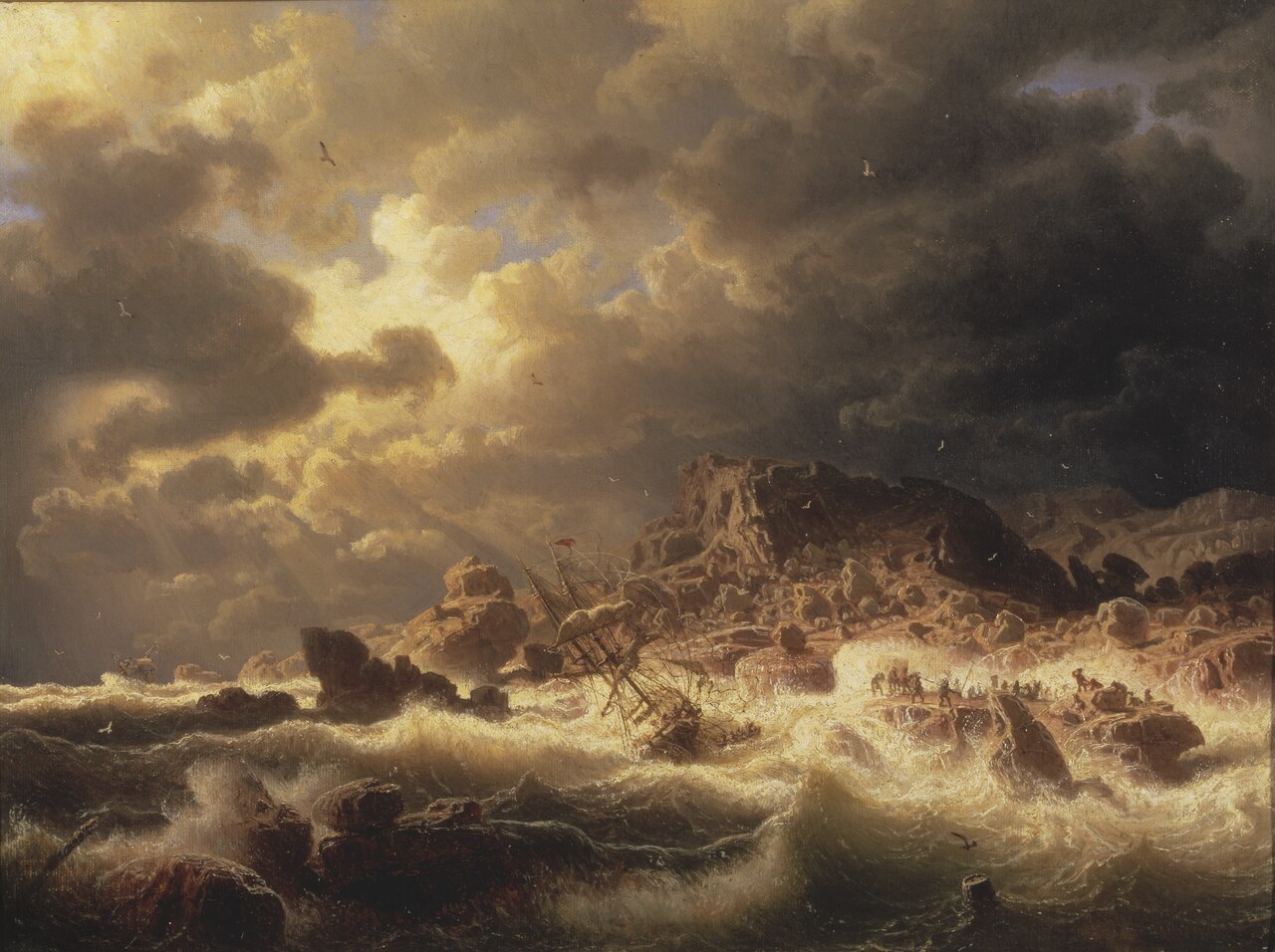
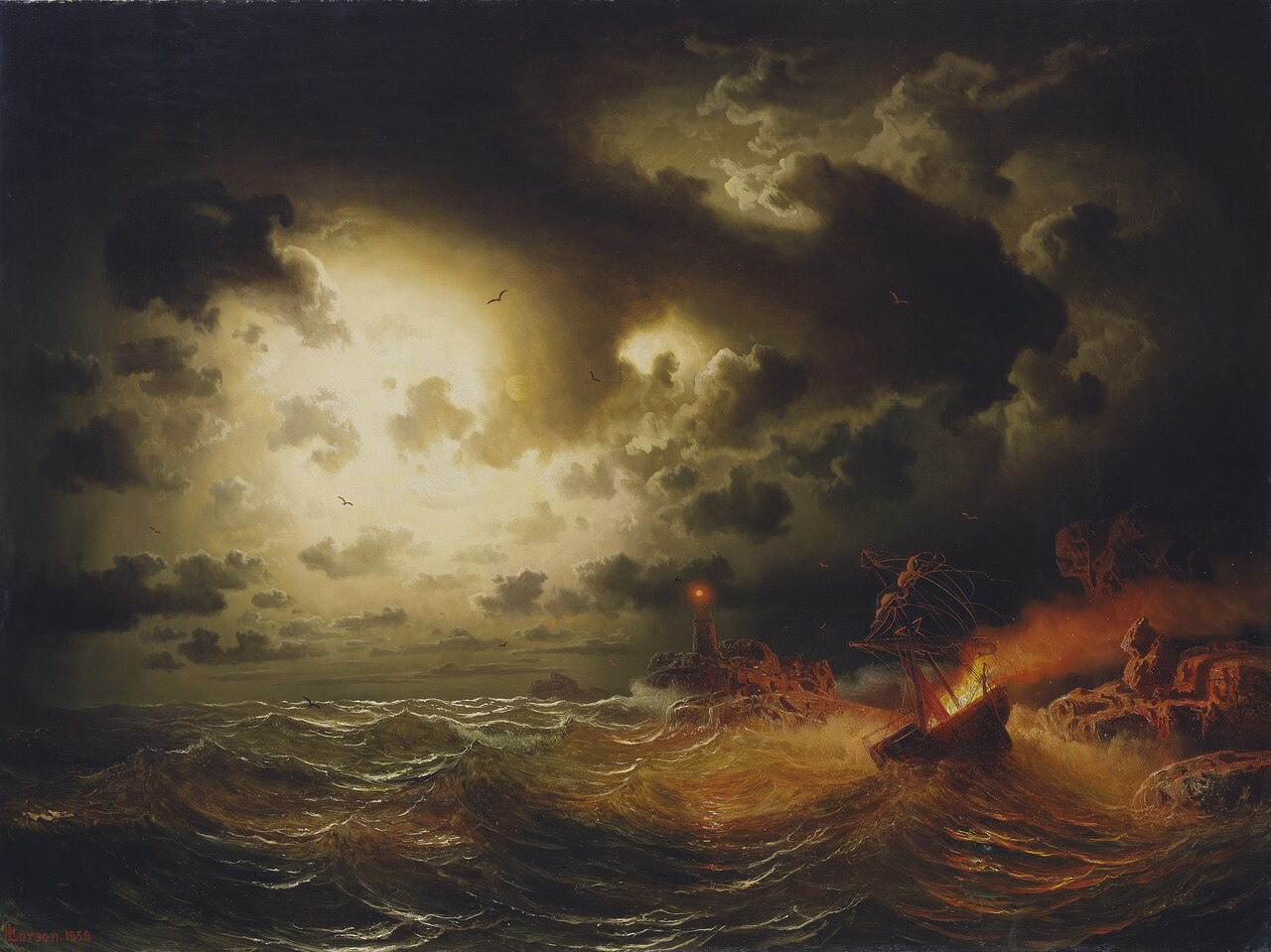
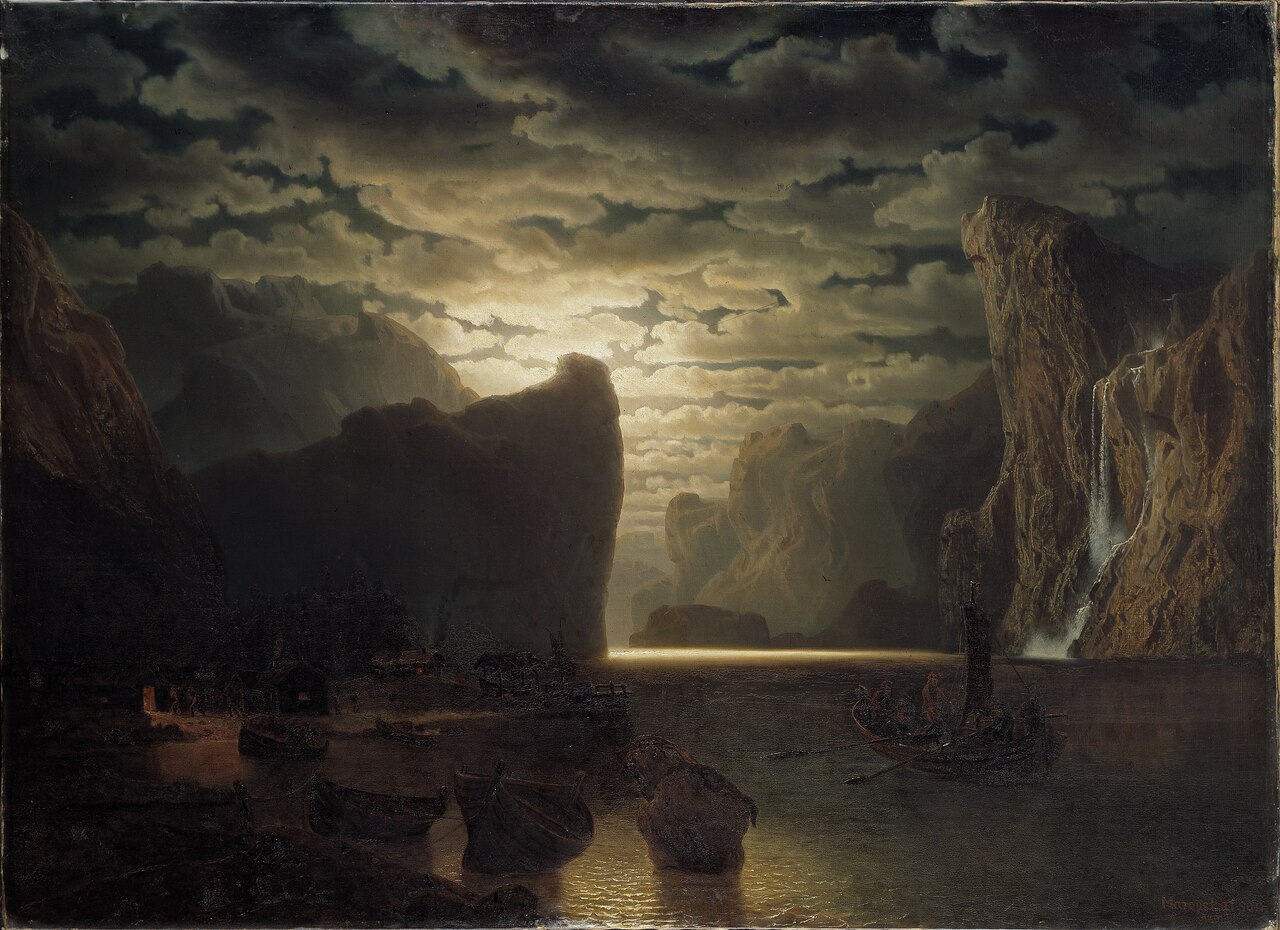
Major works - **Waterfall in Småland (1856)** – This early masterpiece depicts a towering cascade set amid dense Swedish forest. The waterfall dominates the centre of the picture, its white spray contrasting with the dark, moss‑covered rocks. Larson’s use of light emphasises the kinetic energy of the water, while the surrounding trees recede into a misty background, suggesting both the grandeur and isolation of the natural site. - **Gale on the Bohuslän Coast (1857)** – In this seascape, a fierce north‑eastern wind hauls the clouds across a bleak coastline. Fishermen’s boats are huddled against the cliffs, their masts bending under the force of the gale. The painting’s colour scheme—stormy greys and bruised blues—conveys an imminent sense of danger, underscoring the artist’s preoccupation with humanity’s vulnerability to the elements. - **Burning Steamer (1858)** – Perhaps Larson’s most famous maritime disaster, the work captures a steamship ablaze amid a churning sea. Flames lick the hull while smoke spirals upward, merging with the darkening sky. The composition is deliberately chaotic; splintered wood and shattered rigging are scattered across the foreground, drawing the viewer’s eye toward the central inferno. The painting’s emotional impact lies in its raw depiction of tragedy, a hallmark of Larson’s narrative style. - **Vildmarkslandskap (1861)** – Translating to “Wilderness Landscape,” this piece presents a remote, snow‑capped mountain range under a storm‑clouded sky. The foreground is populated by jagged rocks and a solitary pine, while the mid‑ground opens to a glacial valley. The work exemplifies Larson’s later period, where he refined his handling of light to create a more subtle, almost ethereal atmosphere. - **Norwegian Fjord in Moonlight. Motif from the Sogne‑Fjord (1861)** – In this nocturnal scene, Larson captures the serene side of his oeuvre. A moonlit fjord glistens with reflected light, while steep cliffs rise on either side. The limited illumination creates a tranquil mood, contrasting with his more tempestuous works. The painting demonstrates his ability to render both the violent and the peaceful aspects of natural landscapes.
Influence and legacy Marcus Larson died prematurely in London in 1864, yet his relatively brief career left a lasting imprint on Scandinavian art. Contemporary critics hailed him as one of Sweden’s foremost 19th‑century painters, and later historians have described him as the most outstanding member of the Swedish Düsseldorf cohort. His dramatic treatment of landscape paved the way for the next generation of Swedish artists who sought to combine technical mastery with emotive storytelling. The intensity of his storm‑filled seascapes influenced later marine painters, while his handling of light and atmosphere contributed to the development of Nordic Romanticism. Today, Larson’s works are held in major museums across Sweden and Europe, and they continue to be studied for their synthesis of German academic training and native Scandinavian sensibility.
Frequently asked questions
Who was Marcus Larson?
Marcus Larson (1825–1864) was a Swedish painter known for dramatic landscapes and maritime scenes, associated with the Düsseldorf school of painting.
What artistic movement did he belong to?
He worked within the Düsseldorf school, a 19th‑century German movement that emphasized precise draftsmanship, atmospheric perspective, and narrative composition.
What are his most famous works?
Key works include *Waterfall in Småland* (1856), *Gale on the Bohuslän Coast* (1857), *Burning Steamer* (1858), *Vildmarkslandskap* (1861), and *Norwegian Fjord in Moonlight* (1861).
Why is he important in art history?
Larson is regarded as a leading figure in Swedish Romantic landscape painting, bridging German academic techniques with a uniquely Nordic vision of nature’s power.
How can I recognise a Marcus Larson painting?
Look for sweeping, turbulent skies, dramatic water or sea scenes, a limited palette of blues and greys, and a strong diagonal composition that heightens tension.