John Bauer
1882 – 1918
In short
John Bauer (1882–1918) was a Swedish painter and illustrator best known for his evocative depictions of folklore and myth, especially the illustrations he created for early editions of the fairy‑tale collection *Bland tomtar och troll*. His work blends landscape, narrative, and a distinctive, atmospheric style that has become iconic in Swedish visual culture.
Notable works


Early life John Albert Bauer was born on 4 June 1882 in the parish of Jönköpings Kristina, a rural area in southern Sweden. He grew up in a modest family; his father worked as a railway clerk and his mother managed the household. From an early age Bauer displayed a talent for drawing, often sketching the surrounding countryside and the folk tales he heard from his grandparents. After completing his primary education, he earned a scholarship that allowed him to attend the Royal Swedish Academy of Fine Arts in Stockholm, where he received formal training in drawing, painting and illustration. The academy’s curriculum emphasized both classical techniques and contemporary artistic developments, providing Bauer with a solid technical foundation while exposing him to the emerging Symbolist and Art Nouveau currents that were influencing European art at the turn of the century.
Career and style Bauer’s professional career began in the early 1900s, when he started to receive commissions for book illustrations, magazine plates and decorative panels. His style quickly distinguished itself through a seamless integration of landscape and narrative. Rather than treating scenery as a mere backdrop, Bauer rendered natural settings—forests, lakes, and mist‑filled hills—as active participants in his stories. This approach reflected a broader Scandinavian fascination with the mythic qualities of the natural world, a theme that resonated strongly with the nation’s burgeoning interest in folklore.
Although he never aligned himself with a formal art movement, Bauer’s work bears hallmarks of Symbolism, particularly in its use of mood and allegory, and of Art Nouveau, evident in the flowing lines and decorative motifs that frame many of his compositions. His colour palette is often subdued, dominated by muted greens, greys and blues, which enhance the sense of mystery and quietude. At the same time, he employed striking contrasts of light and shadow to highlight focal points—usually a fairy, troll or child—drawing the viewer’s eye into the narrative moment.
Signature techniques Bauer combined several media to achieve his characteristic look. He frequently worked in watercolour, a medium that allowed him to produce delicate washes and atmospheric effects. For the finer details—such as the intricate patterns on a fairy’s dress or the textured bark of a tree—he employed ink or graphite, adding crisp lines that contrast with the softer watercolour fields. This layered approach gave his illustrations depth and a tactile quality.
His compositional technique often involved a low horizon line, which expands the sky and creates a sense of vastness. He also favoured a slightly elevated perspective, enabling the viewer to see both the characters and the surrounding environment simultaneously. The use of negative space—particularly the misty, empty expanses of forest—contributes to a feeling of isolation and anticipation, a visual echo of the stories’ magical tension.
Major works Bauer’s most celebrated pieces are closely linked to the *Bland tomtar och troll* series, an anthology of Swedish fairy tales that he illustrated for its early editions. Among these, **The Fairy Princess (1904)** stands out as an early example of his mature style: a solitary fairy perched on a moss‑covered stone, bathed in soft, diffused light. The composition balances delicate figure work with a richly rendered woodland, illustrating Bauer’s skill at marrying character and setting.
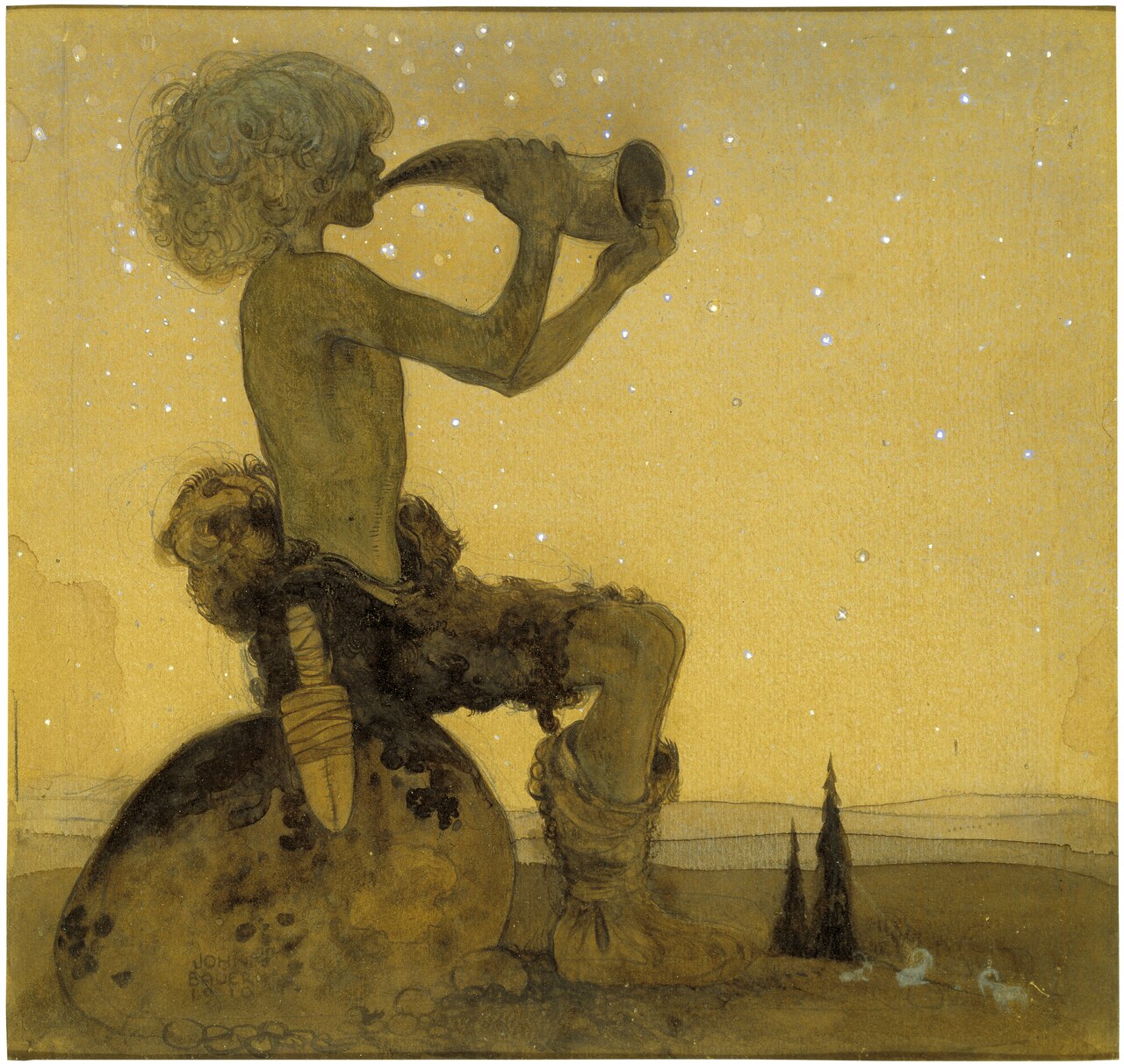
In 1910, he produced Vill Vallareman (a Fairy Shepherd), a work that showcases his fascination with pastoral myth. The shepherd figure, surrounded by gentle swaths of grass and distant mountains, embodies the serene, almost timeless quality that pervades much of his oeuvre.
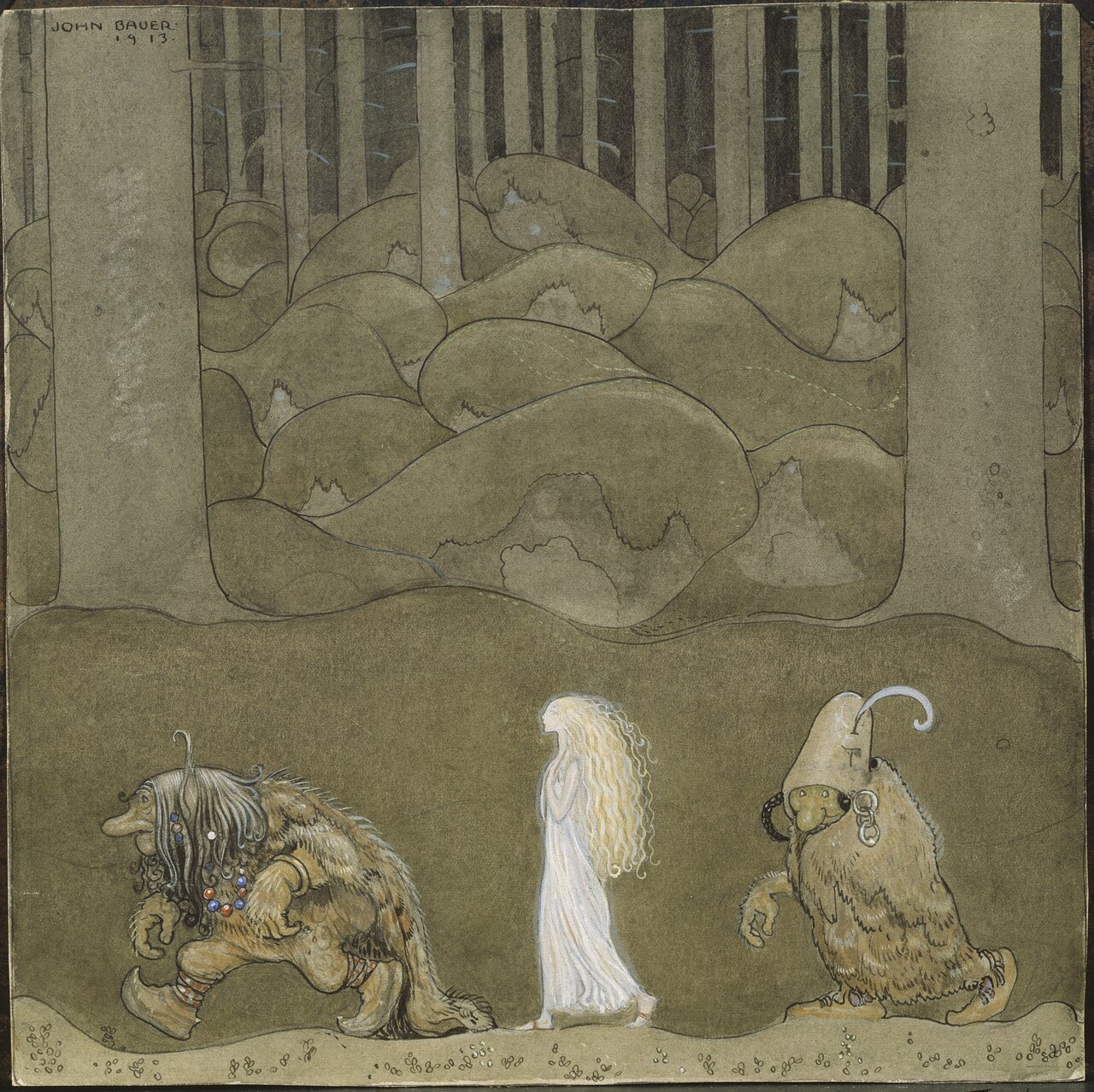
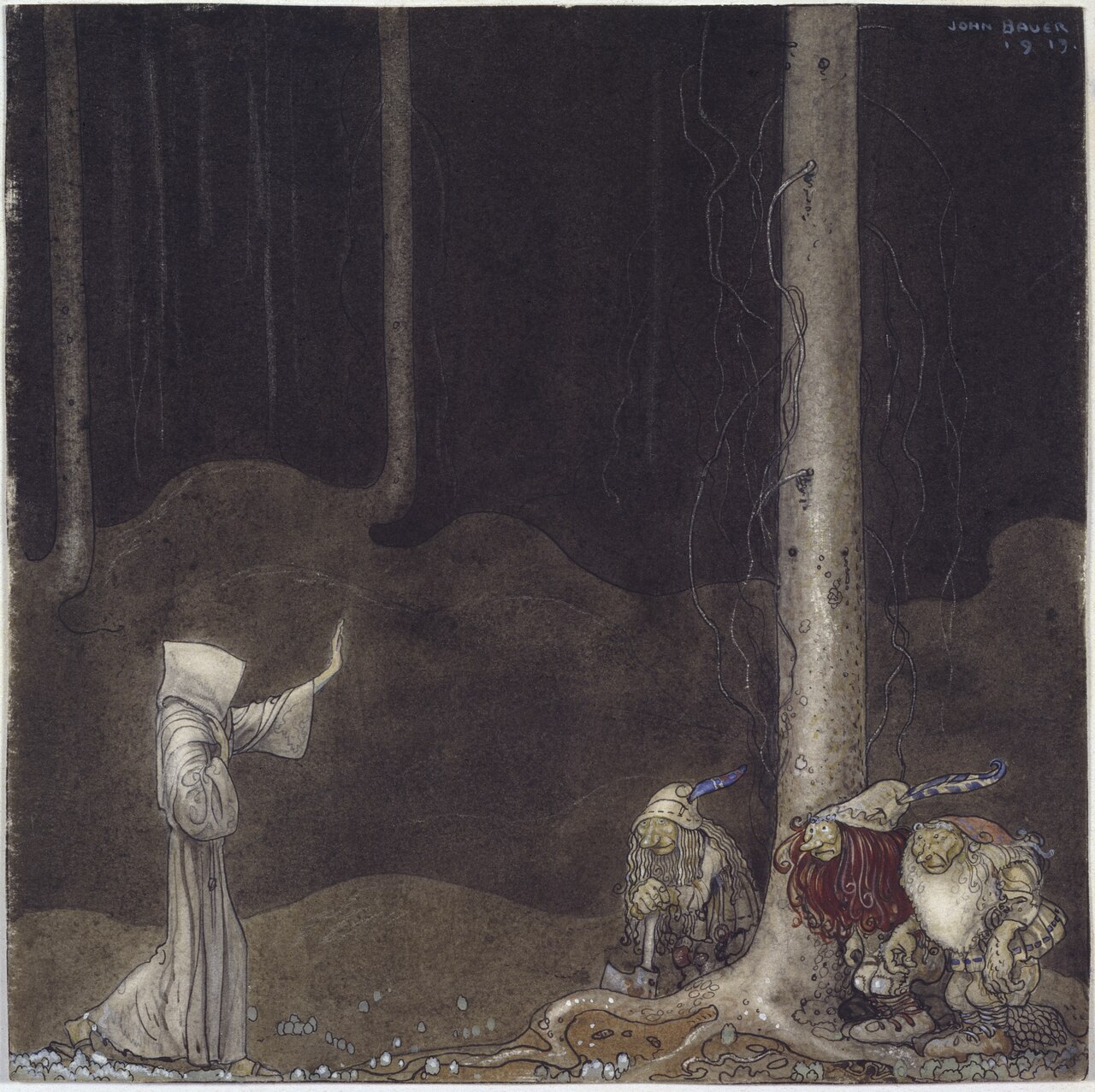
Three works from 1913—Tuvstarr is still sitting there wistfully looking into the water, The Princess and the Trolls, and Brother St. Martin and the Three Trolls—represent the height of his illustration career. In the first, a young girl gazes pensively at a lake, her contemplative pose echoing the quiet melancholy that Bauer often infused into his human subjects. *The Princess and the Trolls* and *Brother St. Martin and the Three Trolls* both feature dynamic interactions between human figures and mythic creatures, rendered with dramatic chiaroscuro that heightens narrative tension. These pieces illustrate Bauer’s ability to convey storytelling through visual rhythm, placing characters within a landscape that feels both enchanted and believable.
Bauer’s untimely death on 20 November 1918, when the ferry he was traveling on sank in Lake Vättern, cut short a prolific career. Yet his illustrations continued to appear posthumously, cementing his reputation as the visual voice of Swedish folklore.
Influence and legacy Despite his brief lifespan, John Bauer left an indelible mark on Swedish visual culture. His illustrations for *Bland tomtar och troll* became the definitive images associated with many of the nation’s fairy‑tale characters, shaping the collective imagination of generations of readers. The iconic style he established influenced a wide range of subsequent artists, from graphic designers working on contemporary children’s books to animators adapting folk narratives for film and television.
Beyond the realm of illustration, Bauer’s approach to integrating landscape and narrative contributed to a broader artistic dialogue about the relationship between nature and myth in early‑twentieth‑century Scandinavia. His work is frequently exhibited in Swedish museums, often alongside contemporaries such as Bruno Liljefors, whose naturalist paintings share a similar reverence for the forest.
In recent decades, academic interest in Bauer has grown, with scholars examining his contributions to national identity formation and the visual language of folklore. His images continue to be reproduced in various media—posters, merchandise, and digital platforms—ensuring that his atmospheric vision remains accessible to new audiences. The enduring popularity of his illustrations demonstrates the timeless appeal of his blend of the mystical and the natural, confirming John Bauer’s status as a cornerstone of Swedish art history.
Frequently asked questions
Who was John Bauer?
John Bauer (1882–1918) was a Swedish painter and illustrator best known for his atmospheric depictions of folklore, especially his illustrations for early editions of the fairy‑tale collection *Bland tomtar och troll*.
What artistic style or movement is he associated with?
Bauer did not belong to a formal movement, but his work shows influences of Symbolism and Art Nouveau, characterised by a muted palette, lyrical lines and a strong integration of landscape and narrative.
What are his most famous works?
His most celebrated pieces include *The Fairy Princess* (1904), *Vill Vallareman (a Fairy Shepherd)* (1910), and the 1913 illustrations *Tuvstarr is still sitting there wistfully looking into the water*, *The Princess and the Trolls*, and *Brother St. Martin and the Three Trolls*.
Why does John Bauer matter in art history?
Bauer defined the visual language of Swedish folklore, influencing later illustrators, designers and animators, and his images continue to shape the cultural perception of mythical creatures throughout Scandinavia.
How can I recognise a John Bauer illustration?
Look for soft watercolour washes combined with fine ink lines, a muted colour scheme, low horizons, misty forest settings and a gentle, narrative focus on fairies, trolls or children placed within the landscape.