Anders Zorn
1860 – 1920
In short
Anders Zorn (1860–1920) was a Swedish painter, sculptor and etcher who achieved international fame for his portraits and genre scenes, working chiefly in an Impressionist style. He is renowned for works such as Summer Fun, Omnibus and Midsummer Dance, and for his portraits of royalty and three U.S. presidents.
Notable works
,_akvarell_av_Anders_Zorn.jpg)


Early life Anders Leonard Zorn was born on 18 February 1860 in the rural parish of Mora, Dalarna, Sweden. He was the youngest of five children in a modest farming family. From an early age Zorn showed a talent for drawing, copying religious icons and folk motifs that surrounded his childhood. In 1875, at the age of fifteen, he left school to apprentice with a local decorative painter, where he learned the basics of oil painting and commercial illustration. His early exposure to the natural light of the Swedish countryside would later inform his colour palette.
In 1879 Zorn moved to Stockholm to study at the Royal Swedish Academy of Fine Arts. The Academy provided formal training in drawing from casts and life models, while also exposing him to contemporary European art trends. During his student years he supported himself by producing illustrations for newspapers and magazines, a practice that honed his ability to capture fleeting gestures – a skill that became a hallmark of his later work.
Career and style After completing his studies, Zorn travelled extensively throughout Europe. Visits to Paris, Munich and London introduced him to the burgeoning Impressionist movement, which resonated with his interest in light, colour and the depiction of everyday life. Although he never formally joined an Impressionist group, Zorn incorporated its principles into his own practice, blending them with a distinctly Swedish sensibility.
Zorn’s career accelerated in the 1880s when his portraiture attracted the attention of the Swedish aristocracy. His reputation grew beyond Sweden when he exhibited at the Paris Salon and the World’s Columbian Exposition in Chicago (1893). By the 1890s he was receiving commissions from royalty and political leaders, including King Oscar II of Sweden and three American presidents – Grover Cleveland, William H. Taft and Theodore Roosevelt. These high‑profile portraits cemented his status as an international portraitist.
Throughout his life Zorn worked in oil, watercolour, pastel, etching and bronze sculpture. He maintained a prolific output, producing over a thousand works in a variety of media. His subjects ranged from intimate studies of friends and family to grand social scenes, reflecting both the private and public facets of late‑19th‑century life.
Signature techniques Zorn’s technique is characterised by a limited but vibrant palette, often dominated by a few key hues – a deep ultramarine, a warm ochre, a rich crimson and a subtle ivory. This restrained colour scheme enabled him to achieve a luminous quality without relying on extensive glazing. He employed a wet‑on‑wet approach, applying fresh paint over still‑wet layers to create seamless transitions and a sense of immediacy.
In his etchings, Zorn utilised a drypoint method that produced bold, velvety lines. He combined multiple plates to achieve tonal depth, a practice that contributed to the atmospheric quality of his prints. His handling of watercolour and pastel was similarly swift, often completing works in a single sitting to capture the spontaneity of the moment.
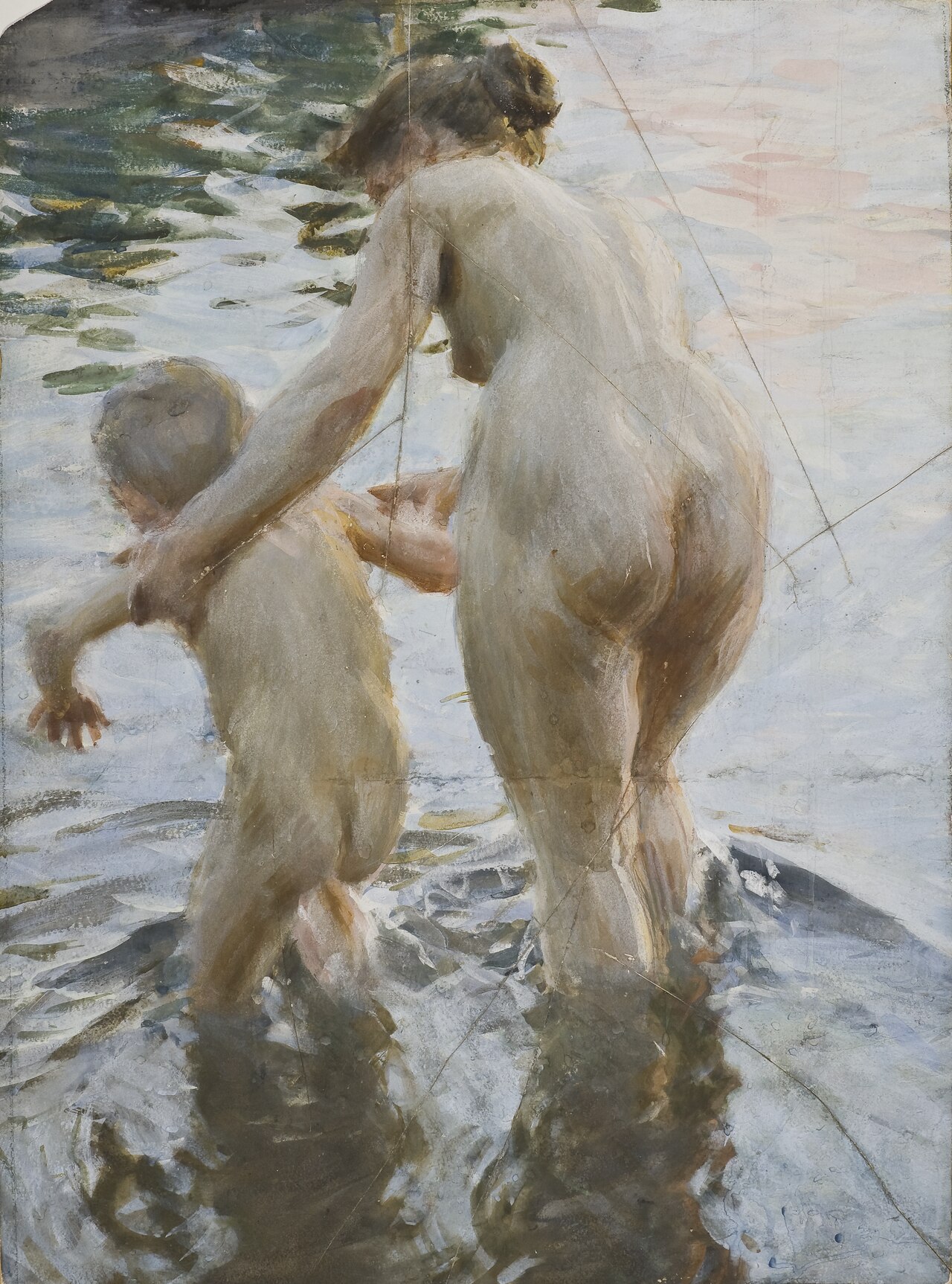
Zorn’s compositional choices frequently placed figures against neutral backgrounds, allowing the play of light on skin and fabric to become the focal point. He was adept at rendering the subtle sheen of wet skin and the reflective qualities of water, which earned him the nickname “the master of the nude” among his contemporaries.
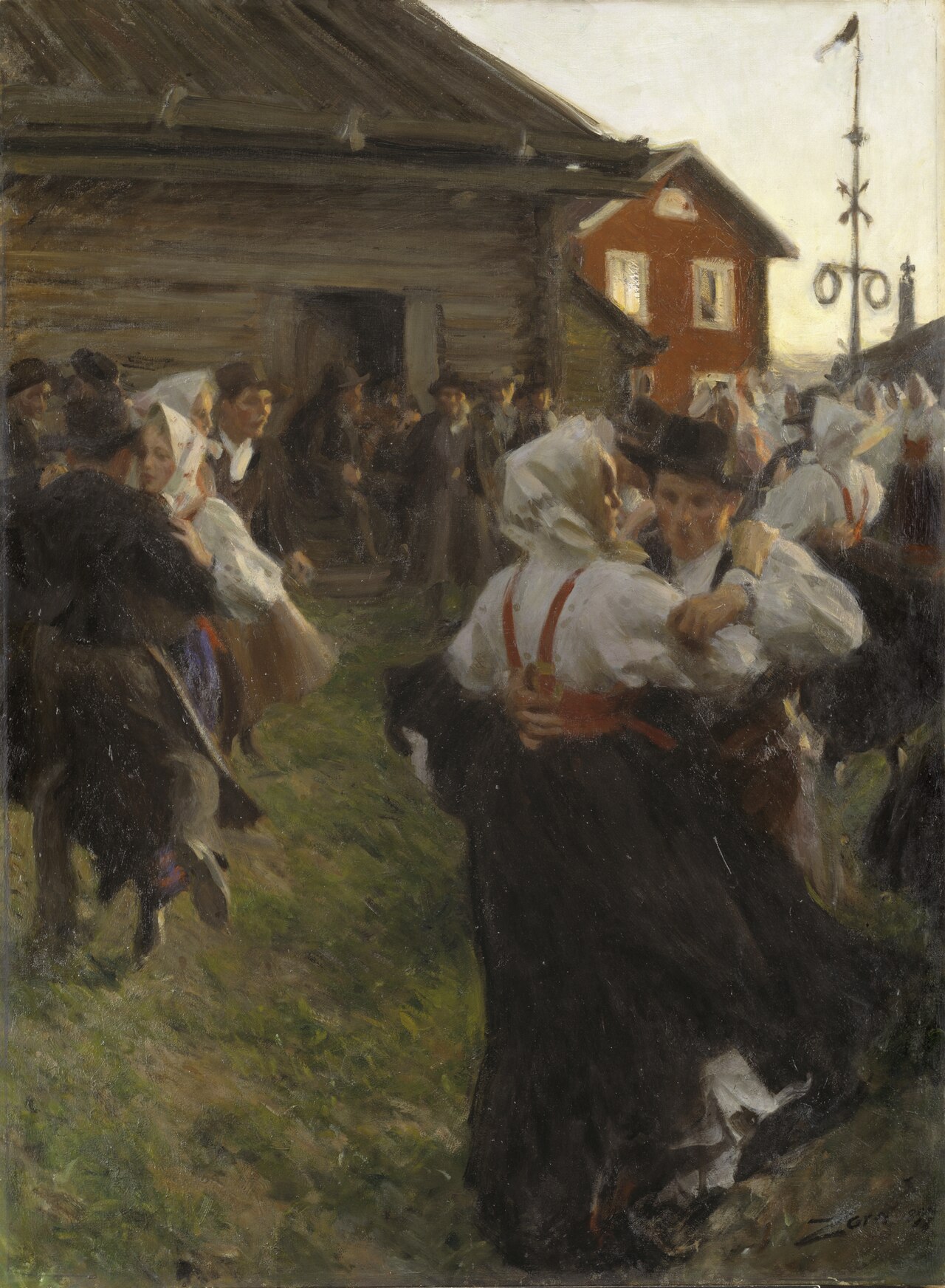
Major works - **Summer Fun (1886)** – This oil painting depicts a group of young people enjoying a lakeside picnic. The work exemplifies Zorn’s skill in rendering sunlight on water and foliage, while his restrained palette conveys the relaxed atmosphere of a Swedish summer. - **En premiär (1888)** – Translating to “The Premiere,” this work captures a theatrical opening in a dimly lit interior. Zorn’s use of chiaroscuro highlights the excitement of the audience and the flickering stage lights, demonstrating his ability to convey narrative tension. - **Omnibus (1891)** – A bustling street scene set inside a public carriage, Omnibus showcases Zorn’s talent for depicting movement and social interaction. The composition is built around the cramped interior, where passengers of varied classes share an intimate space, illuminated by shafts of daylight. - **A Portrait of the Daughters of Ramón Subercaseaux (1892)** – This portrait exemplifies Zorn’s refined approach to capturing likeness and character. The three young sisters are rendered with delicate modelling and a subtle interplay of light, reflecting both their individuality and familial bond. - **Midsummer Dance (1897)** – One of Zorn’s most celebrated genre scenes, Midsummer Dance portrays a traditional Swedish folk dance under a moonlit sky. The painting’s dynamic rhythm, luminous night‑time palette and attention to costume detail have made it an iconic representation of Swedish cultural heritage.
These works, together with his numerous portraits of royalty and presidents, illustrate Zorn’s versatility and his capacity to blend Impressionist techniques with a distinctly Nordic perspective.
Influence and legacy Anders Zorn’s influence extended beyond his own prolific output. He helped introduce Impressionist ideas to Scandinavian art circles, encouraging younger artists to experiment with light and colour. His mastery of multiple media demonstrated that a single artist could excel across disciplines, setting a precedent for future Swedish painters and printmakers.
Zorn’s legacy is also institutional. In 1920, shortly before his death, he endowed the Bellman Prize, an annual award recognising excellence in Swedish literature, thereby linking visual and literary culture. His former home and studio in Mora have been preserved as a museum, attracting scholars and tourists interested in his life and work.
Internationally, Zorn remains a reference point for portraiture and genre painting. His ability to capture the psychological depth of sitters, combined with a luminous handling of skin and fabric, continues to be studied in art academies worldwide. The enduring popularity of works such as Midsummer Dance attests to his skill in translating national traditions into universally appealing visual narratives.
Overall, Anders Zorn stands as a pivotal figure who bridged Swedish folk art and European modernism, leaving an indelible mark on the trajectory of late‑19th‑century art.
Frequently asked questions
Who was Anders Zorn?
Anders Zorn (1860–1920) was a Swedish painter, sculptor and etcher renowned for his portraits, genre scenes and mastery of Impressionist techniques.
What artistic style or movement is Zorn associated with?
Zorn worked chiefly in an Impressionist style, blending its focus on light and colour with a distinctly Swedish sensibility.
What are Zorn's most famous works?
His most celebrated paintings include Summer Fun (1886), Omnibus (1891), Midsummer Dance (1897), En premiär (1888) and the portrait A Portrait of the Daughters of Ramón Subercaseaux (1892).
Why is Anders Zorn important in art history?
Zorn introduced Impressionist ideas to Scandinavia, achieved international fame as a portraitist of royalty and presidents, and left a lasting legacy through his diverse media practice and the Bellman Prize.
How can I recognise an Anders Zorn painting?
Look for a limited, vibrant palette, swift brushwork that captures light on skin and water, and often a focus on a single figure against a neutral background, with a luminous, almost photographic quality.