Hilma af Klint
1862 – 1944
In short
Hilma af Klint (1862–1944) was a Swedish painter whose spiritually‑driven abstract canvases predate the recognised pioneers of abstraction. Working in secret until after her death, she produced series such as The Ten Largest, exploring mystical ideas through colour, geometry and symbolic motifs.
Notable works


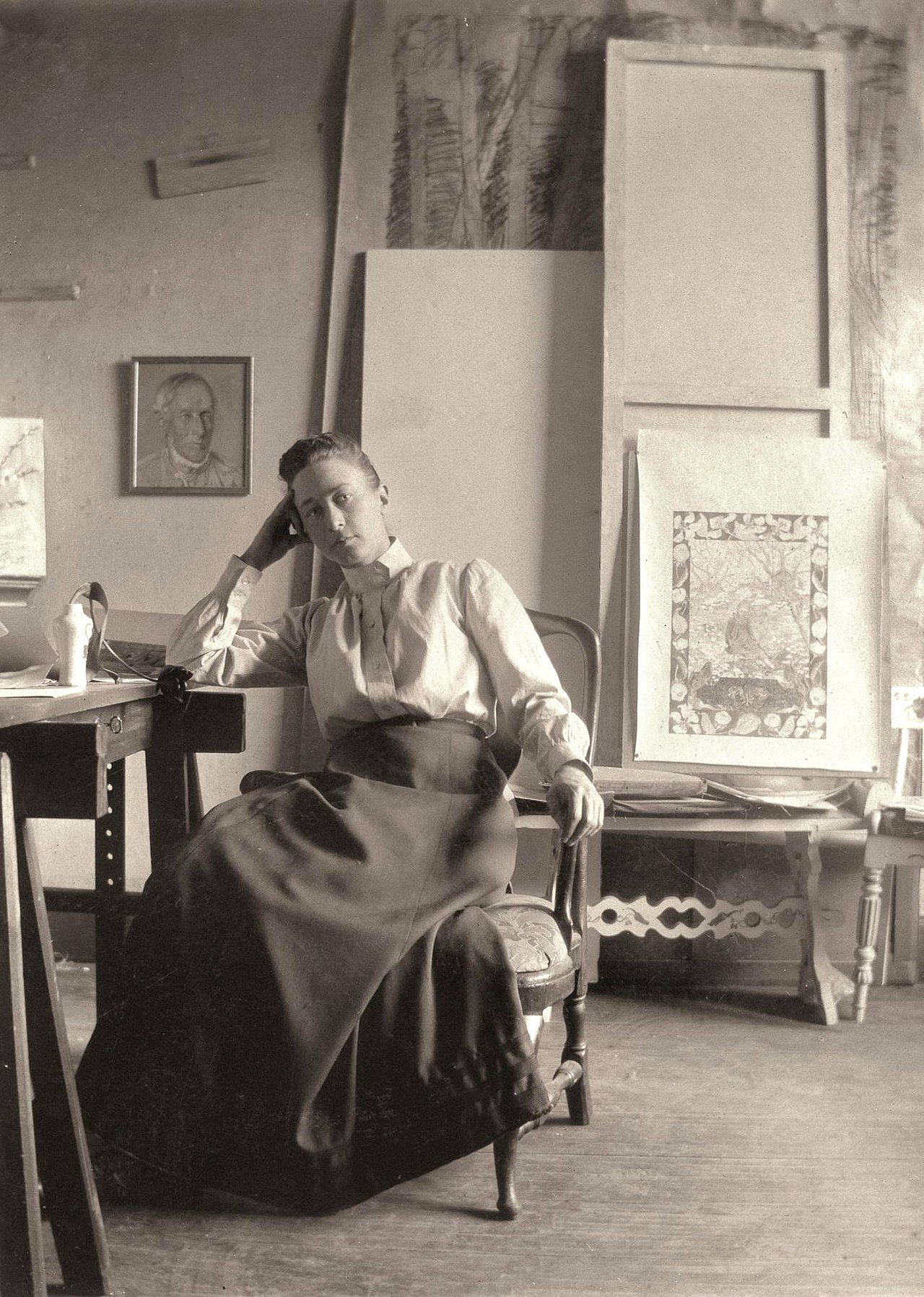


Early life Hilma Elisabeth af Klint was born on 26 October 1862 in Solna, a suburb of Stockholm, Sweden. She grew up in a well‑to‑do family; her father, a civil engineer, encouraged her early interest in drawing. After completing her basic schooling, Hilma enrolled at the Royal Academy of Fine Arts in Stockholm in 1882, where she received a conventional training in drawing, portraiture and landscape painting. The Academy’s curriculum was firmly rooted in academic realism, and Hilma excelled in the technical aspects of drawing, earning several awards for her skill.
During her studies she formed a close friendship with fellow student Anna Cassel. The two women shared a fascination with the occult, a curiosity that would later shape their artistic direction. After graduating in 1887, Hilma worked as a portraitist in Stockholm, supporting herself while continuing to explore the spiritual literature that was popular in late‑19th‑century Europe.
Career and style In the early 1900s Hilma’s artistic trajectory shifted dramatically after she encountered theosophical writings and the philosophy of the Swedish spiritualist group known as "The Five" ("De Fem"). This circle, comprising Hilma, Anna Cassel, Sigrid Hedman, Lotten Rönnlund and Carola Höök, met regularly for séances and discussions about higher dimensions, the afterlife and the role of art as a conduit for hidden knowledge. The group’s belief that visual art could translate unseen spiritual forces into material form became the foundation of Hilma’s mature style.
From 1906 onward she began a series of large‑scale canvases that abandoned representational subject matter in favour of abstract symbols, geometric arrangements and bold colour fields. Unlike the later abstractions of Wassily Kandinsky or Kazimir Malevich, Hilma’s work was explicitly guided by a pre‑meditated spiritual program. She kept meticulous journals, noting the dates of creation, the intended spiritual meaning, and the specific cosmic principles each painting was meant to express. The result was a body of work that combined the precision of scientific diagramming with the emotive power of colour.
Signature techniques Hilma’s canvases are characterised by several recurring technical choices:
1. Layered colour fields – She applied multiple layers of oil paint, often allowing each hue to dry before adding the next, creating a luminous depth that suggests an inner light. 2. Geometric motifs – Circles, spirals, triangles and intersecting lines appear as structural scaffolds, each symbolising a particular spiritual concept such as unity, duality or the passage of time. 3. Symbolic iconography – Recurrent symbols include the swan (representing the soul’s ascent), the serpent (transformation), and numerological groupings that echo theosophical numerology. 4. Scale and format – Many of her works are unusually large for the period, with canvases extending beyond two metres in height. The size reinforces the notion that the paintings are portals rather than decorative objects. 5. Hidden inscriptions – Hilma often inscribed dates, titles and cryptic notes in the margins of her canvases, providing future viewers with clues about the intended metaphysical narrative.
These techniques together generate a visual language that is both systematic and expressive, positioning her work at the intersection of scientific illustration and mystical art.
Major works ### The Ten Largest (1907) The Ten Largest is a series of ten monumental paintings created between 1907 and 1915, each measuring roughly 2.5 × 1.5 metres. The series is intended to depict the stages of human evolution and the spiritual journey of the soul. Two notable panels are: - **The Ten Largest, No. 2, Childhood (1907)** – This canvas juxtaposes soft pastel tones with a central spiralling motif, evoking the nascent, unconditioned consciousness of early life. - **The Ten Largest, No. 9, Old Age (1907)** – In contrast, the older‑age panel employs darker, more saturated colours and a dense network of intersecting lines, symbolising the accumulation of experience and the approach to spiritual culmination.
The series as a whole is unified by a recurring lattice of circles and triangles, each layer representing a different plane of existence. Hilma stipulated that the works should not be exhibited until after her death, believing that the world was not yet ready to receive their message.
### The Swan (1910) The Swan is a single canvas that showcases Hilma’s fascination with avian symbolism. The bird is rendered as an abstracted, white silhouette set against a field of deep blue, surrounded by radiating circles that suggest an aura of light. The painting is often interpreted as a visual metaphor for the soul’s ascent from the material world to a higher spiritual realm.
### Portrait Although Hilma is best known for her abstract series, she also produced a limited number of conventional portraits early in her career. The most frequently cited example is a portrait of a young woman, rendered with soft brushwork and a muted palette. This work demonstrates her solid grounding in academic technique and provides a contrast to the later, more experimental canvases.
Influence and legacy Hilma af Klint’s oeuvre remained largely unseen during her lifetime. She stipulated that her paintings be kept in storage for 20 years after her death, a wish that was honoured; the works only emerged publicly in the 1980s when her estate donated them to the Moderna Museet in Stockholm. The subsequent exhibitions sparked a reassessment of the chronology of abstract art, positioning Hilma as a forerunner who anticipated the modernist breakthroughs of Kandinsky, Mondrian and Malevich.
Her influence extends beyond art history into contemporary discussions about gender and the marginalisation of women artists. The fact that a woman, working largely in isolation and within a secretive spiritual community, produced such pioneering abstract work challenges the male‑dominated narratives of early modernism. Recent exhibitions in New York, London and Los Angeles have cemented her status as a pivotal figure, inspiring a new generation of artists who explore the intersection of science, mysticism and visual language.
In scholarly circles, Hilma’s work is now cited as a prime example of how occult and theosophical ideas permeated the avant‑garde at the turn of the twentieth century. Her meticulous journals provide valuable primary sources for researchers studying the cultural cross‑currents of art, spirituality and early modern scientific thought. As museums continue to acquire and display her paintings, Hilma af Klint’s legacy grows, reshaping our understanding of the origins and possibilities of abstract art.
Frequently asked questions
Who was Hilma af Klint?
Hilma af Klint was a Swedish painter (1862–1944) whose spiritually inspired abstract canvases predate the recognised pioneers of abstraction.
What style or movement is she associated with?
She is linked to early abstract art and to theosophical mysticism, producing works that combine geometry, colour and symbolic motifs.
What are her most famous works?
Her best‑known pieces include the series The Ten Largest (1907), especially No. 2 Childhood and No. 9 Old Age, the painting The Swan (1910), and a few early portraits.
Why does Hilma af Klint matter in art history?
She created some of the first large‑scale abstract paintings, challenging the conventional timeline of modernism and highlighting the role of women and spiritual ideas in early abstraction.
How can I recognise a Hilma af Klint painting?
Look for bold, layered colour fields, geometric symbols such as circles and triangles, and often hidden inscriptions; many works are large, with a luminous, diagram‑like quality that suggests a hidden spiritual narrative.