Anna Munthe-Norstedt
1854 – 1936
In short
Anna Munthe-Norstedt (1854–1936) was a Swedish painter renowned for her meticulous still‑life and interior scenes, with a career that spanned the late‑19th and early‑20th centuries. Her work combines a keen observation of everyday objects with a subtle, restrained colour palette, securing her place among Sweden’s notable female artists of the period.
Notable works


Early life Anna Katarina Fredrika Munthe‑Norstedt was born in 1854 in the rural parish of Döderhults, Sweden. Little is recorded about her childhood, but the cultural climate of the Swedish countryside in the mid‑19th century offered a vivid visual environment that would later inform her attention to natural detail. Growing up during a period of increasing educational opportunities for women, Anna was able to pursue a formal artistic education, a path that was still relatively uncommon for women in Sweden at the time.
Career and style After completing her primary schooling, Munthe‑Norstedt moved to Stockholm to study at the Royal Swedish Academy of Arts, the principal institution for artistic training in the country. There, she received instruction in drawing, composition, and the technical aspects of oil painting. The Academy’s curriculum emphasized classical techniques, which she combined with an emerging interest in realism and the domestic genre that was gaining popularity among Scandinavian artists.
Munthe‑Norstedt’s professional career began in the 1880s, when she exhibited works at the annual Swedish Art Society salons. Her early paintings were primarily genre scenes and portraits, reflecting the Academy’s emphasis on figure work. Over time, however, she gravitated toward still‑life subjects, a shift that coincided with a broader European trend in which artists used everyday objects to explore light, texture, and colour. The Swedish art market of the period, while still dominated by male artists, began to recognise the unique perspective that female painters brought to domestic subjects, and Munthe‑Norstedt’s meticulous compositions found a receptive audience.
Her style can be described as a restrained realism. She employed a muted colour palette—soft greens, warm ochres, and delicate pinks—yet she was capable of rendering vivid contrasts when the subject demanded it, such as the deep reds of ripe fruit or the glossy black of grapes. The compositions are often carefully balanced, with objects placed in a harmonious arrangement that guides the viewer’s eye across the canvas. Light is rendered with subtle gradations, creating a quiet, almost contemplative atmosphere that distinguishes her work from the more dramatic chiaroscuro of her male contemporaries.
Signature techniques Munthe‑Norstedt’s technique is characterised by several recurring elements:
1. Layered glazing – She built up colour through multiple thin layers of oil, a method that allowed her to achieve depth and luminous quality, particularly in the rendering of glass and fruit skins. 2. Precise brushwork – Fine, controlled strokes are evident in the depiction of petals, leaves, and the delicate surfaces of porcelain. This meticulousness contributes to the tactile realism of her still‑lifes. 3. Balanced composition – Objects are arranged according to a subtle geometric logic, often employing triangular or pyramidal structures that lend stability to the image. 4. subdued tonal contrast – While she could employ strong colour accents, the overall tonal range remains moderate, reinforcing the tranquil mood of her interiors. 5. Attention to texture – Whether it is the roughness of a grape’s skin, the smoothness of a ceramic vase, or the velvety softness of a rose, Munthe‑Norstedt captured texture through careful modulation of light and shadow.
These techniques together create works that feel both intimate and timeless, inviting viewers to linger on the quiet beauty of ordinary objects.
Major works Munthe‑Norstedt’s oeuvre includes several paintings that have become reference points for her artistic identity:
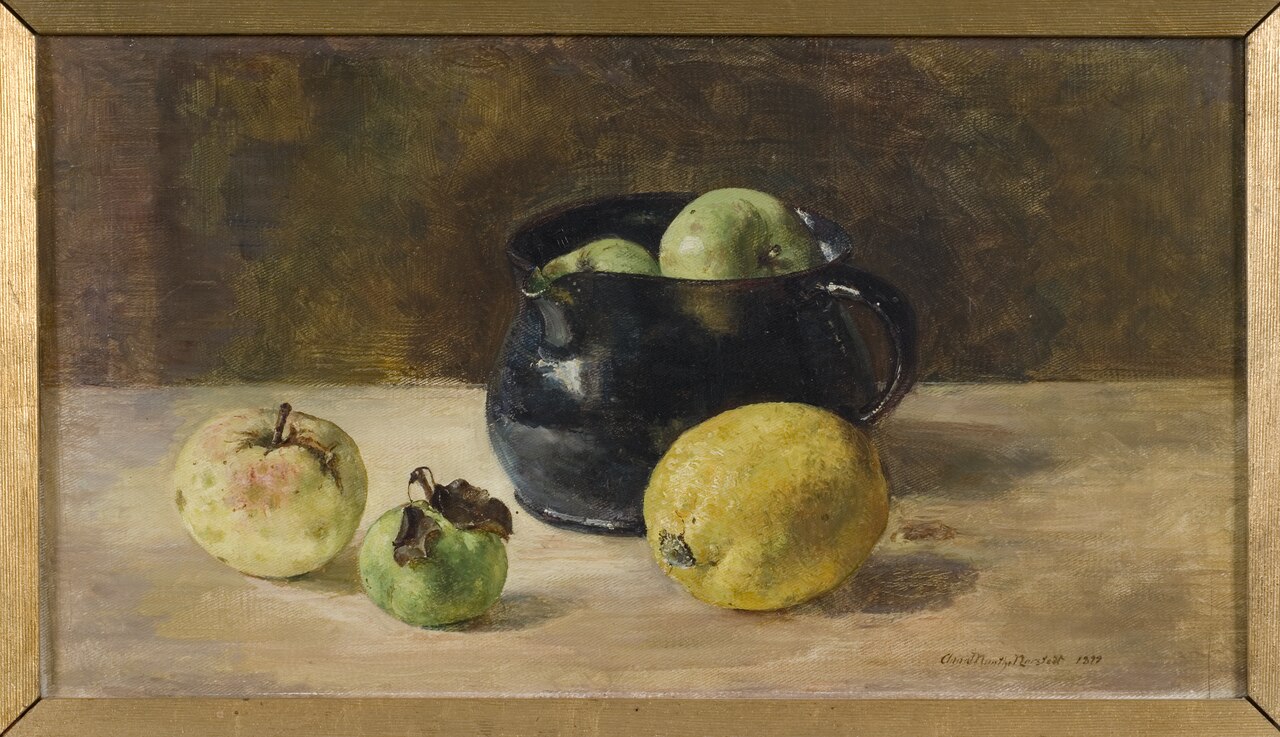
- Still Life (1899) – This painting showcases a simple arrangement of fruit, a glass bottle, and a linen cloth. The composition is anchored by a dark stone surface, while the light falls gently on the fruit, emphasizing their ripeness. The work illustrates her skill in rendering reflective surfaces and subtle colour shifts.
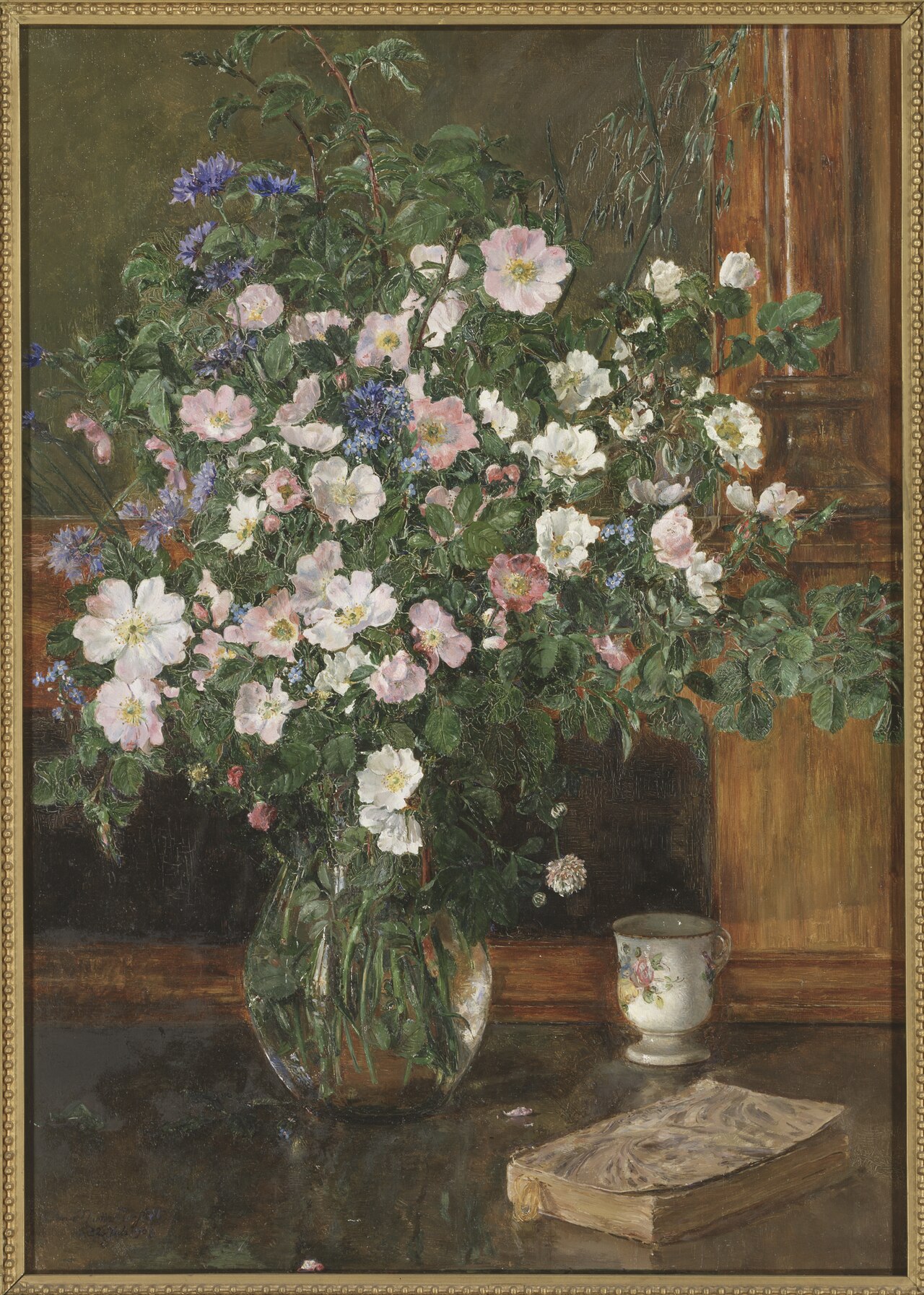
- Wild Briar Roses (1908) – In this later work, the artist focuses on a cluster of wild roses, their pink petals juxtaposed against a muted background. The piece demonstrates her evolving interest in botanical subjects and the ability to convey the delicate translucency of rose petals.
- Still Life with Spring Flowers (1892) – One of her earliest still‑life successes, this painting features a vase of fresh spring blossoms surrounded by a modest table setting. The composition balances the vibrancy of the flowers with the subdued tones of the surrounding objects, highlighting her skill in colour harmony.
- Still Life with Flowers and Fruits (1899) – Combining both botanical and fruit elements, this work exemplifies her mature style. The arrangement is carefully orchestrated, with a central vase of flowers flanked by a bowl of fruit, allowing for an interplay of textures—soft petals against the smooth skin of apples and grapes.
- Still life painting with grapes on a plate and a bottle (1889) – This early piece marks a clear turn toward still‑life subjects. The dark plate and the glossy grapes are rendered with meticulous attention to light, while the bottle adds a reflective element that showcases her developing glazing technique.
Across these works, Munthe‑Norstedt consistently demonstrates a devotion to quiet observation, a mastery of oil technique, and an ability to infuse ordinary subjects with a subtle sense of dignity.
Influence and legacy Although Anna Munthe‑Norstedt never achieved the international fame of some of her male contemporaries, her contribution to Swedish art history is significant. She is recognised as part of a generation of women artists who expanded the possibilities for female participation in the public art sphere. Her still‑life paintings offered an alternative to the grand historical and mythological subjects that dominated the academies, affirming the artistic value of domestic and everyday themes.
Her works were regularly displayed at the Swedish Art Society exhibitions and were included in private collections throughout Sweden. In the decades following her death in 1936—she passed away in the parish of Helsingborgs Maria church—her paintings continued to be featured in retrospectives of 19th‑century Swedish art, contributing to a reassessment of women’s roles in the period’s artistic production.
Modern scholars cite Munthe‑Norstedt as an example of how technical proficiency and an intimate subject matter can coexist, providing a nuanced perspective on the broader realist movement in Scandinavia. Her paintings are now held in several Swedish museums, where they serve as educational exemplars of still‑life technique and as a testament to the quiet perseverance of women artists in a historically male‑dominated field.
In contemporary art discourse, Munthe‑Norstedt’s legacy endures through renewed interest in gender‑balanced art histories and the appreciation of still‑life as a genre capable of profound visual and cultural insight.
Frequently asked questions
Who was Anna Munthe‑Norstedt?
Anna Munthe‑Norstedt (1854–1936) was a Swedish painter best known for her finely detailed still‑life and interior paintings.
What artistic style or movement is she associated with?
She worked in a restrained realist style, focusing on domestic subjects and employing careful composition, subtle colour, and layered glazing.
What are her most famous works?
Key paintings include Still Life (1899), Wild Briar Roses (1908), Still Life with Spring Flowers (1892), Still Life with Flowers and Fruits (1899), and the grape and bottle still life (1889).
Why is Anna Munthe‑Norstedt important in art history?
She exemplifies the rise of women artists in Sweden, demonstrates high technical mastery in still‑life painting, and helped legitise domestic subjects within the academic art world.
How can I recognise a painting by Anna Munthe‑Norstedt?
Look for meticulously rendered fruit or flowers, a muted yet harmonious colour palette, balanced compositions often anchored by a dark surface, and a subtle, layered glazing that gives objects a quiet luminosity.