Muqi
1210 – 1269
In short
Muqi (1210–1269) was a Chan Buddhist monk‑painter of the Southern Song dynasty, celebrated for his ink paintings that embody the spiritual austerity of Chan Buddhism. His works such as Six Persimmons and the Daitokuji triptych have become touchstones for Chinese and Japanese monastic art.
Notable works


_-_Fishing_Village_at_Sunset.jpg)
Early life Muqi was born in 1210 in the province of Sichuan, a region known for its rugged mountains and vibrant Buddhist communities. Little is recorded about his family background, but early exposure to monastic life is evident: he entered the Chan tradition as a child and took the religious name Fachang. The Southern Song court, though waning, still patronised Buddhist institutions, allowing talented monks like Muqi to receive a classical education in calligraphy, poetry and painting.
Career and style After completing his monastic training, Muqi moved to the cultural centre of Hangzhou, where he spent the remainder of his career. Hangzhou, as the imperial capital of the Southern Song, was a hub for literati and court artists, but Muqi deliberately positioned himself outside the secular art market, focusing on spiritual expression. His paintings are characterised by a spare, monochrome ink palette, bold brushstrokes and an emphasis on the empty space that surrounds the subject. This aesthetic reflects the Chan principle of emptiness (kōng) and the belief that the essence of a thing can be conveyed with minimal means.
Signature techniques Muqi’s technique combines the "boneless" (mogu) wash method with vigorous, calligraphic strokes. He often used a dry brush to suggest texture, allowing the paper’s fibre to show through the pigment, which gives his trees, rocks and animal forms a tactile quality. In works such as Six Persimmons, he employed a restrained, almost meditative layering of ink washes to render the fruit’s volume without relying on colour. Another hallmark is his use of "ink‑splashed" backgrounds, where droplets of diluted ink create a misty atmosphere that frames the central motif, reinforcing the sense of impermanence.
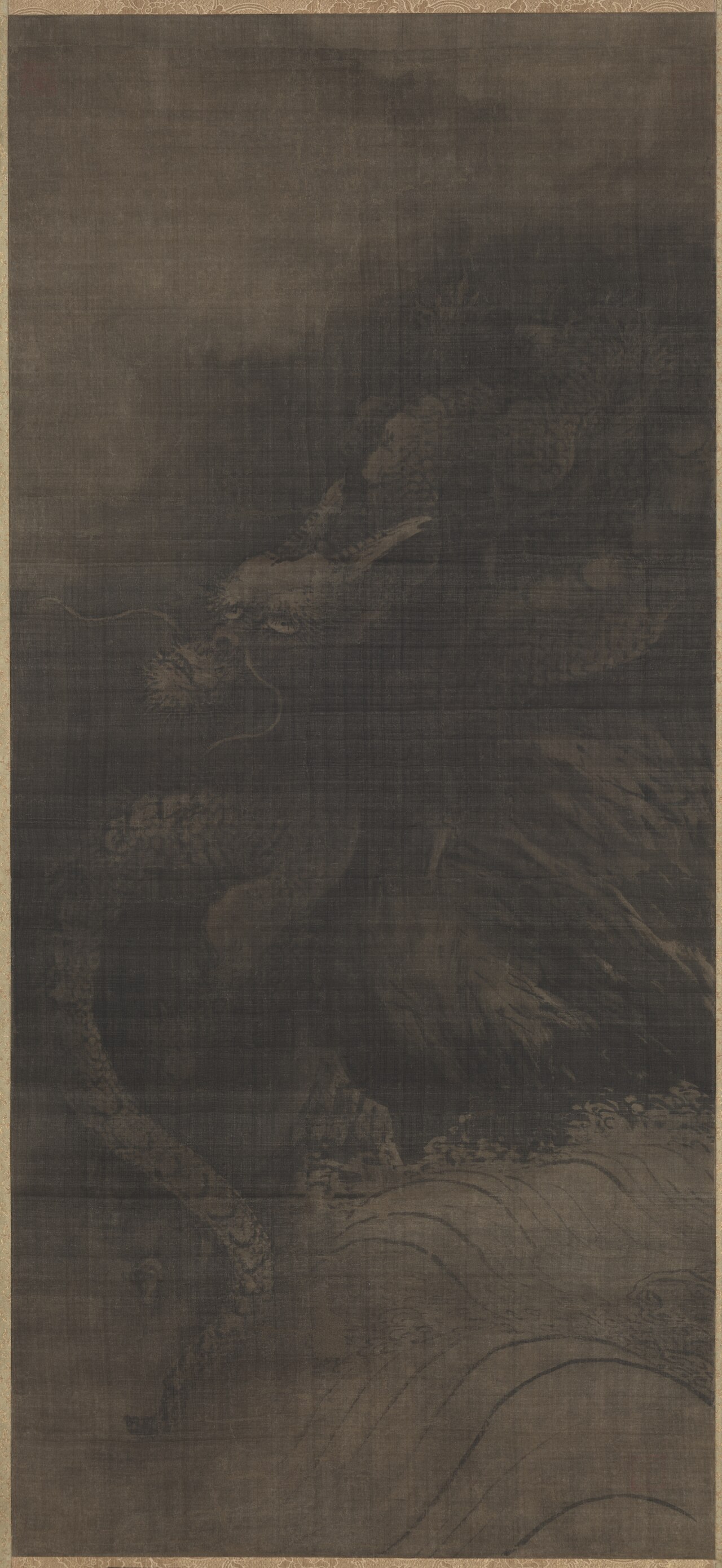
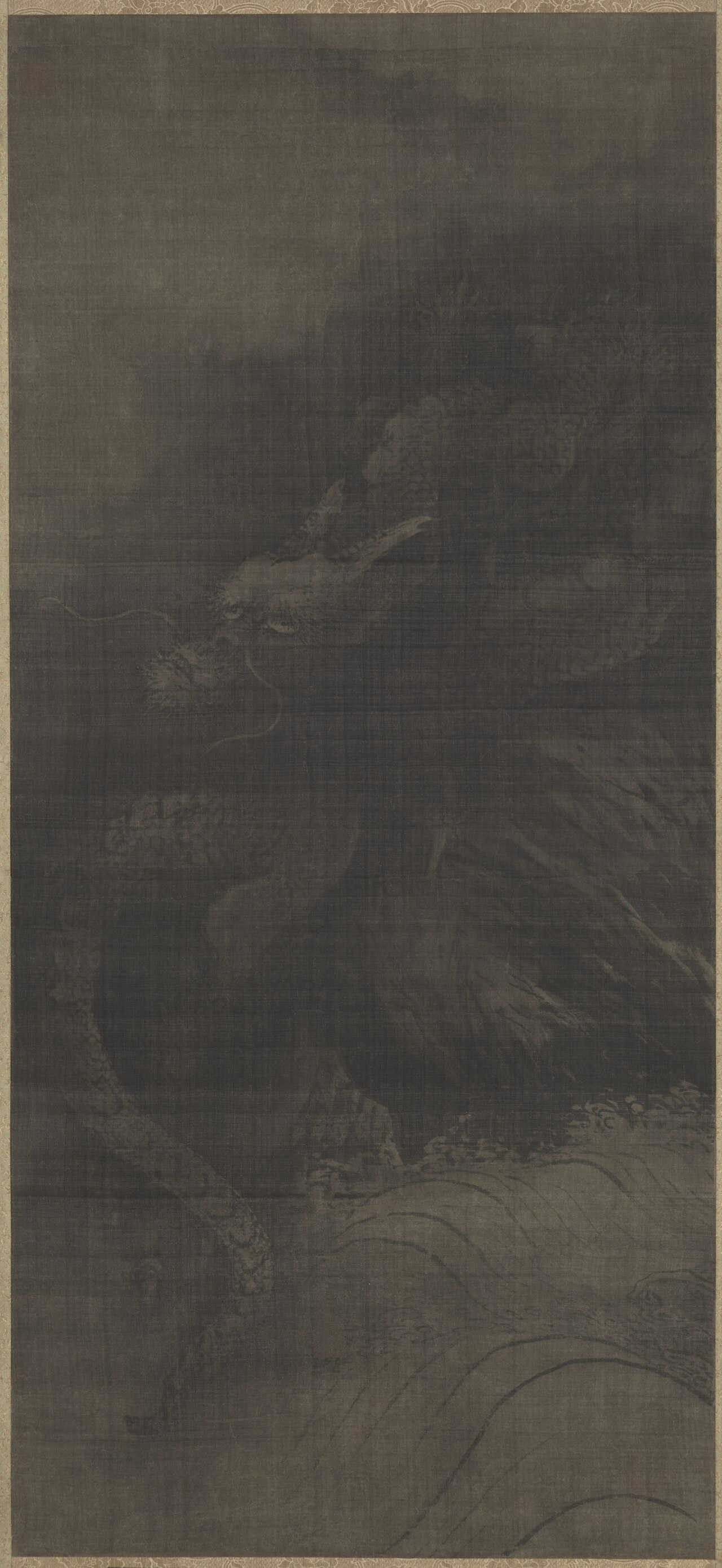
Major works - **Six Persimmons** – Traditionally dated around the early 13th century, this small hand‑scroll presents six persimmons arranged on a plain surface. The composition is celebrated for its balance of positive and negative space, each fruit rendered with a single, confident brushstroke that conveys both form and spiritual resonance. - **Evening Bell from Mist‑Shrouded Temple** – Attributed to Muqi in the late 13th century, the painting depicts a solitary temple bell hanging amid a veil of mist. The work exemplifies his mastery of atmospheric perspective, using graded ink washes to suggest depth and the fleeting nature of sound. - **Dragon; Tiger (1262)** – This pair of animal studies illustrates Muqi’s ability to capture the vitality of powerful creatures with few strokes. The dragon is suggested by swirling ink lines that evoke movement, while the tiger’s muscular form is hinted at by bold, angular marks. - **Fishing Village at Sunset (1300)** – Though the date post‑dates Muqi’s death, the composition is commonly linked to his workshop. It portrays a tranquil harbour bathed in warm, amber‑toned ink, with fishermen’s boats silhouetted against a fading sky, embodying the Chan ideal of harmony between humanity and nature. - **Dragon (1264)** – A later, more elaborate dragon study, this piece demonstrates a refined control of line and a deeper exploration of mythic symbolism, reflecting the artist’s ongoing dialogue with Buddhist iconography.
Influence and legacy Muqi’s work exerted a lasting influence on East Asian monastic painting, particularly in Japan where his Daitokuji triptych was revered by Zen masters. Japanese monk‑painters of the Muromachi period copied his brushwork, integrating the "ink‑spirit" aesthetic into their own practice. In the modern era, Muqi’s paintings are exhibited in major museums worldwide, and scholars cite his approach as a prototype for the minimalist abstraction that emerged in 20th‑century Western art. His ability to convey profound spiritual concepts through restrained visual means continues to inspire contemporary artists seeking to merge contemplation with visual expression.
Frequently asked questions
Who was Muqi?
Muqi (1210–1269) was a Chan Buddhist monk‑painter of the Southern Song dynasty, renowned for his ink paintings that embody the principles of Zen meditation.
What artistic style or movement is Muqi associated with?
He is linked to Chan (Zen) painting, a style that emphasises simplicity, emptiness and the spiritual power of monochrome ink.
What are Muqi’s most famous works?
His best‑known pieces include Six Persimmons, Evening Bell from Mist‑Shrouded Temple, the Dragon‑Tiger pair (1262), Fishing Village at Sunset, and a later Dragon study (1264).
Why is Muqi important in art history?
Muqi set a benchmark for monastic ink painting, influencing later Chinese and Japanese artists and providing a model of how minimal brushwork can convey deep philosophical ideas.
How can I recognise a genuine Muqi painting?
Look for a spare monochrome palette, bold calligraphic strokes, a strong sense of empty space, and subtle ink washes that suggest mist or atmosphere rather than detailed realism.