Per Krafft the Younger
1777 – 1863
In short
Per Krafft the Younger (1777–1863) was a Swedish painter renowned for his portraits of the national elite and historical scenes, working primarily in the early‑19th century.
Notable works

_i_slaget_vid_Hogland_-_NMDrh_772_-_Nationalmuseum.jpg)
,_count,_prime_minister_of_Justice,_married_to_Charlotta_Maria_Toutin_-_NMGrh_2194_-_Nationalmuseum.jpg)
,_author,_publisher,_librarian,_deputy_assistant_undersecretary,_married_to_1._Sophia_Elisabeth_Isoz,_2._Hedvig_Elisabeth_Wallgren.jpg)
Early life
Per Krafft the Younger was born in 1777 in the Klara Church Parish of Stockholm, Sweden. He was the son of Per Krafft the Elder, an established painter, which placed him in a household steeped in artistic practice from an early age. The younger Krafft received his first instruction at home, learning drawing fundamentals and the handling of oil paint under his father's guidance. By his teenage years he was admitted to the Royal Swedish Academy of Arts, where he refined his technique and began to engage with the broader currents of European painting. The Academy’s curriculum emphasized drawing from life, study of classical antiquity, and mastery of colour, all of which would shape Krafft’s later work.
Career and style
Krafft entered his professional career in the first decade of the 19th century, a period when Sweden was consolidating its national identity after the loss of Finland in 1809. He quickly established a reputation as a portraitist for the aristocracy, the emerging bourgeoisie, and senior civil servants. His clientele included members of the royal family, high‑ranking officials, and successful merchants, reflecting the growing demand for visual documentation of status and achievement.
Stylistically, Krafft’s oeuvre straddles the late‑Baroque sensibility of his father’s generation and the neoclassical language that dominated European academies at the time. His portraits display a restrained elegance: figures are rendered with careful attention to facial expression and costume, while backgrounds are often muted to keep the sitter central. In his historical compositions, Krafft adopts a more narrative approach, arranging multiple figures in dynamic poses that convey the drama of the event. The colour palette is typically sober, favouring earth tones and deep blues that enhance the dignified atmosphere of his subjects.
Signature techniques
Krafft worked chiefly in oil on canvas, a medium that allowed him to achieve the fine modelling and subtle tonal transitions prized by his patrons. He employed a layered glazing technique, building thin translucent layers over an underpainting to create depth and luminosity, particularly in skin tones and fabric textures. His handling of light shows a consistent use of chiaroscuro: a strong, directional light source illuminates the principal figure while surrounding elements recede into shadow, reinforcing the three‑dimensional illusion. In historical scenes, Krafft often used compositional devices such as diagonal lines and grouped clusters of figures to guide the viewer’s eye across the canvas and to highlight the focal moment of the narrative.
Major works
- Karl XIV Johans kröning 1818 (1824) – This large‑scale oil painting commemorates the coronation of King Charles XIV John. Krafft captures the regal ceremony with a solemn arrangement of the monarch, clergy, and courtiers. The king is positioned centrally, bathed in a soft, golden light that accentuates his royal regalia, while the surrounding figures are rendered with a restrained palette that emphasises the solemnity of the occasion.
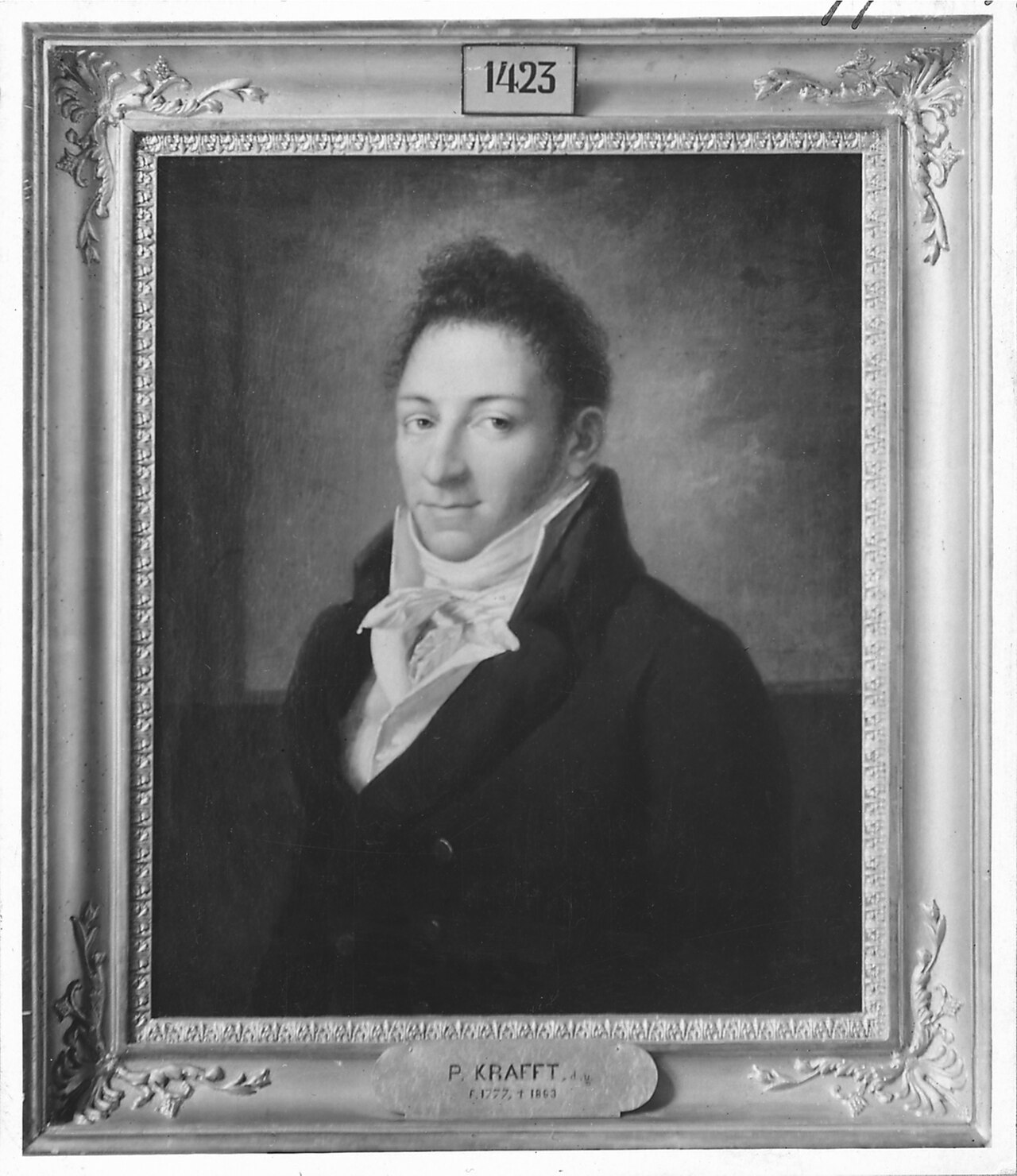
- Mr D.M. Lamm, Merchant – A portrait of the prominent merchant D.M. Lamm, this work illustrates Krafft’s ability to convey both status and personality. The sitter is depicted in contemporary attire, with a focus on the texture of his coat and the reflective quality of his lapel. Krafft’s careful rendering of the merchant’s hands and the subtle smile suggest a confidence befitting a successful businessman.
- Hertig Karl (Karl XIII) i slaget vid Hogland (1810) – In this historical scene, Krafft portrays Duke Karl (later King Charles XIII) at the Battle of Hogland, a naval engagement of 1788. The composition places the duke on a ship’s deck, gesturing commandingly amid a tumultuous sea. Krafft’s use of dramatic lighting and vigorous brushwork conveys the chaos of battle while maintaining a clear focus on the central figure.
- Mattias Rosenblad (1758‑1847), count, prime minister of Justice, married to Charlotta Maria Toutin (1837) – This portrait of Count Mattias Rosenblad reflects Krafft’s skill in representing the Swedish aristocracy. The count is shown seated, with an emphasis on the fine detailing of his coat of arms and the dignified posture that signals his judicial authority. The background is subdued, allowing the viewer to concentrate on the sitter’s expression and attire.
- Peter Adam Wallmark (1777‑1858), author, publisher, librarian, deputy assistant undersecretary, married to 1. Sophia Elisabeth Isoz, 2. Hedvig Elisabeth Wallgren (1829) – Krafft’s portrait of Wallmark captures a learned figure surrounded by books and papers, underscoring his intellectual pursuits. The careful rendering of the textures of parchment and leather, together with the soft illumination of the face, conveys both the scholarly environment and the personal gravitas of the subject.
Influence and legacy
Per Krafft the Younger played a pivotal role in sustaining and developing the Swedish portrait tradition during a period of political and cultural transition. By providing high‑quality visual records of the nation’s elite, he contributed to a visual archive that later historians and curators have drawn upon to understand early‑19th‑century Swedish society. His historical paintings, though fewer in number, offered a visual narrative of key national events, reinforcing a sense of collective memory.
Krafft’s technical proficiency and adherence to academic standards influenced a generation of Swedish artists who trained at the Royal Academy. While he never aligned himself with a specific avant‑garde movement, his work exemplifies the disciplined, craft‑oriented approach that characterised much of Sweden’s academic art until the later Romantic and Realist shifts. Today, his paintings are held in the collections of the Nationalmuseum in Stockholm and several regional museums, where they continue to be studied for their compositional balance, meticulous technique, and insight into the social hierarchy of his time.
In sum, Per Krafft the Younger remains an important figure for scholars of Swedish art, offering a bridge between the late Baroque portraiture of his father’s era and the emerging neoclassical sensibilities that would dominate the 19th century.
Frequently asked questions
Who was Per Krafft the Younger?
Per Krafft the Younger (1777–1863) was a Swedish painter known for his portraits of aristocrats and historical scenes of national events.
What style or movement is his work associated with?
His work blends late‑Baroque realism with the neoclassical language taught at the Royal Swedish Academy of Arts, emphasizing disciplined composition and refined colour.
Which of his works are the most famous?
Among his best‑known paintings are the coronation portrait ‘Karl XIV Johans kröning 1818 (1824)’, the battle scene ‘Hertig Karl i slaget vid Hogland (1810)’, and several high‑profile portraits such as those of Mr D.M. Lamm and Count Mattias Rosenblad.
Why does Per Krafft the Younger matter in art history?
He sustained the Swedish portrait tradition during a formative period, documented key figures and events of early‑19th‑century Sweden, and influenced younger artists through his academic approach.
How can I recognise a painting by Per Krafft the Younger?
Look for meticulous oil glazing, a restrained colour palette, chiaroscuro lighting that highlights the sitter, and careful detailing of fabrics and insignia typical of his portraiture.