Ottmar Elliger the Younger
1666 – 1732
In short
Ottmar Elliger the Younger (1666–1732) was a Dutch painter of German birth, known for mythological and historical scenes. He worked in Amsterdam and produced works such as Mythological Scene (1708) and Dido with Ascanius and Aeneas (1706).
Notable works



Early life Ottmar Elliger the Younger was born in 1666 in Hamburg, a major trading city of the Holy Roman Empire. His family had artistic connections; his father, also a painter, moved the family to the Dutch Republic in the early 1670s, where the younger Ottmar spent his formative years. Growing up in a cosmopolitan environment, he was exposed to both German and Dutch artistic traditions. He received his initial training in the studio of a local master in Amsterdam, where he learned the fundamentals of drawing, colour, and the handling of oil paint.
Career and style By the late 1680s Elliger had established himself as an independent painter in Amsterdam. The city’s vibrant art market, dominated by the legacy of the Dutch Golden Age, offered a range of commissions for history, mythological and genre subjects. Elliger’s style reflects a synthesis of Dutch realism and a lingering Baroque sensibility inherited from his German roots. His compositions are typically balanced, with a clear foreground‑background delineation, and he favoured a restrained palette of earth tones punctuated by richer reds and blues for accent. While he never aligned himself with a formal movement, his work shows affinities with the late‑Baroque and early‑Rococo currents that were spreading through the Dutch Republic in the early eighteenth century.
Signature techniques Elliger’s paintings are characterised by meticulous draftsmanship and a smooth, almost polished surface finish. He employed a layered glazing technique, building thin translucent layers of colour over a carefully modelled underpainting. This approach gave his figures a subtle luminosity and a sense of depth that distinguishes his canvases from the more impasto‑heavy works of his contemporaries. Light in his scenes is often diffused, creating a gentle chiaroscuro that highlights the narrative focus without dramatic contrast. Additionally, he paid close attention to the rendering of fabrics and drapery, using fine brushwork to suggest texture while maintaining overall visual harmony.
Major works Among Elliger’s known oeuvre, several canvases stand out. **Mythological Scene (1708)** depicts an ambiguous narrative drawn from classical lore; the composition centres on a group of semi‑nude figures arranged around a marble altar, illuminated by a soft, golden light. The work demonstrates Elliger’s skill in arranging complex groups while preserving a clear visual hierarchy.
The death of Dido (1750) is attributed to Elliger despite its posthumous date, suggesting that the painting may have been completed earlier and later dated by a collector. The canvas portrays the tragic queen in a moment of quiet resignation, surrounded by mournful attendants. The subdued colour scheme and the delicate rendering of Dido’s facial expression are typical of Elliger’s empathetic approach to historical drama.
Venus and Mars (1725) presents the Roman deities in an intimate garden setting. Elliger juxtaposes the sensuality of Venus with the martial vigor of Mars, using contrasting textures—silky drapery against polished armour—to highlight their differing natures. The painting’s balanced composition and the subtle interplay of light and shadow exemplify his mature style.
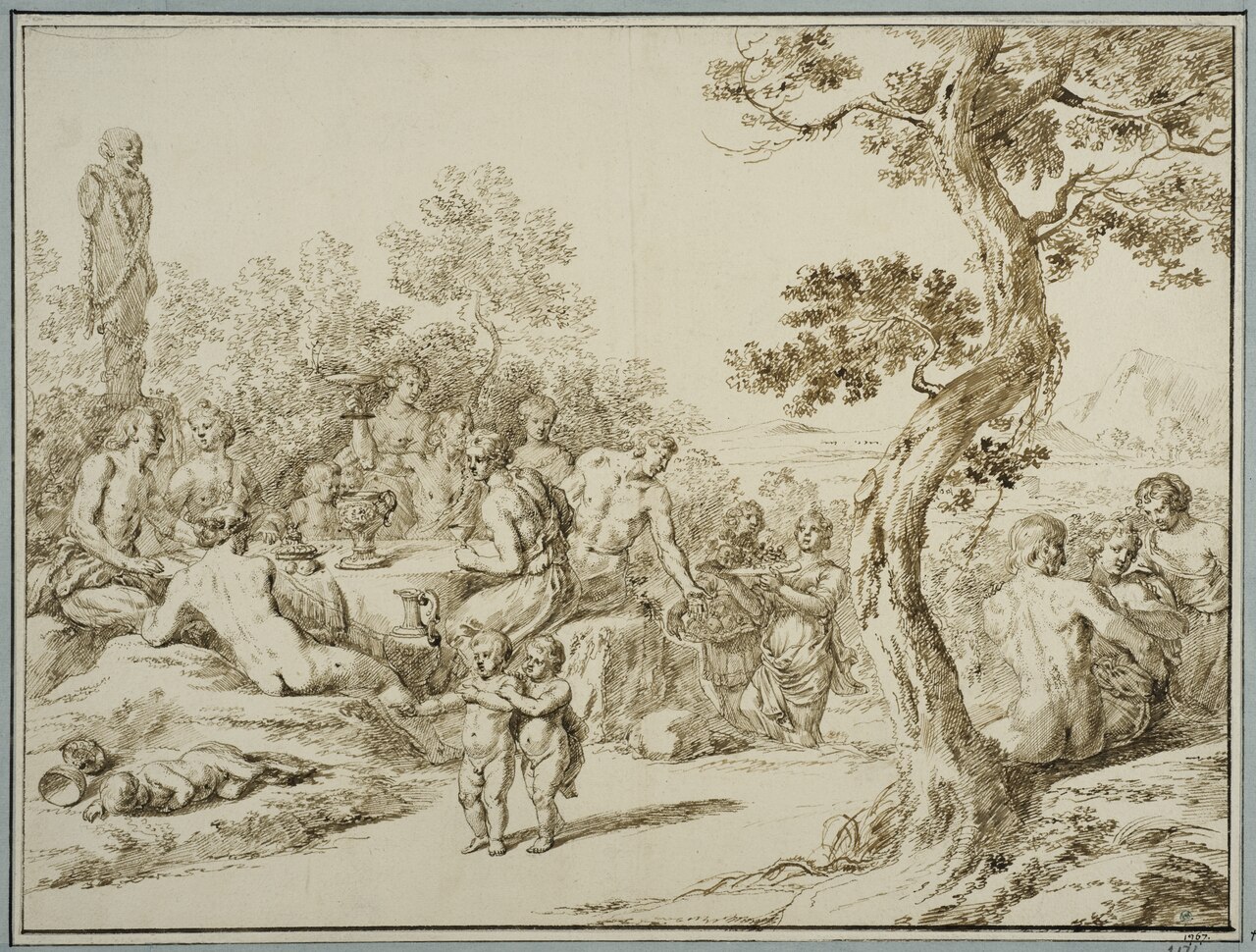
Bacchanal, an untitled work in several catalogues, captures a festive revelry of wine‑god followers. The piece is notable for its dynamic arrangement of figures, the exuberant use of colour, and the atmospheric handling of foliage and architecture that frames the scene.
Dido with Ascanius and Aeneas (1706) predates many of his later mythological works and shows a young Dido with her son Ascanius beside the heroic Aeneas. The narrative focus is on the tender interaction between the characters rather than on grandiose gestures, reflecting Elliger’s preference for intimate storytelling. The fine modelling of faces and the careful treatment of light on the figures reinforce the painter’s commitment to naturalism within a mythic context.
These works collectively illustrate Elliger’s concentration on narrative content, his adept handling of human anatomy, and his ability to convey emotional nuance through controlled colour and light.
Influence and legacy Ottmar Elliger the Younger did not found a school nor become a household name like Rembrandt or Vermeer, but his paintings contributed to the continuation of history painting in the Dutch Republic after the peak of the Golden Age. He served as a bridge between the rigorous realism of the seventeenth century and the more decorative tendencies of the early eighteenth century. His careful compositional structures and glazing techniques influenced a number of younger Dutch painters who sought to blend narrative depth with aesthetic refinement. Though relatively few of his works survive in public collections, those that do are valued for their technical proficiency and their insight into the transitional artistic climate of early‑modern Amsterdam. Modern scholarship regards Elliger as a competent, if under‑recognised, practitioner whose oeuvre enriches the broader picture of Dutch art in the post‑Golden Age period.
Frequently asked questions
Who was Ottmar Elliger the Younger?
Ottmar Elliger the Younger (1666–1732) was a Dutch painter of German birth who worked mainly in Amsterdam, producing mythological and historical scenes.
What style or movement is he associated with?
He is not linked to a specific movement, but his work blends late‑Baroque realism with early‑Rococo decorative elements typical of early eighteenth‑century Dutch art.
What are his most famous works?
Key paintings include *Mythological Scene* (1708), *The death of Dido* (1750), *Venus and Mars* (1725), *Bacchanal*, and *Dido with Ascanius and Aeneas* (1706).
Why does he matter in art history?
Elliger helped sustain the tradition of narrative history painting in the Dutch Republic after the Golden Age, influencing younger artists with his refined composition and glazing techniques.
How can I recognise an Ottmar Elliger painting?
Look for smooth, glazed surfaces, restrained colour palettes punctuated by rich reds or blues, careful modelling of drapery, and a calm, balanced composition that emphasizes narrative over dramatic contrast.