Ivar Arosenius
1878 – 1909
In short
Ivar Arosenius (1878–1909) was a Swedish painter and picture‑book illustrator noted for his whimsical, often satirical images and a small but influential body of work that includes self‑portraits, genre scenes and a series of watercolours. Though his career was brief, his distinctive style left a lasting imprint on early 20th‑century Swedish art.
Notable works
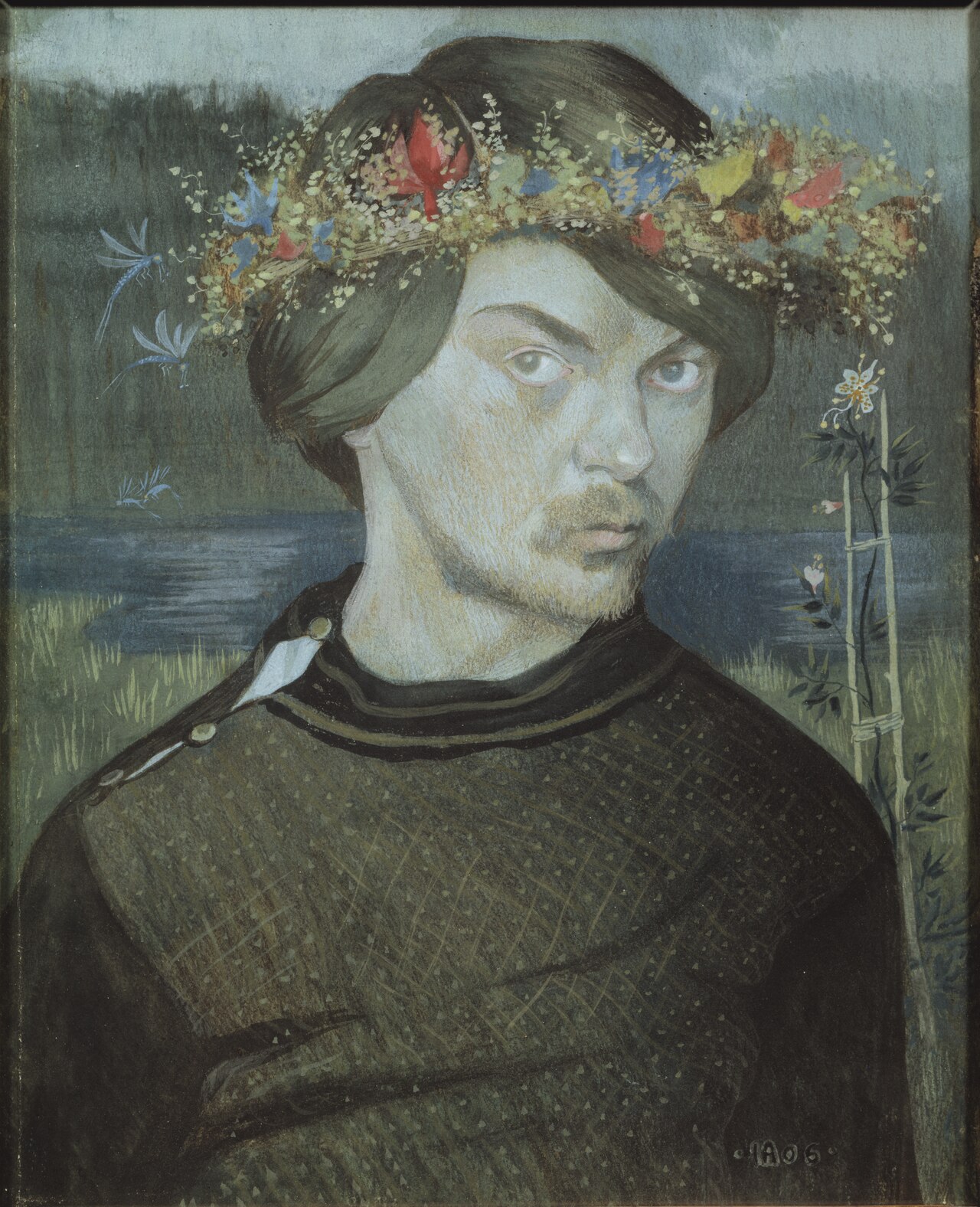


Early life Ivar Axel Henrik Arosenius was born in 1878 in the parish of Göteborgs Kristine, a district of Gothenburg, Sweden. He grew up in a modest household; his father worked as a clerk while his mother encouraged his early interest in drawing. Arosenius displayed artistic talent from a young age, sketching caricatures of neighbourhood characters and copying illustrations from popular magazines. In 1896, he left Gothenburg for Stockholm to enrol at the Royal Swedish Academy of Arts, where he received formal training in drawing, composition and colour theory. The Academy’s curriculum, rooted in classical techniques but increasingly open to contemporary currents, provided Arosenius with a solid technical foundation while exposing him to the work of European modernists.
During his academy years he also took part in informal gatherings of young artists who were interested in the emerging Symbolist and Art Nouveau movements. These circles fostered a sense of experimentation that would later surface in his own work. After completing his studies, Arosenius travelled to Paris in 1903, a common pilgrimage for Scandinavian artists seeking exposure to avant‑garde trends. In Paris he attended the Académie Julian and frequented cafés where he met Swedish expatriates and French illustrators. The experience broadened his visual vocabulary, introducing him to the playful lyricism of Aubrey Beardsley and the decorative elegance of Alphonse Mucha, influences that would be subtly reflected in his later illustrations.
Career and style Returning to Sweden in 1905, Arosenius settled in Stockholm and began working as a freelance illustrator for newspapers, magazines and children’s books. His illustrations were characterised by a vivid imagination, a dry humour and a keen eye for the absurdities of everyday life. While he never aligned himself formally with a specific art movement, his work straddled the line between late‑Romantic symbolism and the nascent modernist tendencies of the early 20th century. The narrative quality of his pictures—often featuring fantastical creatures, exaggerated gestures and exaggerated facial expressions—echoed the storytelling tradition of Swedish folk art, yet his line work displayed a crispness more typical of Art Nouveau graphic design.
Arosenius’s paintings, though fewer in number, shared the same whimsical sensibility. He favoured small‑scale canvases and watercolours, allowing him to experiment with colour and atmosphere without the constraints of large‑format commissions. His palette ranged from muted earth tones in sober portraits to bright, saturated hues in his more fantastical scenes. The artist’s subject matter varied widely: from self‑portraits that revealed a self‑deprecating wit, to domestic interiors populated by mischievous children, to allegorical compositions that hinted at deeper psychological narratives.
Signature techniques Arosenius’s technique was anchored in a deft handling of line and colour. In his illustrations he employed clean, flowing contours that gave figures a sense of movement while preserving clarity. He often used ink washes to build atmospheric depth, allowing the underlying pencil sketch to remain visible and adding a spontaneous, sketch‑like quality to the final image. In watercolours, he layered translucent washes to achieve luminous skin tones and delicate backgrounds, a method that contributed to the ethereal mood of works such as "Ben Onis dröm".
Another hallmark of his practice was the integration of text and image. As an illustrator, Arosenius was adept at synchronising narrative captions with visual elements, creating a seamless storytelling experience. He also experimented with collage, incorporating cut‑out paper and fabric fragments into some compositions, a technique that hinted at the later developments of Dada and Cubism.
Major works - **Self‑portrait (1906)** – This intimate work presents the artist in a modest studio setting, rendered in muted tones with a hint of self‑mockery. The portrait’s direct gaze and slightly exaggerated facial features convey both confidence and vulnerability, encapsulating Arosenius’s characteristic blend of seriousness and humour. - **Selma tänder brasan (1907)** – Translating to "Selma lights the fire," this painting depicts a young girl striking a match, the flame illuminating her face. The composition captures a fleeting moment of domestic ritual, while the use of light and shadow demonstrates Arosenius’s skill at rendering atmosphere. - **Fyllbult** – Though details about this piece are scarce, the title suggests a genre scene, possibly portraying a rural or agricultural motif common in Swedish art of the period. The work likely reflects Arosenius’s interest in everyday life and his ability to infuse ordinary subjects with narrative tension. - **Ben Onis dröm. Serie om 8 akvareller. 5, För lösa tyglar rusar vinghästen iväg med dem båda (1908)** – Part of an eight‑watercolour series, this fifth piece illustrates a dreamlike scenario where a winged horse gallops away with two riders whose reins are loose. The fantastical subject matter, combined with fluid watercolour washes, exemplifies Arosenius’s fascination with the surreal and his mastery of the medium. - **Kungligt mottagande** – Translating to "Royal Reception," this work likely depicts an official ceremony, perhaps rendered with the same satirical edge that Arosenius applied to other social scenes. The painting would have offered commentary on the pomp and circumstance of royal events, a theme that resonated with his contemporaries.
These works, though limited in number, collectively illustrate the breadth of Arosenius’s artistic concerns—from intimate self‑reflection to mythic imagination and social observation.
Influence and legacy Ivar Arosenius died prematurely in 1909 at the age of thirty‑one in Älvängen, a small town near Gothenburg, succumbing to illness that cut short a promising career. Despite his brief lifespan, his drawings and watercolours left an indelible mark on Swedish illustration and early modernist painting. Contemporary Swedish artists such as Carl Larsson and later illustrators of the 1920s cited Arosenius’s playful line work and narrative vigor as a source of inspiration.
His books, especially picture‑books for children, continued to be reprinted throughout the twentieth century, ensuring that his distinctive visual language reached new generations. Art historians regard Arosenius as a bridge between the decorative illustration traditions of the nineteenth century and the more experimental visual culture that emerged after World War I. His willingness to blend humour with serious artistic inquiry paved the way for later Scandinavian illustrators who combined graphic design with storytelling, a lineage that can be traced to modern graphic novels and animation.
In recent decades, Arosenius’s work has been the subject of several retrospectives at Swedish museums, and his pieces have entered public collections such as the Nationalmuseum in Stockholm. Scholarly interest has revived discussion of his role within the broader European context, positioning him alongside other early twentieth‑century artists who explored the intersection of fine art and illustration. While he never achieved the fame of some of his contemporaries during his lifetime, his posthumous reputation affirms his status as a pivotal figure in the development of Swedish visual culture.
Overall, Ivar Arosenius remains an exemplar of artistic versatility—a painter, illustrator and storyteller whose concise yet potent oeuvre continues to captivate scholars and art lovers alike.
Frequently asked questions
Who was Ivar Arosenius?
Ivar Arosenius (1878–1909) was a Swedish painter and picture‑book illustrator known for his whimsical, narrative‑driven images and a small but influential body of work.
What artistic style or movement is he associated with?
He did not belong to a formal movement, but his work blends elements of late‑Romantic Symbolism, Art Nouveau graphic design and a distinctly Swedish folk‑art humour.
What are his most famous works?
Key pieces include the Self‑portrait (1906), Selma tänder brasan (1907), the watercolour series "Ben Onis dröm" (1908), and the genre painting Kungligt mottagande.
Why does Ivar Arosenius matter in art history?
Arosenius bridges 19th‑century illustration and early 20th‑century modernism, influencing Swedish graphic art, children’s book illustration and the narrative style of later Scandinavian visual culture.
How can I recognise an Arosenius work?
Look for small‑scale compositions with clean, flowing lines, playful yet slightly exaggerated figures, a mix of humour and melancholy, and a deft use of watercolour washes to create luminous, dream‑like atmospheres.