Wu Zhen
1280 – 1354
In short
Wu Zhen (1280–1354) was a Chinese painter of the Yuan dynasty, celebrated as one of the Four Masters of the Yuan. He is renowned for his ink landscapes and bird‑and‑flower paintings that embody the literati aesthetic.
Notable works




Early life Wu Zhen was born in 1280 in Jiashan County, a region that now forms part of Zhejiang province. Little is known about his family background, but the area was a cultural crossroads where Confucian scholarship and Buddhist practice coexisted. Wu received a traditional Confucian education, which included calligraphy and poetry—skills that would later inform his artistic practice. The Yuan period, ruled by the Mongol empire, limited official avenues for Chinese scholars, prompting many, including Wu, to pursue artistic expression as a form of personal and cultural statement.
Career and style After completing his studies, Wu Zhen chose the life of a scholar‑artist rather than seeking a civil service position. He moved to the Hangzhou region, where a community of literati painters was emerging. Wu’s oeuvre is firmly rooted in the literati (wenren) tradition, characterised by a preference for ink wash, an emphasis on the artist’s inner spirit, and a disdain for overly decorative court styles. His paintings often feature solitary subjects—bamboo, pine, plum blossoms, and hermit figures—set against a sparse, suggestive landscape. This restrained approach reflects the Yuan intellectual climate, where personal expression through brushwork became a subtle form of cultural resistance.
Signature techniques Wu Zhen’s brushwork is distinguished by a controlled, yet expressive use of the "wet‑brush" technique (shuimo). He employed a range of ink tones, from deep black to delicate grey washes, to suggest depth and atmosphere. In his bamboo studies, he rendered the stalks with swift, vertical strokes that capture both strength and flexibility, while the leaves are suggested with light, flickering touches. His pine depictions are notable for the "cracked bark" texture, achieved through repeated, short, angular strokes that convey age and endurance. Wu also incorporated poetic inscriptions directly onto the painting surface, integrating calligraphy with visual form to create a unified literary‑artistic statement.
Major works Wu Zhen’s surviving catalogue includes several key pieces that illustrate his mature style.
- Twin Purities of Bamboo and Plum Blossom (1350) – This pair of hanging scrolls juxtaposes bamboo and plum blossoms, two plants traditionally symbolising integrity and resilience. The bamboo is rendered with elegant, vertical brushstrokes, while the plum blossoms are depicted with delicate, stippled ink that evokes the fleeting beauty of early spring.
- Poetic Feeling in a Thatched Pavilion (1347) – In this composition, Wu portrays a modest thatched pavilion nestled among misty hills. A solitary figure, likely a hermit scholar, sits within, suggesting contemplation. The atmospheric washes and subtle shading create a sense of depth without relying on detailed perspective.
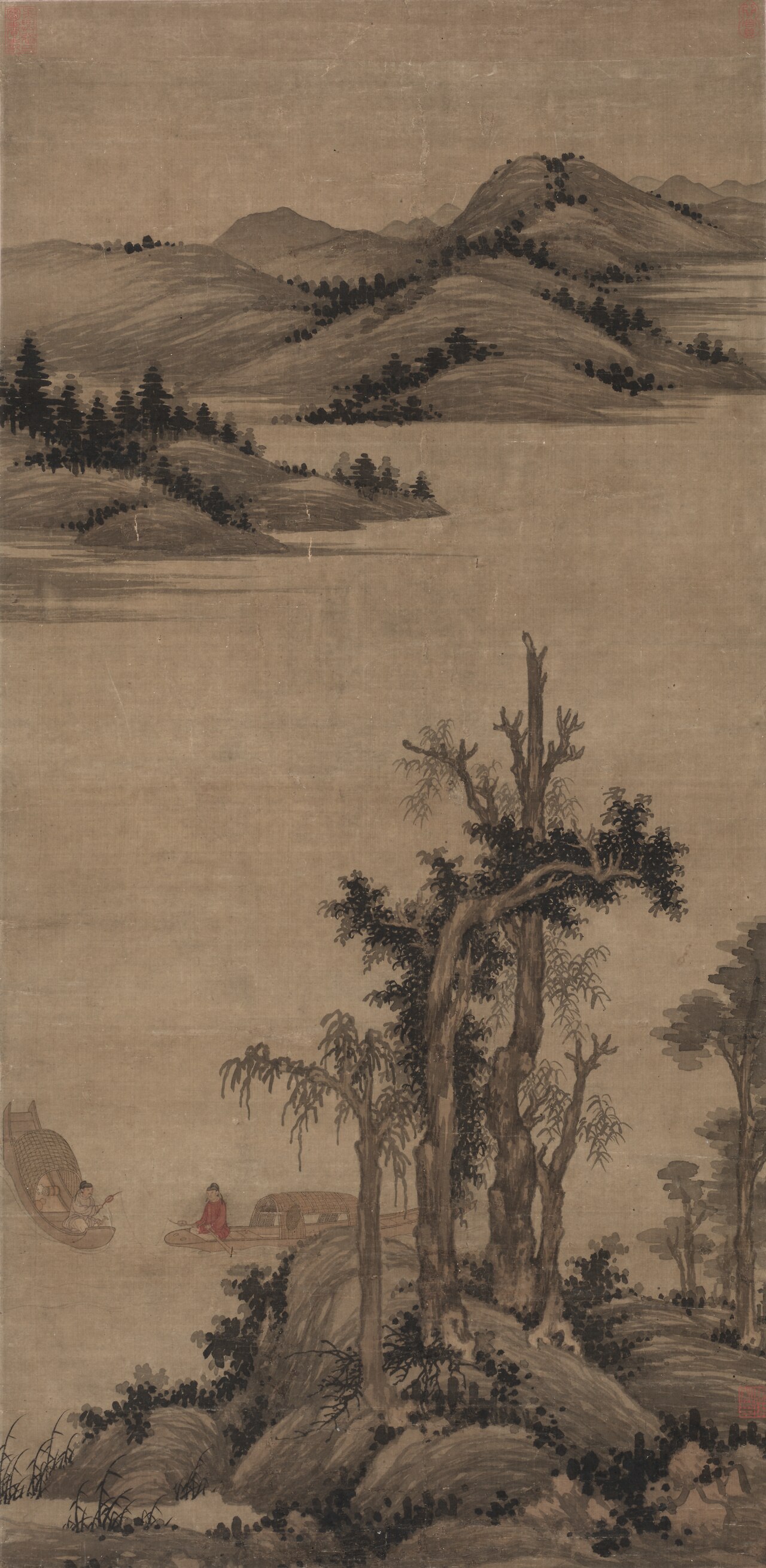
- Fishermen‑Hermits in Stream and Mountain (1327) – This work combines landscape and genre elements, featuring hermit‑fishermen navigating a winding stream that cuts through craggy mountains. The figures are rendered with minimal line, allowing the surrounding scenery to dominate the visual narrative.
- Fisherman (1350) – A smaller study focusing on a single fisherman casting his line. The composition is dominated by a sweeping brushstroke that suggests the water’s surface, while the figure is hinted at with only a few decisive strokes.
- Crooked Pine (1335) – Perhaps Wu’s most iconic single‑subject painting, the crooked pine stands against a stark background, its twisted trunk rendered with bold, angular strokes. The bark texture and the sparse foliage convey a sense of endurance and solitary dignity.
These works collectively demonstrate Wu’s mastery of ink technique, his ability to convey mood through minimal means, and his deep engagement with classical Chinese poetic themes.
Influence and legacy Wu Zhen’s reputation grew steadily after his death in 1354, and he was later canonised as one of the Four Masters of the Yuan alongside Huang Gongwang, Ni Zan and Wang Meng. His approach to brushwork and his integration of poetry into painting exerted a lasting influence on subsequent generations of literati artists. During the Ming dynasty, scholars looked to Wu’s restrained compositions as exemplars of the ideal scholar‑artist, and his techniques were emulated in the “Southern School” of Chinese painting. In the modern era, Wu Zhen’s works are studied for their embodiment of the Yuan literati ethos, and they continue to inspire contemporary artists who seek to balance technical skill with personal expression. Major museums across the world, including the Shanghai Museum and the Metropolitan Museum of Art, hold his paintings, ensuring his legacy endures in both academic and public spheres.
Frequently asked questions
Who was Wu Zhen?
Wu Zhen (1280–1354) was a Chinese painter of the Yuan dynasty, recognised as one of the Four Masters of the Yuan for his influential ink landscapes and bird‑and‑flower works.
What style or movement is Wu Zhen associated with?
He worked within the literati (wenren) tradition, favouring expressive ink wash, poetic inscriptions, and a restrained, scholarly aesthetic rather than courtly decorative styles.
What are Wu Zhen’s most famous works?
His most celebrated pieces include "Twin Purities of Bamboo and Plum Blossom" (1350), "Poetic Feeling in a Thatched Pavilion" (1347), "Fishermen‑Hermits in Stream and Mountain" (1327), "Fisherman" (1350) and "Crooked Pine" (1335).
Why is Wu Zhen important in art history?
He helped define the Yuan literati aesthetic, influencing later Ming and modern Chinese painters, and his integration of poetry and brushwork set a lasting standard for scholarly art.
How can I recognise a painting by Wu Zhen?
Look for sparse compositions, expressive ink brushwork, subjects such as bamboo, pine or hermit figures, and the inclusion of poetic calligraphy that together convey a quiet, contemplative mood.