Wang Mian
1287 – 1359
In short
Wang Mian (1287–1359) was a Yuan‑dynasty Chinese painter and poet renowned for his plum‑blossom paintings. He was born and died in Zhuji, and his work is celebrated for its elegant brushwork and poetic atmosphere.
Notable works


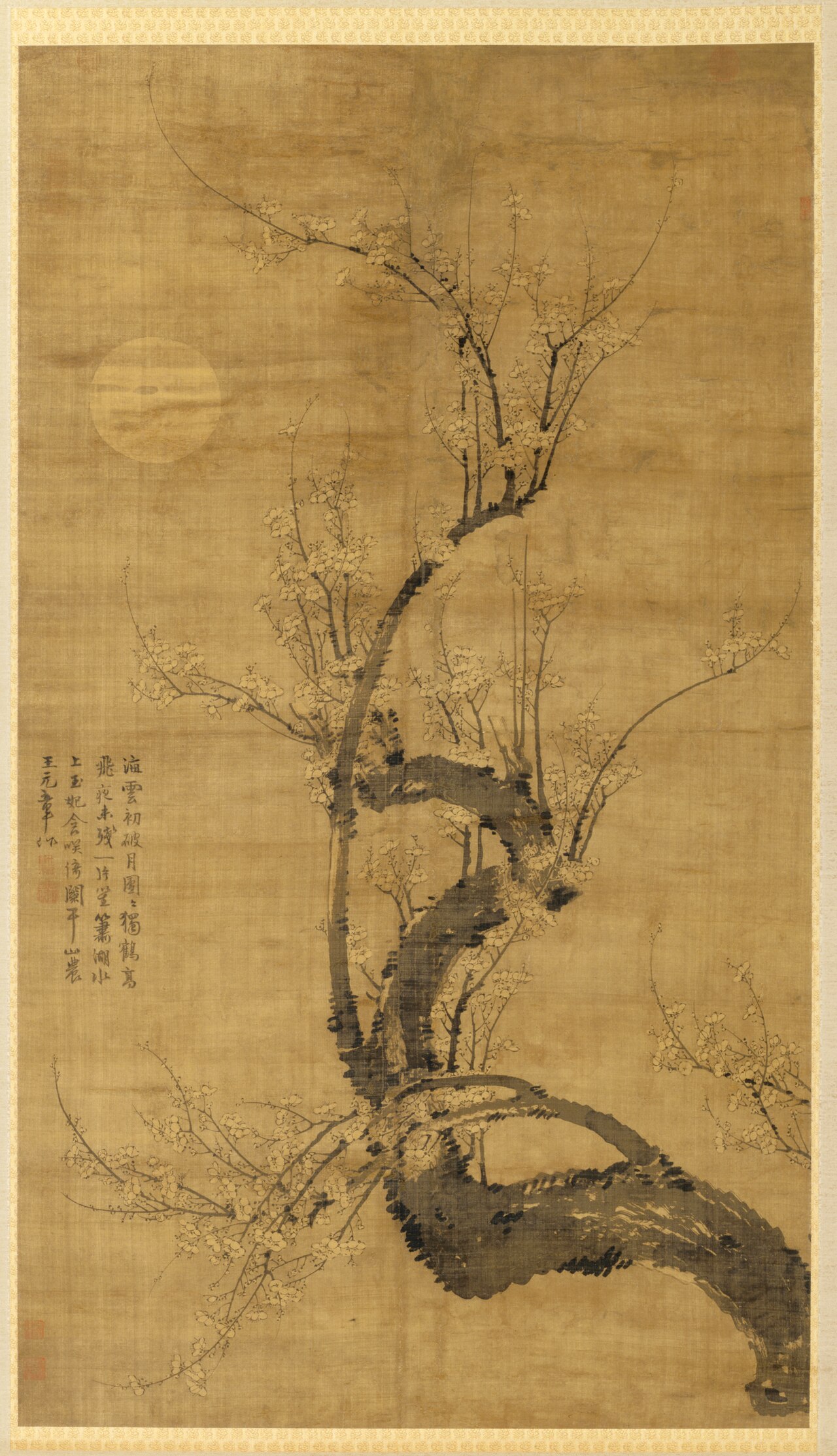


Early life Wang Mian was born in 1287 in the town of Zhuji, located in present‑day Zhejiang province. His family belonged to the educated gentry class, and he received a traditional Confucian education. Early in his life Wang pursued the civil‑service examinations with the aim of becoming a government official, a common ambition for men of his social standing. Though he demonstrated literary talent, he did not secure an official post, and this disappointment nudged him toward the arts.
Career and style During the Yuan dynasty, the patronage of the arts shifted from the imperial court to private collectors and literati circles. Wang Mian emerged within this context as a painter whose subject matter centred almost entirely on the plum tree, a symbol of resilience and purity in Chinese culture. His paintings are characterised by a spare, monochrome aesthetic, employing ink washes that evoke the delicate translucence of blossom petals against a stark background. The lyrical quality of his work reflects his background as a poet; many of his pieces are accompanied by verses that reinforce the themes of solitude, seasonal change, and moral fortitude.
Wang’s reputation grew among contemporary scholars and connoisseurs, and he was known for his ability to capture the spirit of the plum blossom with a few decisive strokes. Although his oeuvre is not extensive, the surviving works demonstrate a consistent visual language that balances restraint with expressive vigor. In his later years, Wang fell out of the public eye, a circumstance that may have been linked to political turbulence or personal retreat. Historical records indicate a brief episode in which he served as a military adviser to Zhu Yuanzhang, the future founder of the Ming dynasty, although details of this role remain sparse.
Signature techniques Wang Mian’s technique rests on mastery of brush and ink. He employed the "wet‑brush" method, allowing the brush to retain moisture so that ink would flow in soft, continuous lines. This approach produced the characteristic wispy branches and subtle shading of blossoms. In addition, he used the "dry‑brush" technique to suggest texture on bark and leaves, creating a contrast between the bold, dark outlines and lighter, feather‑like strokes. The compositional balance of his paintings often places a single branch or a small cluster of blossoms against an expansive void, emphasizing the principle of "emptiness" that underpins much of Yuan‑dynasty aesthetic theory.
Another hallmark of Wang’s work is the integration of poetry directly on the painting surface. Calligraphic inscriptions are rendered in an elegant, semi‑cursive script, reinforcing the unity of visual and literary arts that was prized by the scholar‑artist class. The ink tones range from deep black to diluted grey, allowing for subtle gradations that convey both depth and atmospheric perspective.
Major works Wang Mian’s surviving corpus includes several dated pieces that illustrate his artistic development. **Twin Purities of Bamboo and Plum Blossom (1350)** juxtaposes two emblematic plants, using the same refined brushwork to render both bamboo stalks and plum branches, thereby highlighting their shared symbolism of integrity. **Ink Plum** showcases a solitary blossom rendered with a single, flowing stroke, embodying the painter’s ability to convey vitality through minimal means.
A Prunus in the Moonlight (1349) is notable for its atmospheric rendering of moonlight reflected on the blossoms, achieved through delicate gradations of grey ink that suggest a silvery glow. Fragrant Snow at Broken Bridge (1323) combines the motif of plum blossoms with a wintry landscape, employing fine, stippled dots to evoke falling snow while maintaining the central focus on the flowering branches.
In Spring's Earliest Blossoms (1353), Wang captures the first flush of spring, with tender buds that hint at renewal. Across these works, recurring elements include the use of negative space, the interplay of light and shadow, and the integration of poetic inscriptions that deepen the viewer’s engagement with the subject.
Influence and legacy Wang Mian’s dedication to the plum blossom established him as a pivotal figure in the lineage of Chinese flower painting. His approach influenced later Ming‑dynasty artists, who adopted his emphasis on simplicity and the moral symbolism of the plum. The painter’s reputation endured through literary references; he appears in the eighteenth‑century novel *The Scholars*, where his artistic ideals are invoked as an exemplar of refined taste.
Modern scholarship regards Wang Mian as a bridge between the Yuan literati aesthetic and the more formal court painting of the subsequent Ming period. His works are held in major Chinese museums and continue to be studied for their technical mastery and cultural significance. The enduring appeal of his paintings lies in their ability to convey profound philosophical ideas through the modest subject of a single blossom, a testament to the power of understated artistry.
Wang’s legacy also informs contemporary practice. Artists and collectors alike value his paintings for their subtlety, and his techniques are taught in traditional Chinese painting curricula. The continued exhibition of his works, both domestically and internationally, underscores his lasting contribution to the visual language of Chinese art.
Frequently asked questions
Who was Wang Mian?
Wang Mian (1287–1359) was a Yuan‑dynasty Chinese painter and poet best known for his elegant plum‑blossom paintings.
What artistic style or movement is Wang Mian associated with?
He is linked to the Yuan‑dynasty literati tradition, emphasizing minimalist brushwork, monochrome ink, and the integration of poetry.
What are Wang Mian’s most famous works?
His most celebrated pieces include *Twin Purities of Bamboo and Plum Blossom* (1350), *A Prunus in the Moonlight* (1349), and *Spring's Earliest Blossoms* (1353).
Why is Wang Mian important in art history?
He refined the visual language of plum‑blossom painting, influencing later Ming artists and embodying the moral symbolism that linked art to Confucian ideals.
How can I recognise a genuine Wang Mian painting?
Look for his signature use of wet‑brush ink strokes, subtle gradations of grey, ample empty space, and poetic inscriptions rendered in semi‑cursive calligraphy.