Ni Zan
1301 – 1374
In short
Ni Zan (1301–1374) was a Chinese painter of the Yuan dynasty, recognised as one of the Four Masters of that era. He is celebrated for his spare, monochrome landscapes that embody the Southern School’s emphasis on personal expression over realistic detail.
Notable works


_-_Twin_Trees_by_the_South_Bank_(Annan_shuangshu)_-_Google_Art_Project.jpg)

Early life Ni Zan was born in 1301 in Wuxi, a prosperous city on the banks of Lake Tai in present‑day Jiangsu province. His family belonged to the scholar‑official class, which afforded him a classical education in poetry, calligraphy and the Confucian classics. Little is recorded about his childhood, but the cultural milieu of Wuxi—renowned for its gardens, canals and cultivated literati circles—provided a fertile backdrop for his early exposure to brushwork and the ideals of the literati tradition.
Career and style In his thirties Ni Zan began to travel extensively across the Yuan empire, a period that coincided with the decline of the Mongol‑ruled court and a growing sense of disillusionment among Chinese scholars. Like many of his contemporaries, he retreated from official duties to pursue a life of artistic and scholarly independence. This withdrawal is reflected in his paintings, which favour an austere, almost meditative approach. Ni Zan’s style is firmly situated within the Southern School of Chinese painting, a movement that championed personal expression, spontaneity and the use of ink to convey the spirit of a landscape rather than its exact topography.
His canvases are characterised by an economy of brushstroke, a limited palette—often reduced to black ink on paper or silk—and an emphasis on empty space. The resulting works convey a sense of quietude and introspection, mirroring the scholar‑artist’s desire to retreat from the turbulence of the world. By privileging simplicity, Ni Zan created a visual language that communicated both the physical and philosophical dimensions of nature.
Signature techniques Ni Zan’s technique revolves around three interlocking methods:
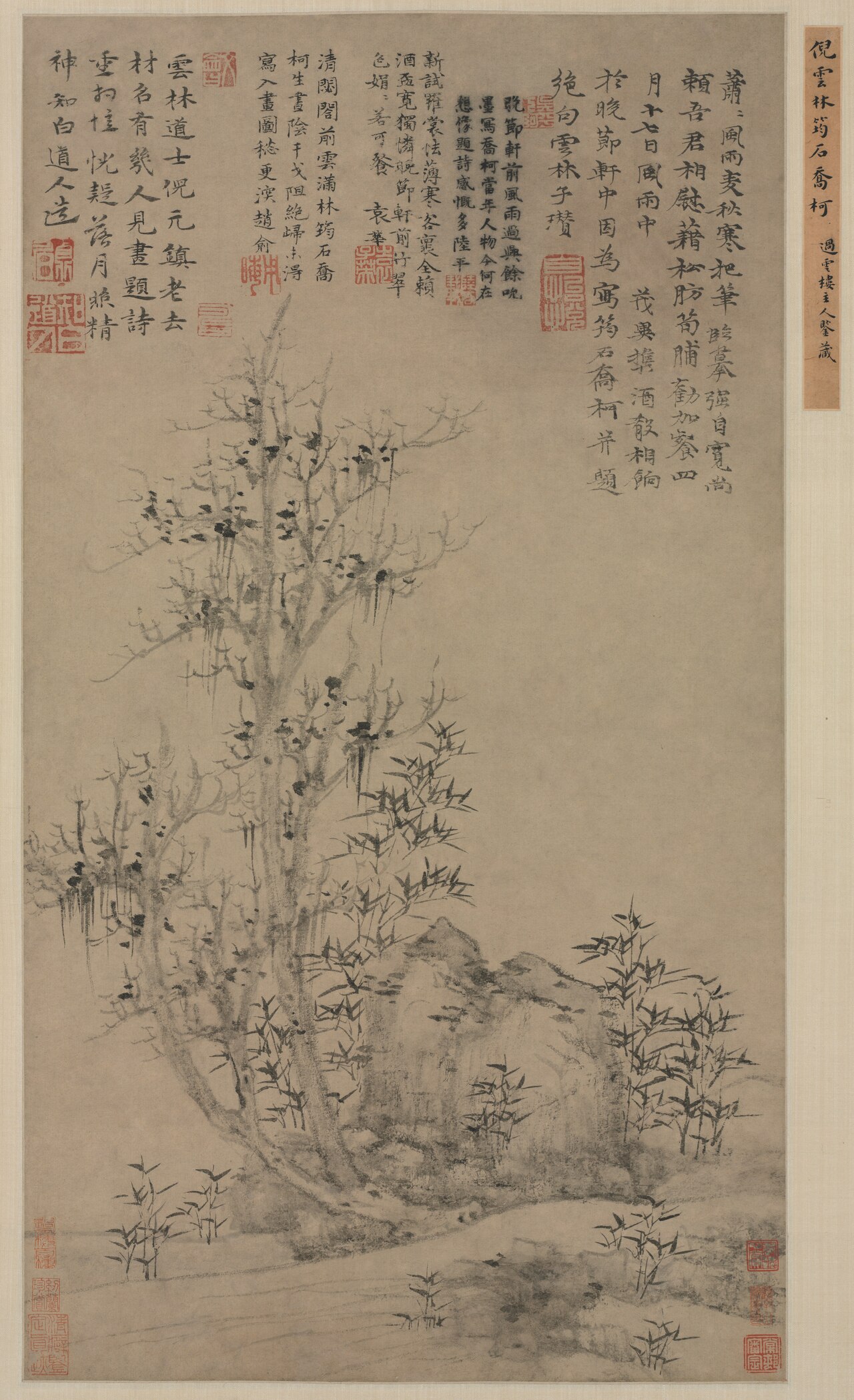
1. Sparse brushwork – He employed thin, dry strokes to suggest rocks, trees and distant mountains, allowing the paper’s whiteness to act as a compositional element. This approach creates a feeling of atmospheric depth without heavy detailing. 2. Monochrome restraint – While colour was occasionally used in later Ming copies, Ni Zan’s authentic pieces remain almost exclusively ink, reinforcing the contemplative mood and aligning with the literati preference for moral purity. 3. Negative space – Large swathes of unpainted surface dominate his compositions, a deliberate choice that invites the viewer’s imagination to complete the scene. This use of empty space is a hallmark of the Southern School and distinguishes his work from the more decorative Northern School traditions.
Major works Ni Zan’s surviving oeuvre includes several dated pieces that illustrate his evolving mastery:
- Six Gentlemen (1345) – This early landscape portrays six slender trees standing against a misty horizon. The title alludes to the Confucian ideal of virtuous gentlemen, and the composition’s restrained brushwork exemplifies his commitment to moral clarity. - Bamboo, Rock, and Tall Tree (1349) – Here Ni Zan juxtaposes a solitary bamboo stalk with a rugged rock formation and a towering pine, each rendered with delicate, calligraphic strokes. The painting’s asymmetrical balance reflects his belief in the harmony of opposing forces. - Twin Trees by the South Bank (Annan shuangshu) (1353) – The work captures two gnarled trees flanking a riverbank, rendered in ink washes that dissolve into the paper’s void. The piece is celebrated for its lyrical simplicity and its subtle suggestion of movement within stillness. - Poetic Thoughts in a Forest Pavilion (1371) – Created in the final decade of his life, this composition depicts a modest pavilion nestled among trees, evoking the scholar‑artist’s retreat into nature for contemplation. The ink layers are progressively lighter, indicating an increasing emphasis on ethereality. - Woods and Valleys of Mount Yu (1372) – One of his latest dated works, it portrays a sweeping valley with distant peaks, rendered in a series of swift, gestural strokes. The painting’s minimalism reaches a near‑abstract zenith, embodying the culmination of Ni Zan’s lifelong aesthetic.
These works collectively demonstrate Ni Zan’s consistent pursuit of a serene, intellectual vision of the landscape, each piece serving as a visual poem that balances form and emptiness.
Influence and legacy Ni Zan’s influence extended far beyond his lifetime. His minimalist approach resonated with later Ming and Qing painters who sought to escape the ornate court style in favour of a more personal, scholarly expression. The Four Masters—Ni Zan, Huang Gongwang, Wu Zhen and Wang Meng—became canonical references for the Southern School, their teachings transmitted through generations of literati artists.
In modern times, Ni Zan’s paintings are prized not only for their aesthetic qualities but also for the philosophical statements they embody. His emphasis on restraint, meditation and the moral potency of ink has inspired contemporary artists working within both traditional Chinese media and cross‑cultural experimental practices. Museums worldwide, from the Palace Museum in Beijing to the Metropolitan Museum of Art in New York, hold his works, and his name frequently appears in academic curricula as a prime example of Yuan‑dynasty literati painting.
Overall, Ni Zan remains a pivotal figure whose quiet brushstrokes continue to speak to viewers across centuries, offering a window into the inner world of a scholar‑artist who chose the ink‑filled void over the tumult of his age.
Frequently asked questions
Who was Ni Zan?
Ni Zan (1301–1374) was a Chinese painter of the Yuan dynasty, recognised as one of the Four Masters of that era and a leading figure of the Southern School of landscape painting.
What artistic movement or style is Ni Zan associated with?
He is associated with the Southern School, which prioritises personal expression, sparse brushwork and the use of ink to capture the spirit of a landscape rather than precise detail.
What are Ni Zan’s most famous works?
His most celebrated pieces include Six Gentlemen (1345), Bamboo, Rock, and Tall Tree (1349), Twin Trees by the South Bank (1353), Poetic Thoughts in a Forest Pavilion (1371) and Woods and Valleys of Mount Yu (1372).
Why does Ni Zan matter in art history?
Ni Zan’s minimalist, contemplative approach helped define the literati aesthetic, influencing successive generations of Chinese painters and shaping the philosophical discourse of landscape art.
How can I recognise a genuine Ni Zan painting?
Look for a spare composition dominated by ink washes, thin, calligraphic brushstrokes, extensive empty space and a serene, almost abstract treatment of trees, rocks and water.