Wang Meng
1308 – 1385
In short
Wang Meng (1308–1385) was a Chinese painter of the Yuan dynasty, renowned for his intricate, poetic landscapes and counted among the Four Masters of the Yuan period.
Notable works

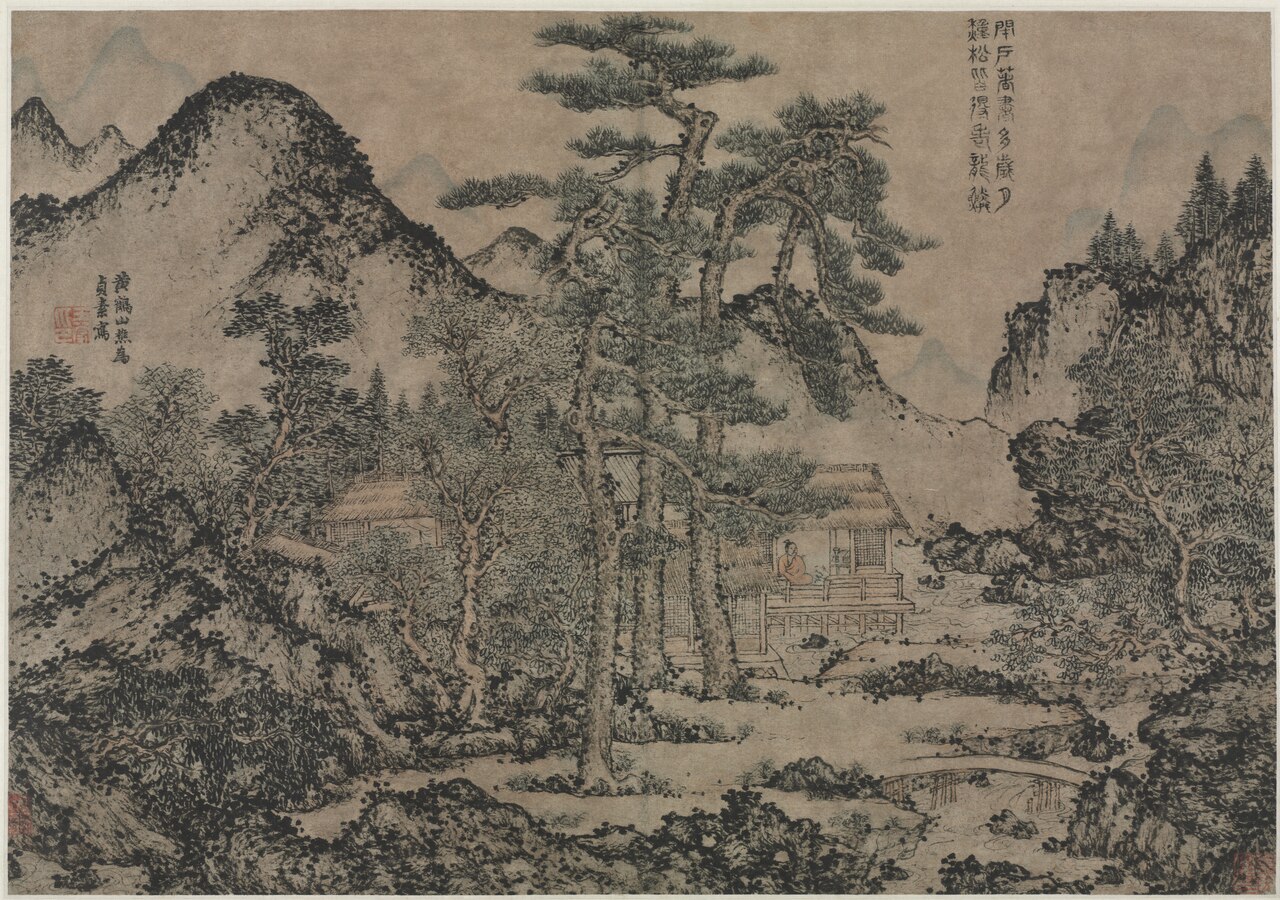


Early life Wang Meng was born in 1308 in Huzhou, a town in the Zhejiang province of what is now the People’s Republic of China. Little is known about his family background, but contemporary records indicate that he grew up in a cultured environment that prized scholarship and the arts. The Yuan dynasty (1271–1368) was a period of foreign rule under the Mongols, yet Chinese literati continued to cultivate their own artistic traditions, often as a subtle form of cultural resistance. Wang Meng received a classical education, learning calligraphy and poetry alongside painting, a combination that would shape his artistic identity.
Career and style Wang Meng emerged as a leading figure in the literati painting tradition, a style that privileged personal expression over realistic representation. He was contemporaneous with three other eminent painters—Huang Gongwang, Wu Zhen, and Ni Zan—who together are known as the Four Masters of the Yuan dynasty. Unlike court painters who worked for imperial patrons, Wang Meng pursued a more independent path, often painting for private collectors and fellow scholars.
His style is characterised by dense, layered brushwork that creates a sense of atmospheric depth. Rather than depicting specific geographic locations, his landscapes evoke an idealised, timeless realm where mountains, trees, and water intertwine in a harmonious composition. The use of ink washes, subtle tonal variations, and occasional touches of colour reflect the influence of earlier Song‑dynasty masters while also signalling a distinct Yuan‑era sensibility. Throughout his career, Wang Meng maintained a focus on the spiritual and contemplative aspects of nature, aligning his visual practice with the ideals of Daoist and Confucian thought.
Signature techniques Wang Meng’s brushwork is perhaps his most recognisable hallmark. He employed a technique known as "cun" (texture strokes) where the brush is repeatedly lifted and pressed to produce a rhythmic, almost calligraphic pattern across rock faces and foliage. These strokes convey both solidity and movement, allowing the viewer to sense the underlying structure of the landscape.
Another defining element is his use of "wet‑on‑wet" ink washes. By applying a diluted ink over a previously laid down darker ink, he achieved a soft, misty atmosphere that suggests early morning or evening light. This layering creates depth without relying on linear perspective, a method that became a staple of later Chinese landscape painting.
Wang Meng also paid close attention to compositional balance. He often placed a solitary pavilion or a cluster of trees in the foreground, anchoring the viewer’s eye before guiding it through receding mountains and distant clouds. Negative space—areas of unpainted paper—plays a crucial role, representing water or sky and providing breathing room within the dense pictorial field.
Major works **Quiet Life in a Wooded Glen (1361)** – This hand‑scroll depicts a secluded valley surrounded by towering pines and craggy cliffs. The composition is dominated by a winding path that leads the eye toward a small pavilion, suggesting a retreat for contemplation. The brushwork is particularly intricate, with layered rock textures that convey the solidity of the terrain.
Writing Books under the Pine Trees (1323) – One of Wang Meng’s earliest dated pieces, this work presents a scholar seated beneath ancient pines, absorbed in calligraphy. The painting balances the figure with the surrounding foliage, emphasizing the harmony between intellectual pursuit and natural surroundings. The delicate ink washes convey a gentle breeze that seems to rustle the pine needles.
Red Cliffs and Green Valleys (1367) – In this vibrant landscape, Wang Meng employs subtle touches of red pigment to highlight the cliffs, contrasting with the verdant valleys rendered in deep ink tones. The piece showcases his ability to integrate colour sparingly, allowing the ink to dominate while still providing visual interest.
Sparse Trees and Pavilion (1357) – This painting exemplifies Wang Meng’s skill in rendering emptiness. A lone pavilion perched among a few sparse trees creates a sense of isolation and serenity. The negative space is as important as the painted elements, inviting contemplation of the vastness beyond the immediate scene.
The Simple Retreat (1370) – Completed near the end of his life, this work portrays a modest dwelling set against a backdrop of rolling hills and mist‑shrouded peaks. The composition is deliberately uncluttered, reflecting the artist’s mature philosophy of simplicity and inner peace. The brushwork is looser, suggesting a confidence that comes with years of practice.
Influence and legacy Wang Meng’s contribution to Chinese art lies in his synthesis of technical mastery and philosophical depth. His dense, textured landscapes inspired later Ming‑dynasty painters who sought to emulate the “ink‑stone” aesthetic. Scholars have noted that his approach to negative space and atmospheric perspective informed the development of the "literati" style that dominated Chinese painting for centuries.
Beyond the visual arts, Wang Meng’s works were frequently referenced in poetry and literary circles, reinforcing the idea that painting, calligraphy, and poetry formed an integrated cultural practice. Collections of his scrolls were prized by collectors throughout the Ming and Qing periods, and many of his pieces survive in major museum holdings worldwide.
In contemporary art history, Wang Meng is recognised not only for his technical achievements but also for his embodiment of the Yuan‑dynasty’s intellectual spirit. His paintings continue to be studied for their nuanced brushwork, compositional innovation, and the way they capture the contemplative relationship between humanity and nature.
Frequently asked questions
Who was Wang Meng?
Wang Meng (1308–1385) was a Chinese painter of the Yuan dynasty, celebrated for his intricate, poetic landscapes and counted among the Four Masters of the Yuan period.
What artistic style or movement is he associated with?
He is associated with the literati (scholar‑artist) painting tradition, which emphasizes personal expression, brushwork, and the integration of poetry and calligraphy.
What are his most famous works?
His most renowned works include "Quiet Life in a Wooded Glen" (1361), "Writing Books under the Pine Trees" (1323), "Red Cliffs and Green Valleys" (1367), "Sparse Trees and Pavilion" (1357) and "The Simple Retreat" (1370).
Why does Wang Meng matter in art history?
He helped define the Yuan‑dynasty literati landscape, influencing later Ming and Qing painters with his dense brushwork, atmospheric composition, and philosophical approach to nature.
How can I recognise a painting by Wang Meng?
Look for tightly layered ink strokes that create textured rock surfaces, subtle wet‑on‑wet washes that suggest mist, and a balanced composition that often places a solitary pavilion or sparse trees amid dense foliage.