Nils Kreuger
1858 – 1930
In short
Nils Edvard Kreuger (1858–1930) was a Swedish painter noted for his naturalistic landscapes and rural scenes, often depicting the Swedish countryside and everyday life. His works, such as Landscape of Öland and Horse on the Beach, remain valued examples of late‑19th‑century Scandinavian genre painting.
Notable works


Early life Nils Edvard Kreuger was born in 1858 in the Kalmar cathedral parish, a region on Sweden’s southeastern coast. Growing up in a largely agrarian environment, he was exposed early to the rhythms of rural life that would later dominate his artistic output. His family supported his interest in drawing, and he pursued formal artistic training in Stockholm, where most Swedish painters of his generation attended the Royal Swedish Academy of Fine Arts. The academy’s curriculum emphasized drawing from life, study of anatomy, and a disciplined approach to colour, providing Kreuger with a solid foundation in academic techniques.
Career and style After completing his studies, Kreuger embarked on a career that combined studio work with extensive travel. Like many Scandinavian artists of the period, he spent time in Paris, the epicentre of European art, where he encountered French naturalism and the emerging Impressionist movement. While he never aligned himself with a specific avant‑garde group, the exposure broadened his visual vocabulary and reinforced his commitment to portraying light and atmosphere with fidelity.
Kreuger’s mature style is characterised by a restrained palette of earth tones punctuated by bright, seasonal colours—yellows of ripe wheat, the deep greens of summer pastures, and the soft blues of coastal waters. He favoured clear, balanced compositions that placed the viewer at a modest distance from the scene, allowing the narrative of everyday labour to unfold without overt dramatisation. His subjects are predominantly Swedish landscapes, farmsteads, and the people who inhabit them, reflecting a quiet nationalism that celebrated the country’s natural bounty.
Signature techniques Kreuger employed a meticulous brushwork that combined fine detail in foreground elements with looser, more atmospheric handling of background forms. This technique creates a sense of depth while preserving the tactile quality of textures such as stone, thatch, and the fur of livestock. Light is often depicted as a diffuse glow rather than stark chiaroscuro; he preferred the soft, even illumination of early morning or twilight, which lends his scenes an understated lyrical quality.
Colour modulation is another hallmark of his oeuvre. Kreuger layered thin glazes of muted pigments to achieve subtle tonal shifts, especially in sky and water. This method produces a harmonious integration of sky, land, and sea, a visual strategy that underscores the interconnectedness of the natural world in his work. Additionally, he frequently incorporated small narrative vignettes—a solitary horse, a group of gypsies, a ploughman—within broader landscape settings, inviting viewers to contemplate both the environment and its human inhabitants.
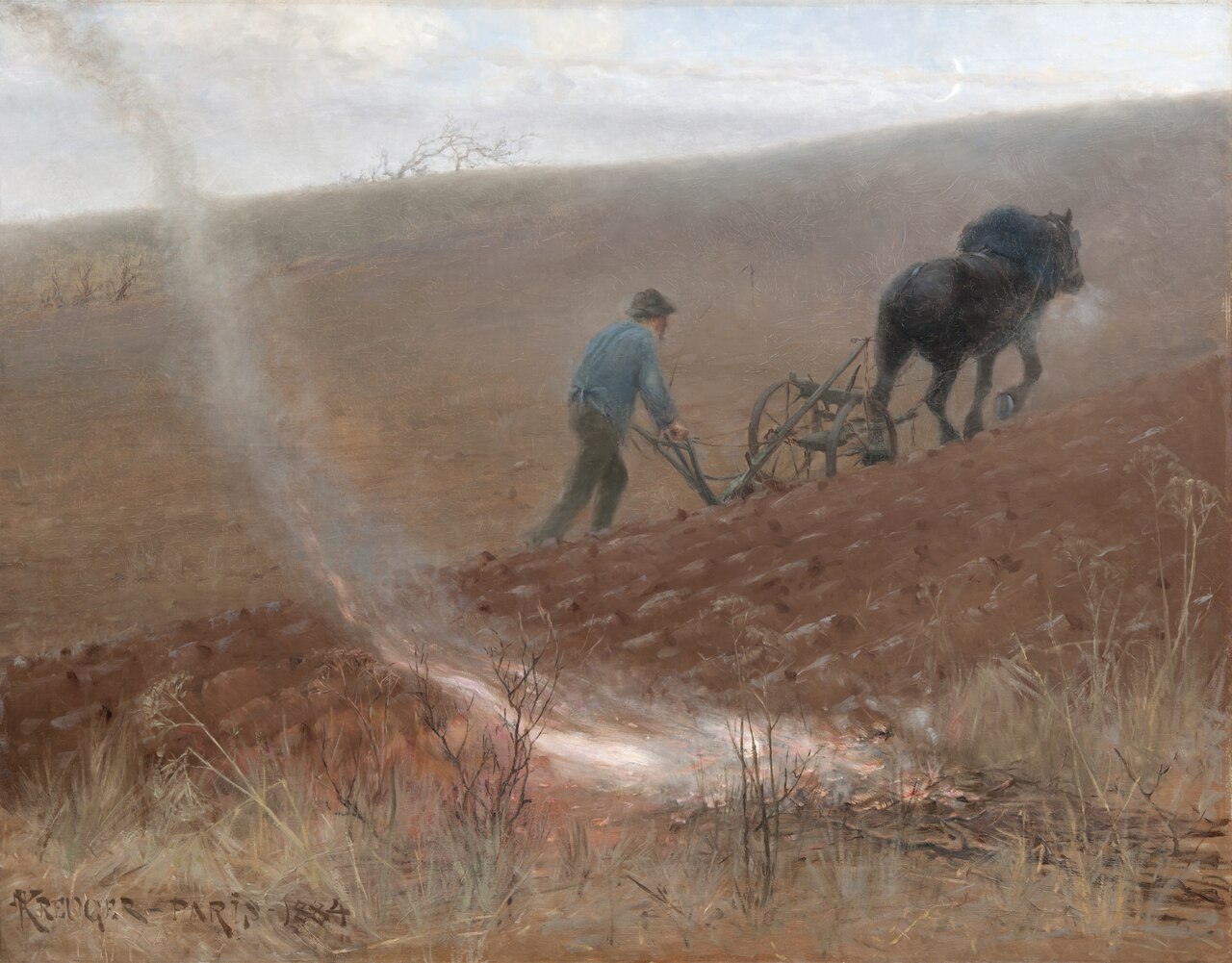
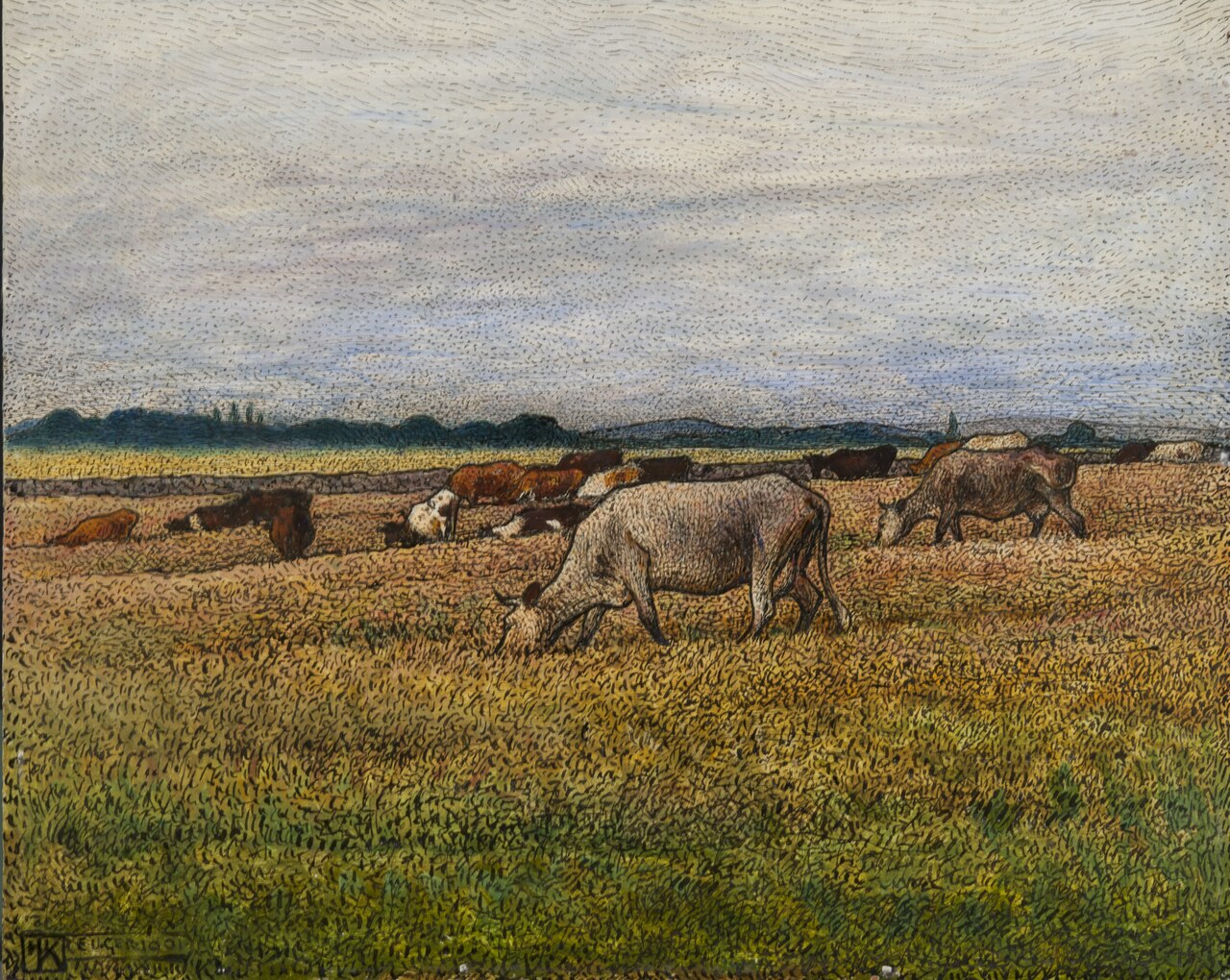
Major works - **Landscape of Öland, Gypsies on a Horse (1885)** – This oil painting captures a windswept coastal plain on the island of Öland, where a pair of itinerant gypsies ride a horse across a barren stretch. The work demonstrates Kreuger’s skill in rendering expansive sky and the stark, limestone terrain that characterises the island. - **Decommissioned Omnibus Horses on Boulevard d’Enfer, Paris (1885)** – Though the subject is French, the composition reflects the artist’s interest in the relationship between animal labour and urban space. The painting shows retired omnibus horses resting on a Parisian boulevard, their weary postures juxtaposed against the bustling city background. - **Spring Ploughing (1884)** – A vivid depiction of agricultural activity, this canvas presents a team of oxen or horses pulling a plough through freshly tilled soil. The earthy palette and careful rendering of fur rows convey the physicality of the work and the seasonal renewal of the countryside. - **Landscape with Cows (1901)** – In this later work, Kreuger returns to a tranquil pastoral scene, placing a herd of cattle against a rolling meadow under a soft, overcast sky. The painting’s calm atmosphere exemplifies his mature approach to balance and tonal harmony. - **Horse on the Beach (Summer Night) (1902)** – This nocturnal scene shows a solitary horse standing on a shoreline at dusk. The subtle blues and purples of the night sky are reflected in the wet sand, while the horse’s silhouette provides a focal point that anchors the composition.
Influence and legacy Nils Kreuger occupies a respected place in Swedish art history as a chronicler of rural life at a time of rapid industrialisation. His paintings serve as visual documents of traditional agricultural practices, offering insight into the social fabric of late‑19th‑century Sweden. Although he never achieved the international fame of contemporaries such as Anders Zorn, his works were regularly exhibited in Stockholm and Paris, and they were acquired by several regional museums, including the Kalmar Konstmuseum and the Nationalmuseum in Stockholm.
Kreuger’s methodical approach to landscape painting influenced younger Swedish artists who sought to balance academic rigour with a more personal, atmospheric vision of nature. His emphasis on modest, everyday subjects contributed to the broader Nordic trend of celebrating the ordinary, a legacy that can be traced through the works of early 20th‑century painters such as Albert Engström and later modernists who revisited rural motifs.
In contemporary scholarship, Kreuger is recognised for his ability to fuse the technical discipline of the academy with an empathetic portrayal of the natural world. His paintings continue to appear in exhibitions focused on Scandinavian realism, and they are frequently cited in studies of Nordic art that examine the tension between tradition and modernity. As a result, Kreuger remains a valuable reference point for understanding how Swedish artists negotiated their cultural identity through landscape and genre painting.
Frequently asked questions
Who was Nils Kreuger?
Nils Edvard Kreuger (1858–1930) was a Swedish painter renowned for his naturalistic landscapes and rural genre scenes.
What style or movement is he associated with?
He worked within a realist‑naturalist tradition, combining academic technique with a focus on everyday Swedish countryside life.
What are his most famous works?
Key paintings include Landscape of Öland, Gypsies on a Horse (1885), Horse on the Beach (Summer Night) (1902), Spring Ploughing (1884), Landscape with Cows (1901) and Decommissioned Omnibus Horses on Boulevard d’Enfer, Paris (1885).
Why does he matter in art history?
Kreuger documented rural Swedish life during a period of industrial change, influencing later Scandinavian artists and contributing to the nation’s visual heritage.
How can I recognise a Nils Kreuger painting?
Look for balanced compositions, muted earth tones with subtle colour glazes, soft diffused light, and modest rural subjects such as farms, animals and coastal scenes.