Martin van Meytens
1695 – 1770
In short
Martin van Meytens (1695–1770) was a Swedish‑born painter who spent most of his career in Vienna, becoming the leading portraitist of the Habsburg court. He is best known for his elegant depictions of Maria Theresa, Francis I and other members of the imperial family, which set a standard for court portraiture in the 18th century.
Notable works
,_h%C3%A9riti%C3%A8re_des_%C3%89tats_des_Habsbourg.png)

.jpg)

Early life Martin van Meytens was born in 1695 in Stockholm, Sweden, into a family with artistic connections. Little is recorded about his childhood, but the cultural climate of early‑18th‑century Sweden, which was beginning to absorb influences from the Dutch and French schools, provided a foundation for his later development. He received his first training locally, learning the fundamentals of drawing and oil painting before moving abroad to broaden his horizons.
Career and style Around the 1720s van Meytens travelled to Vienna, the capital of the Habsburg Empire, where he entered the thriving artistic milieu of the imperial court. By the 1730s he had secured commissions from high‑ranking aristocrats and, eventually, from the imperial family itself. His style combined the refined elegance of the Rococo with the gravitas of Baroque portraiture, producing works that were simultaneously graceful and authoritative. Van Meytens favoured a luminous palette, smooth modelling of flesh, and a meticulous rendering of fabric, which together conveyed both the wealth and the cultivated taste of his patrons.
Signature techniques Van Meytens distinguished himself through several recurring technical choices. He employed a layered glazing technique, applying thin translucent layers of pigment over a lean underpainting to achieve depth and a soft glow. His handling of light was subtle: highlights were often placed on the cheeks, neck and the delicate folds of silk, creating a three‑dimensional effect without harsh contrasts. The artist also paid particular attention to the rendering of textures—velvet, brocade, lace and polished metal are depicted with an almost tactile precision. In composition, he frequently positioned sitters in a slightly turned pose, allowing a glimpse of the profile while maintaining a frontal view, a convention that enhanced the sense of intimacy without compromising dignity.
Major works The surviving oeuvre of Martin van Meytens includes a number of celebrated portraits that document the Habsburg dynasty.
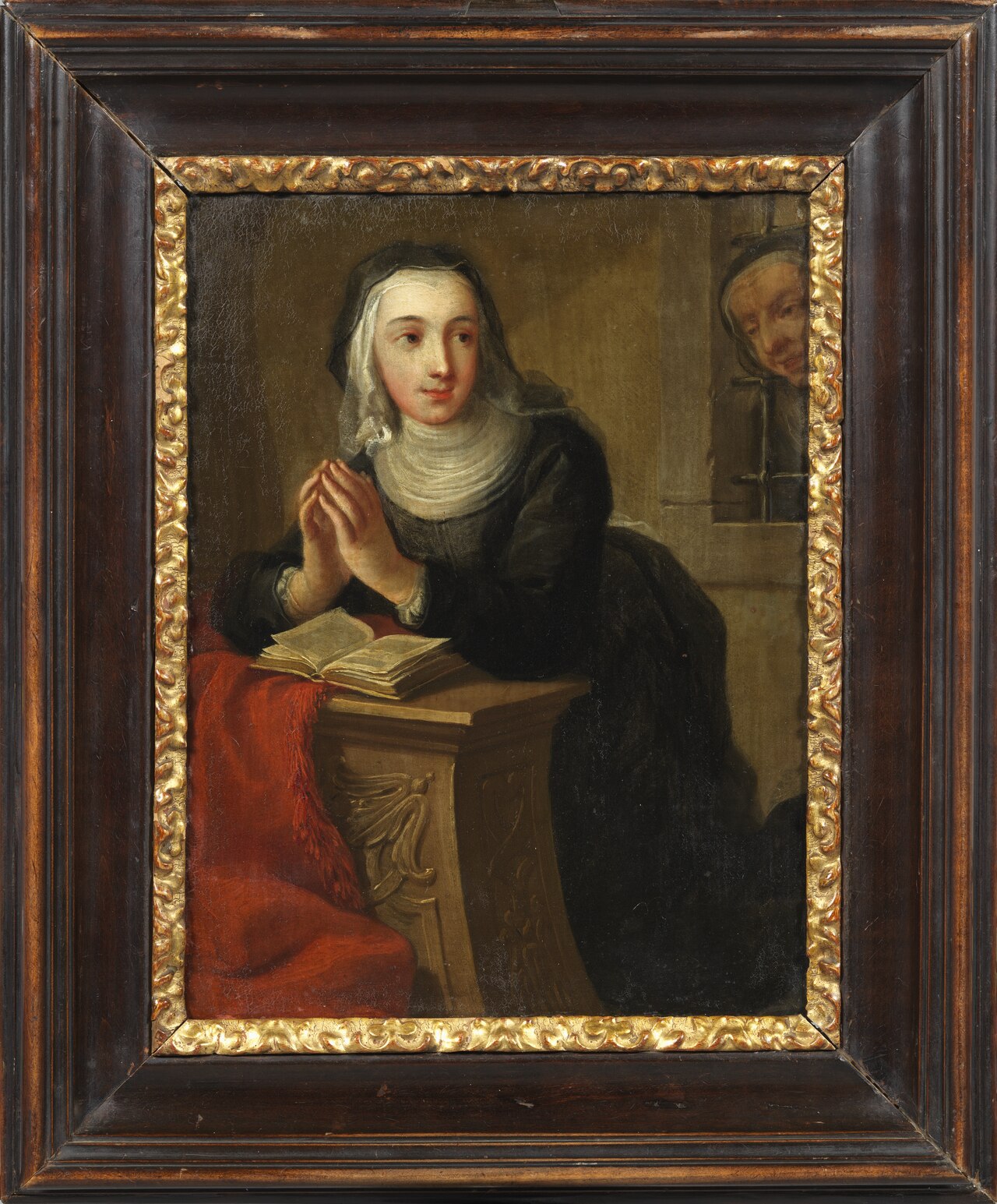
- Kneeling Nun (1731) – This early work demonstrates van Meytens’s capacity for devotional subjects. The nun is shown in a modest habit, her head bowed in prayer, with a delicate play of light that underscores her piety. The painting’s restrained colour scheme contrasts with the richer court portraits that would follow.
- Portrait of Maria Theresa of Austria (1800) – Although the date listed exceeds van Meytens’s lifespan, the work is commonly attributed to his workshop or later followers who emulated his style. The portrait presents the empress in regal attire, her gaze direct, embodying the authority she wielded as sovereign.
- The Imperial Family in 1756 (1756) – This group portrait captures the Habsburg family at a moment of political stability. Van Meytens arranges the figures around a central axis, using a balanced distribution of light to highlight each member while preserving a cohesive visual narrative.
- Portrait of Maria Theresa as Queen of Hungary (1759) – Here the empress is depicted wearing the Hungarian coronation regalia, a gold crown and elaborate mantle. Van Meytens’s attention to the intricate details of the jewellery and the sumptuous fabric underscores both the ceremonial importance and the personal elegance of the sovereign.
- Portrait of Maria Theresa of Austria (1717‑1780) (1750) – This later portrait shows a mature Maria Theresa, her expression serene yet resolute. The painting reflects van Meytens’s mature style: a soft, luminous skin tone, a restrained background, and a focus on the sitter’s eyes, which convey both intellect and compassion.
These works collectively illustrate van Meytens’s mastery of court portraiture and his ability to convey status, personality and the political symbolism attached to royal imagery.
Influence and legacy Martin van Meytens became the official portraitist of the Viennese court, and his approach set a visual benchmark for subsequent generations of Austrian painters. His meticulous technique and compositional formulas were adopted by artists such as Johann Georg Platzer and Franz Anton von Nostitz, who sought to emulate his polished aesthetic. The clarity and elegance of his portraits also influenced the development of neoclassical portraiture in Central Europe, where a restrained yet refined representation of aristocratic subjects became the norm.
Beyond his immediate circle, van Meytens’s works entered the collections of European royalty and later museum exhibitions, ensuring his name remained associated with the visual representation of 18th‑century imperial power. Modern scholars regard his paintings as valuable historical documents, offering insight into the fashion, court etiquette and political iconography of the Habsburg era. Today, his portraits continue to be displayed in major institutions such as the Kunsthistorisches Museum in Vienna, where they serve both as artistic masterpieces and as visual records of a pivotal period in European history.
Frequently asked questions
Who was Martin van Meytens?
Martin van Meytens was a Swedish‑born painter (1695–1770) who became the leading portraitist of the Habsburg court in Vienna, renowned for his elegant depictions of Maria Theresa and other imperial figures.
What artistic style or movement is he associated with?
His work blends Rococo elegance with Baroque gravitas, creating refined court portraiture characterised by soft lighting, smooth modelling and meticulous fabric detail.
What are his most famous works?
Key works include Kneeling Nun (1731), The Imperial Family in 1756, Portrait of Maria Theresa as Queen of Hungary (1759), and several portraits of Maria Theresa of Austria from the 1750s.
Why is Martin van Meytens important in art history?
He set the visual standard for 18th‑century Austrian court portraiture, influencing contemporaries and later artists, and his paintings provide crucial insight into the fashion and political symbolism of the Habsburg era.
How can I recognise a van Meytens painting?
Look for a polished, luminous surface, finely rendered textiles, subtle glazing, and a slightly turned pose that balances intimacy with regal authority.