Johann Philipp Lemke
1631 – 1711
In short
Johann Philipp Lemke (1631–1711) was a German‑born Swedish graphic artist and battle painter, known for his etchings and paintings that document 17th‑century Swedish military campaigns, especially those of King Charles X Gustav.
Notable works




Early life Johann Philipp Lemke was born in 1631 in Nuremberg, a city that was then a thriving centre of printmaking and metalwork in the Holy Roman Empire. Little is recorded about his family background, but the artistic climate of Nuremberg—home to masters such as Albrecht Dürer and later a vibrant community of etchers—provided a fertile environment for a budding graphic artist. Lemke is believed to have received his initial training in the city’s workshops, where he would have learned the fundamentals of drawing, copper‑plate engraving and the emerging techniques of chiaroscuro etching.
In his early twenties Lemke travelled to the Swedish territories of the Baltic region, a move that coincided with the expansion of Swedish power under the young monarch Charles X Gustav. The political and military upheavals of the Thirty Years' War and the subsequent Northern Wars created a demand for visual documentation of battles, sieges and royal propaganda. Lemke’s German background and technical skill made him an attractive candidate for the Swedish court, which was eager to commission works that could both celebrate its victories and serve as a visual record for posterity.
Career and style By the mid‑1650s Lemke had established himself in Stockholm as a court artist and etcher. He worked closely with the royal artillery and the Swedish army’s official chroniclers, producing a series of prints that combined accurate topographical detail with dramatic narrative composition. His style reflects the Baroque taste for movement, contrast and theatrical lighting, yet it retains a disciplined draughtsmanship rooted in his German training. Lemke’s compositions often place the viewer at a slight elevation, allowing a clear view of the battlefield while still emphasizing the human drama of combat.
Unlike many of his contemporaries who focused on religious or mythological subjects, Lemke specialised in military subjects. This focus placed him alongside other Northern European battle painters such as Adam de Coster and David Teniers the Younger, though Lemke’s work remained distinctively Swedish in its iconography and patronage. His paintings and prints served both as historical documentation and as tools of royal propaganda, reinforcing the image of Charles X Gustav as a heroic, almost mythic, leader.
Signature techniques Lemke’s technical repertoire centred on copper‑plate etching, a medium that allowed him to render fine line work and subtle tonal gradations. He employed a combination of line engraving for precise architectural elements—such as fortifications, ships and banners—and drypoint for softer, more expressive figures. In many of his battle scenes, Lemke used cross‑hatching to suggest depth and the billowing smoke of cannon fire, creating a sense of atmosphere that was unusual for the period.
Another hallmark of Lemke’s work is his use of chiaroscuro to model three‑dimensional forms. By carefully controlling the density of his incised lines, he could produce deep shadows that gave his soldiers and horses a sculptural quality. This technique also heightened the drama of the compositions, directing the viewer’s eye toward focal points such as the king’s standard or a pivotal clash of troops.
Lemke occasionally incorporated colour through hand‑colouring of his prints, a practice common in the 17th‑century Swedish market. While most of his surviving works are monochrome, the occasional tinted version demonstrates his awareness of contemporary tastes for vivid, collectible prints.
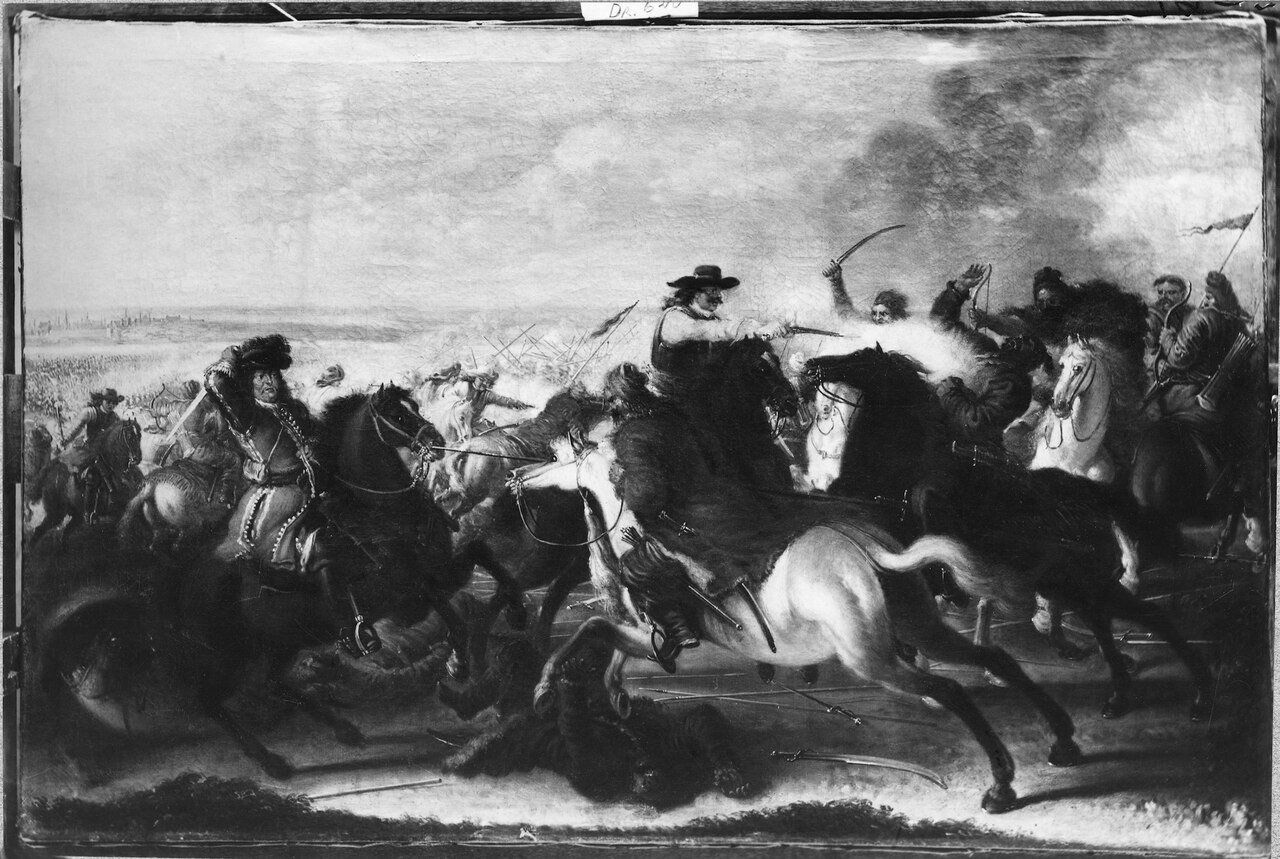
Major works - **Charles X Gustav in skirmish with Polish Tatars at the battle of Warsaw, July 29, 1656 (1684)** – This etching, produced nearly three decades after the event, captures a relatively minor engagement in the larger Second Northern War. Lemke places the Swedish cavalry in the foreground, their lances thrust forward, while the Tatars retreat across a riverbank. The composition is notable for its accurate rendering of the Warsaw landscape, which scholars have used to corroborate contemporary maps.
- Self‑portrait (1681) – Lemke’s self‑portrait is a rare example of his work in a purely personal genre. Rendered in ink and wash, the portrait shows the artist at his drawing board, a set of etching tools laid out beside him. The work demonstrates his confidence in draughtsmanship and offers insight into the modest studio environment of a 17th‑century court artist.
- Karl X Gustav (1622‑1660), count palatine of Zweibrücken, king of Sweden, married to Hedvig Eleonora of Holstein‑Gottorp – This portrait of the king, likely intended for a commemorative series, combines regal iconography with Lemke’s characteristic attention to military detail. The king is depicted in armour, with the royal coat‑of‑arms and a sword, against a backdrop of a stylised battle scene, underscoring his dual identity as sovereign and war‑leader.
- The march across Bält (1658) – One of Lemke’s most celebrated prints, this work records the daring Swedish crossing of the Great Belt (Storebælt) during the winter of 1658. Lemke captures the ice‑covered strait, the fleet of warships, and the disciplined troops marching in formation. The composition balances a sweeping landscape with a tight focus on the royal standard, reinforcing the narrative of Swedish ingenuity and resolve.
- Battle Scenery (1678) – This later work is a more generic representation of a 17th‑century battlefield, possibly intended for a wider market rather than a specific royal commission. It features a chaotic clash of infantry, cavalry and artillery, rendered with Lemke’s characteristic line work. The piece demonstrates his ability to convey movement and confusion while maintaining a clear visual hierarchy.
Influence and legacy Lemke’s oeuvre occupies a singular niche in Swedish art history: he is among the earliest native practitioners to specialise in battle imagery, a genre that would later flourish in the works of artists such as Carl Gustaf Hellqvist and Johan Fredrik Höckert. His meticulous documentation of Swedish campaigns provided a visual counterpart to written chronicles, influencing how later generations visualised the era’s military exploits.
Beyond Sweden, Lemke’s prints circulated in the broader German‑Baltic art market, where they were collected by aristocrats and military officers. His technical proficiency in etching contributed to the diffusion of Northern European printmaking standards, and his combination of accurate topography with dramatic storytelling anticipated the later development of illustrated military atlases.
In contemporary scholarship, Lemke is recognised not only for his artistic merit but also as a valuable primary source for historians of the Northern Wars. His works are frequently cited in studies of 17th‑century Swedish military logistics, fortification design and the visual culture of royal propaganda. While his name may not be as widely known as that of his later Swedish successors, Lemke’s contributions remain essential for understanding the intersection of art, warfare and statecraft in early modern Scandinavia.
Frequently asked questions
Who was Johann Philipp Lemke?
Johann Philipp Lemke (1631–1711) was a German‑born Swedish graphic artist and battle painter who worked for the Swedish court, producing etchings and paintings that documented 17th‑century military campaigns.
What artistic style or movement is Lemke associated with?
Lemke’s work reflects the Baroque style, characterised by dramatic composition, strong chiaroscuro, and dynamic movement, but he is principally known as a specialist in battle painting rather than a member of a specific formal movement.
What are Lemke’s most famous works?
His most celebrated pieces include the etching of Charles X Gustav’s skirmish with Polish Tatars (1656), the self‑portrait (1681), the portrait of King Charles X Gustav, The March across Bält (1658), and the generic Battle Scenery (1678).
Why is Lemke important in art history?
Lemke pioneered the genre of Swedish battle painting, providing visual records that shaped royal propaganda and later influencing artists who depicted military subjects in Scandinavia.
How can I recognise a Lemke artwork?
Look for meticulous line work in copper‑plate etchings, a strong contrast of light and shadow, detailed topographical backgrounds, and dynamic, crowded battle scenes that centre on a royal figure or standard.