Johan Tirén
1853 – 1911
In short
Johan Tirén (1853–1911) was a Swedish painter renowned for his depictions of rural life in northern Sweden. His work combines realistic observation with a compassionate portrayal of everyday people and landscapes.
Notable works
.jpg)


Early life Johan Tirén was born in 1853 in the parish of Själevad, a rural community in the province of Ångermanland, Sweden. He grew up in a region characterised by dense forests, scattered farms and a strong tradition of reindeer herding among the Sami people. The natural environment and the rhythms of agricultural life left a lasting imprint on his visual imagination. Tirén received his first artistic instruction from local craftsmen before moving to Stockholm to pursue formal training at the Royal Swedish Academy of Fine Arts, where he was exposed to the academic traditions that dominated Swedish art education in the late nineteenth century.
Career and style After completing his studies, Tirén returned to the north and began a career that blended academic technique with a deep empathy for his subjects. He specialised in genre scenes that portrayed the everyday activities of farmers, hunters and Sami herders. While he never aligned himself with a specific avant‑garde movement, his work reflects the broader realist tendencies of the period, particularly the influence of naturalist painters who sought to document social conditions with fidelity. Tirén’s palette was dominated by muted earth tones, punctuated by the vivid reds of autumn foliage or the bright whites of winter snow, which served to highlight the stark beauty of the northern landscape.
Signature techniques Tirén’s paintings are distinguished by a careful handling of light and atmosphere. He employed a layered glazing technique that allowed subtle colour shifts to emerge, giving his canvases a luminous quality even in subdued settings. His brushwork remained relatively tight in the foreground, rendering figures and animals with anatomical accuracy, while the background often softened into a hazy, almost impressionistic wash that suggested depth without distracting from the narrative focus. Another hallmark of his practice was the inclusion of symbolic details – a fallen branch, a distant church spire, or an empty sled – which added layers of meaning about the relationship between humans and the land.
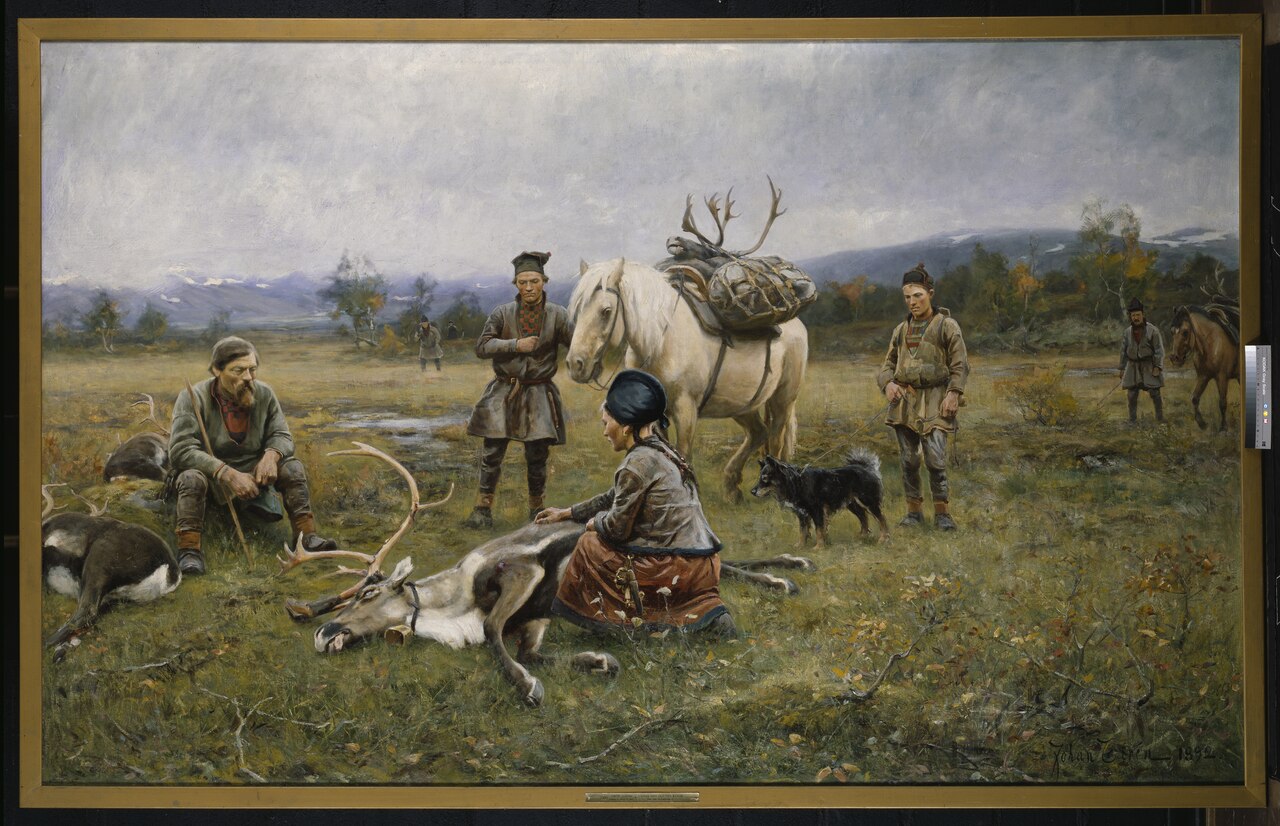
Major works Among Tirén’s most celebrated pieces is **Sami Collecting Reindeer which have Been Shot (1892)**, a poignant scene that captures the aftermath of a hunt. The composition balances the sorrow of the Sami herders with a meticulous study of the wounded reindeer, highlighting both the harshness of subsistence life and the respect the community holds for the animals. **Högsommardag på Njollengassi** depicts a bright summer day on a farm, with laborers engaged in threshing and children playing, the sunlight rendered in a warm, golden hue that conveys a sense of seasonal abundance. The **Portrait of the Artist’s Brother, Victor Tirén, 17 Years Old (1882)** showcases Tirén’s skill in portraiture; the young subject is rendered with a thoughtful gaze, the subtle shading of his cheekbones revealing the artist’s attention to character as well as appearance. Finally, **Helmsman on “Venus” (1882)** presents a maritime subject, unusual in Tirén’s oeuvre, yet executed with the same realism and compositional balance, the helmsman’s focused expression underscoring the universal themes of duty and perseverance.
Influence and legacy Johan Tirén’s commitment to portraying the realities of northern Swedish life earned him a respected place in the nation’s artistic heritage. Though he did not found a formal school, his works influenced a generation of regional painters who sought to document the cultural practices of the Sami and the agrarian communities. His paintings are frequently exhibited in Swedish museums, where they serve both as artistic achievements and as valuable historical records of a way of life that was rapidly changing at the turn of the twentieth century. Contemporary scholars cite Tirén as an early advocate for the visual preservation of minority cultures, and his legacy endures in the continued interest in Nordic genre painting.
In summary, Johan Tirén combined academic training with a genuine affection for the subjects of his native north, producing a body of work that remains a vital visual testimony to Sweden’s rural past.
Frequently asked questions
Who was Johan Tirén?
Johan Tirén (1853–1911) was a Swedish painter known for realistic depictions of rural life in northern Sweden.
What artistic style or movement is he associated with?
He is generally linked to the realist and naturalist traditions of the late 19th century, though he did not belong to a formal movement.
What are his most famous works?
Key works include *Sami Collecting Reindeer which have Been Shot* (1892), *Högsommardag på Njollengassi*, *Portrait of the Artist’s Brother, Victor Tirén, 17 Years Old* (1882), and *Helmsman on “Venus”* (1882).
Why does his art matter today?
His paintings provide a historically valuable visual record of northern Swedish culture and the Sami way of life, while exemplifying high‑quality realist technique.
How can I recognise a Johan Tirén painting?
Look for meticulous detail, a muted earth‑tone palette, realistic light effects, and subjects drawn from northern rural scenes, often featuring reindeer, farm labour or quiet domestic moments.