Björn Ahlgrensson
1872 – 1918
In short
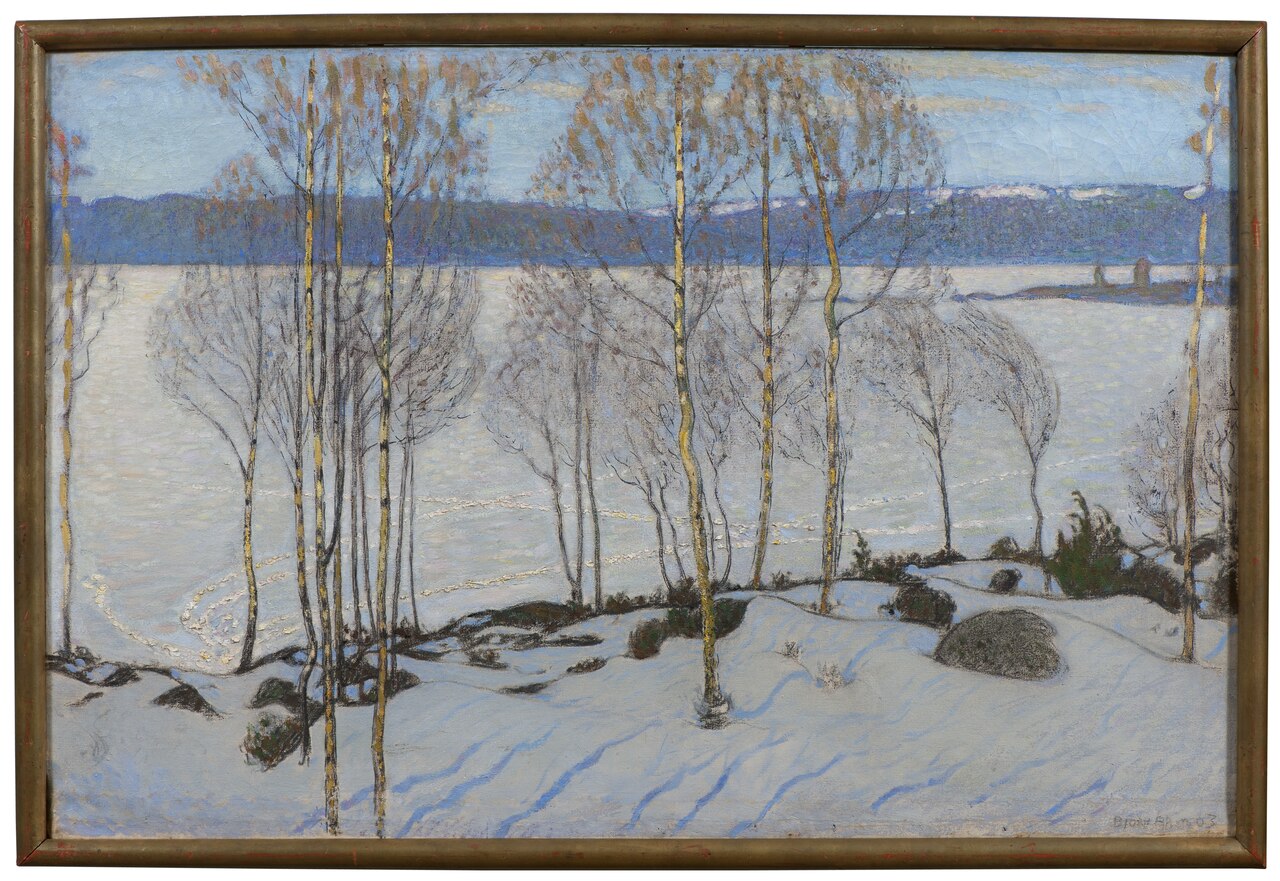
Björn Ahlgrensson (1872–1918) was a Swedish painter of the early twentieth century, born in a Finnish church parish and dying in Arvika Västra parish. Though his artistic movement is not clearly documented, he is remembered for works such as The Approach of Spring (1903), A Summer Night and Alkhöjden, which display a lyrical handling of light and landscape.
Notable works


Early life
Björn Ahlgrensson was born in 1872 in a Finnish church parish that, at the time, lay within the borders of Sweden. The region was characterised by a mixed Swedish‑Finnish cultural heritage, a fact that subtly informed his later sensibilities toward the natural world. Little is known about his family background, but parish records indicate that his parents were modest farmers who valued practical skills and a close relationship with the land. Ahlgrensson’s early education would have been provided by the local parish school, where basic literacy and arithmetic were taught alongside a strong emphasis on religious instruction.
From a young age, Ahlgrensson displayed an aptitude for drawing, often sketching the surrounding forests, lakes and winter skies. The rural environment offered a vivid palette of colours—muted browns and greys in winter, vibrant greens in summer—which later appeared in his canvases. By his teenage years, he had begun to experiment with charcoal and watercolor, a practice common among aspiring artists in provincial Sweden who lacked immediate access to formal art academies.
Career and style
In the early 1890s, Ahlgrensson moved to a larger town to pursue further artistic training. While precise details of his formal education are absent from the historical record, it is probable that he attended a regional art school or apprenticed with a local master painter, as was typical for artists of his generation. The Swedish art scene at the turn of the century was undergoing a transition from the Romantic nationalism of the 19th century toward a more naturalistic and, subsequently, modernist sensibility. Within this context, Ahlgrensson developed a style that blended realistic observation with a lyrical, almost poetic, interpretation of light.
His work does not align neatly with any single movement. Unlike the prominent Symbolist painters of the 1890s, Ahlgrensson rarely employed overt allegory; unlike the emerging Expressionists, he did not distort colour for emotional effect. Instead, his paintings sit comfortably within a tradition of Nordic landscape painting that emphasises atmospheric conditions and the subtle interplay of colour and shadow. Critics of his time noted his ability to capture the fleeting moments of sunrise and dusk, rendering them with a softness that suggests an inner calm.
Signature techniques
Ahlgrensson’s technique was marked by a restrained but expressive brushwork. He favoured thin layers of oil paint, allowing the canvas to breathe and the underlying tones to influence the final hue. This glazing method produced a luminous quality, particularly evident in the treatment of sky and water. He often employed a limited palette—earthy ochres, muted blues, and soft greens—building his compositions through incremental tonal shifts rather than bold contrasts.
Another hallmark of his practice was the careful rendering of atmospheric perspective. By subtly diminishing detail and colour intensity in background elements, Ahlgrensson created a convincing sense of depth that draws the viewer into the scene. His handling of light was equally meticulous; he would observe the same location at different times of day, noting the way sunlight altered the colour temperature of foliage and stone. These observations informed his studio work, where he would replicate the observed effects through delicate modulation of tone.
Major works
The Approach of Spring (1903) – This painting is perhaps Ahlgrensson’s most documented work. It depicts a sparsely treed meadow on the cusp of thaw, with emerging buds and a soft, diffused light that hints at the coming season. The composition balances foreground grasses with distant hills, employing his characteristic glazing technique to achieve a gentle glow. Art historians regard the piece as a quintessential example of his ability to convey seasonal transition without resorting to narrative embellishment.
A Summer Night – Though the exact date of this work is uncertain, it is believed to have been produced in the mid‑1910s. The canvas captures a nocturnal scene where moonlight reflects off a still lake, framed by silhouetted pine trees. The limited palette of deep blues and silvery whites underscores the quiet intimacy of the moment. Ahlgrensson’s subtle gradations of tone give the water a glassy surface, while the faint suggestion of stars above adds a delicate sense of vastness.
Alkhöjden – The title, translating loosely to “The Alpine Meadow,” suggests an imagined or perhaps travelled‑to landscape beyond his native Sweden. In this work, Ahlgrensson explores a more dramatic topography, featuring rugged peaks and a foreground of wildflowers. While retaining his soft brushwork, he introduces a slightly more vigorous handling of rock and sky, hinting at an awareness of contemporary European trends without abandoning his personal aesthetic. The painting demonstrates his capacity to adapt his technique to varied subject matter while maintaining a cohesive visual language.
These three works collectively illustrate Ahlgrensson’s preoccupation with light, atmosphere and the quiet dignity of natural settings. They also reveal a consistency of approach that underscores his artistic integrity across different locales and seasons.
Influence and legacy
Björn Ahlgrensson died relatively young in 1918, succumbing to an illness that swept through Sweden in the final years of World War I. His death coincided with a period of rapid change in European art, when avant‑garde movements such as Cubism and Futurism were reshaping artistic expectations. Consequently, Ahlgrensson’s oeuvre remained largely within the traditional sphere of landscape painting, a fact that contributed to his modest posthumous reputation.
Nevertheless, his paintings have endured in regional collections, particularly in the Västra parish of Arvika where he spent his final years. Local museums preserve his works as exemplars of early twentieth‑century Swedish art, and scholars of Nordic landscape painting cite him as a bridge between the Romantic naturalism of the 1800s and the more nuanced tonal explorations that followed. His meticulous treatment of light and atmosphere has been referenced by later Swedish artists seeking a contemplative approach to nature.
In recent decades, renewed interest in lesser‑known artists of the period has prompted modest exhibitions of Ahlgrensson’s work, often accompanied by scholarly essays that situate him within the broader Scandinavian tradition. While he may not have pioneered a distinct movement, his dedication to rendering the subtle beauties of the natural world continues to resonate with collectors and historians who value quiet, introspective art.
Overall, Björn Ahlgrensson occupies a niche yet respectable place in Swedish art history: a painter whose careful observation and gentle technique produced works of enduring lyrical quality, offering a window onto the landscapes of his time.
Influence and legacy
Björn Ahlgrensson’s legacy is most evident in the way his paintings preserve a specific visual record of early twentieth‑century Scandinavian environments. Though he never achieved wide international fame, his works are valued for their technical proficiency and their capacity to evoke mood through restraint. Contemporary Swedish artists who focus on atmospheric landscape painting often cite Ahlgrensson as an early exemplar of the subtle interplay between light and terrain. Moreover, his paintings continue to be displayed in regional galleries, where they serve educational purposes and inspire appreciation for the nuanced beauty of the Nordic countryside.
Frequently asked questions
Who was Björn Ahlgrensson?
Björn Ahlgrensson (1872–1918) was a Swedish painter known for his lyrical landscapes, born in a Finnish church parish and dying in Arvika Västra parish.
What artistic style or movement is he associated with?
His work does not belong to a specific movement; it reflects a personal, naturalistic style that blends realistic observation with a poetic handling of light.
What are his most famous works?
His most recognised paintings are The Approach of Spring (1903), A Summer Night, and Alkhöjden.
Why is Björn Ahlgrensson important in art history?
He is important for preserving the atmospheric qualities of early‑20th‑century Scandinavian landscapes and influencing later Swedish artists who value subtle light effects.
How can I recognise a painting by Ahlgrensson?
Look for gentle glazing, a limited earthy palette, soft brushwork, and a focus on the nuanced interplay of light and atmosphere in natural scenes.
More Sweden artists
References: Wikidata