Anna Palm de Rosa
1859 – 1924
In short
Anna Palm de Rosa (1859–1924) was a Swedish painter renowned for her watercolours of Stockholm’s waterfront, steamships and maritime scenes, as well as genre scenes such as the card game at Brøndum’s Hotel, before settling in Italy where she spent the remainder of her life.
Notable works
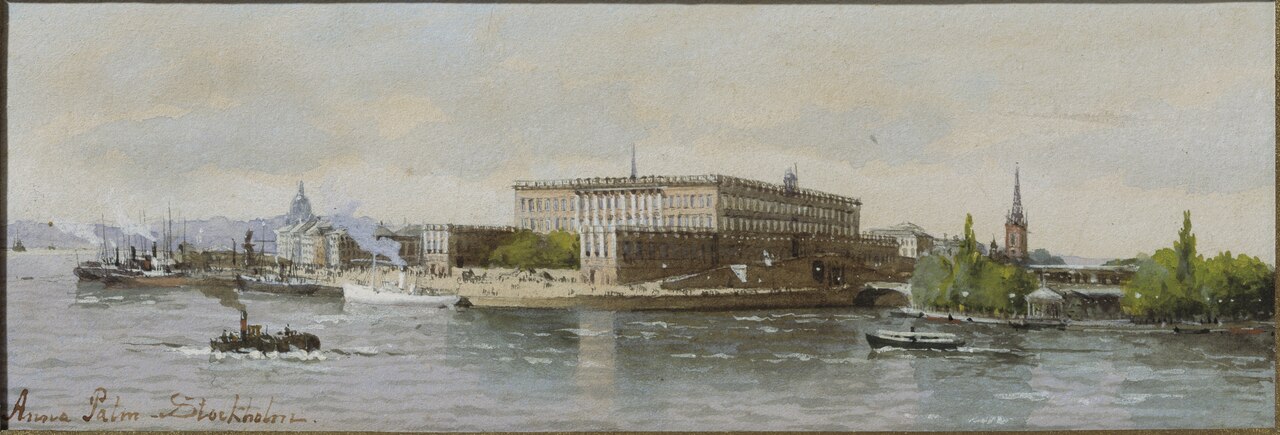


Early life Anna Sofia Palm de Rosa was born in Stockholm in 1859 into a family that valued education and the arts. Growing up in the Swedish capital, she was exposed to the bustling harbour, the royal palace and the surrounding archipelago, landscapes that would later dominate her work. She received her first drawing lessons at a local art school and quickly showed an aptitude for capturing light and atmosphere. While details of her formal training are sparse, records indicate that she attended the Royal Swedish Academy of Fine Arts, where she honed her technique in drawing and watercolour, the medium that would become her signature.
Career and style By the 1880s Palm de Rosa was exhibiting regularly in Stockholm’s art societies. Her early works focused on urban and maritime subjects, reflecting the rapid industrialisation of Sweden’s capital. The 1890s marked the peak of her popularity; her delicate watercolours of steamers, sailing ships and the Stockholm waterfront resonated with a public eager for visual records of modern life. Critics praised her ability to convey the movement of water and the glint of sunlight on hulls, while maintaining a lyrical softness that distinguished her from more realist contemporaries.
A pivotal moment came in 1885 when Palm de Rosa spent a summer in Skagen, Denmark, among the Skagen Painters—a loose group of artists attracted by the unique northern light. There she painted *A game of L'hombre in Brøndum's Hotel*, a genre scene that captured the convivial atmosphere of the artists’ colony. The painting’s composition, with its warm interior lighting and informal arrangement of figures, demonstrates her capacity to blend portraiture, genre and landscape.
In 1895, at the age of thirty‑six, she left Sweden permanently. She married an Italian infantry officer and settled in the Campania region, eventually dying in Madonna dell’Arco in 1924. Although she continued to paint in Italy, the majority of her surviving oeuvre remains rooted in the Swedish subjects that made her famous.
Signature techniques Palm de Rosa’s work is characterised by a restrained palette, often dominated by muted blues, greys and earth tones. She favoured transparent watercolour washes to suggest depth, layering thin glazes to build atmospheric effects. Her handling of water and sky displays a keen observation of meteorological changes; she could render the hazy glow of a sunrise over the Baltic or the crisp reflections of a calm harbour with equal skill.
Another hallmark is her compositional balance. In maritime scenes she frequently placed the vessel off‑centre, allowing the surrounding water and sky to dominate the picture plane. This approach creates a sense of openness and invites the viewer to imagine the ship’s journey beyond the frame. In interior genre works, such as the Brøndum painting, she employed a more intimate framing, using the placement of furniture and the play of light to guide the eye toward the central activity.
Major works - **View of the Royal Palace, Stockholm** – This watercolour captures the iconic façade of the Royal Palace reflected in the waters of the surrounding harbour. Palm de Rosa’s delicate line work and subtle tonal shifts convey both the grandeur of the building and the fleeting quality of light on the water’s surface. - **A game of L'hombre in Brøndum's Hotel (1885)** – A genre scene depicting a group of artists engaged in a card game within the famous Brøndum Hotel in Skagen. The work is noted for its warm interior lighting, the relaxed posture of the figures, and the subtle suggestion of the hotel’s wooden interiors, providing a snapshot of the social life of the Skagen colony. - **Speeding ticket, Bois de Boulogne** – Though less documented than her Swedish pieces, this work shows a bustling Parisian park where a motorised carriage is halted by a police officer. The composition reflects Palm de Rosa’s interest in modernity, juxtaposing the natural setting of the Bois de Boulogne with the new technology of motorised transport.
These pieces illustrate the breadth of her subject matter—from regal architecture to everyday leisure—and demonstrate her consistent use of watercolour to render atmosphere.
Influence and legacy During her lifetime, Anna Palm de Rosa was one of Sweden’s most commercially successful painters. Her prints and reproductions were widely circulated, making her watercolours familiar to a broad audience. While she did not align herself with a specific avant‑garde movement, her work contributed to the popular visual culture of late‑19th‑century Sweden, documenting the nation’s transition from a maritime trading hub to a modern industrial society.
Her legacy endures in several ways. First, her paintings serve as valuable historical records of Stockholm’s harbour and the everyday life of its citizens. Second, she paved the way for later Swedish women artists by demonstrating that a successful career was possible even within the constraints of a male‑dominated art world. Finally, her cross‑cultural experience—spending time with the Skagen Painters and later living in Italy—offers a model of artistic mobility that prefigures the more internationally connected practices of the 20th century.
Today, museums in Sweden, Denmark and Italy hold examples of her work, and her paintings continue to appear in exhibitions focused on women artists of the 19th century, maritime art, and the cultural exchanges of the European art world.
Frequently asked questions
Who was Anna Palm de Rosa?
Anna Palm de Rosa (1859–1924) was a Swedish painter known for her watercolours of Stockholm’s waterfront, steamships, and genre scenes such as the card game at Brøndum’s Hotel.
What artistic style or movement is she associated with?
She did not belong to a formal movement; her work is characterised by lyrical watercolour realism that captures light, atmosphere and everyday modern life.
What are her most famous works?
Her best‑known paintings include *View of the Royal Palace, Stockholm*, *A game of L'hombre in Brøndum's Hotel* (1885) and *Speeding ticket, Bois de Boulogne*.
Why is she important in art history?
She documented Sweden’s maritime and urban transformation in the late 19th century, achieved commercial success as a woman artist, and influenced later generations by showing that watercolour could convey both atmosphere and narrative.
How can I recognise an Anna Palm de Rosa painting?
Look for delicate, transparent watercolour washes, muted blues and greys, balanced compositions with off‑centre vessels or intimate interior lighting, and a focus on atmospheric effects rather than precise detail.