Albert Engström
1869 – 1940
In short
Albert Engström (1869–1940) was a Swedish illustrator, author and humourist, renowned for his satirical drawings of everyday life and a member of the Swedish Academy from 1922.
Notable works

,_financier,_banker,_donor,_married_to_1._Anna_Elisabeth_Ahlberg,_2._Siri_Kugelman_-_NMGrh_3198_-_Nationalmuseum.jpg)
,_fil.dr_h.c.,_geolog,_industriman_-_NMGrh_3610_-_Nationalmuseum.jpg)

Early life Albert Engström was born on 22 March 1869 in the rural parish of Korpåsen, Kalmar County, Sweden. He grew up in a modest farming family, an environment that would later inform his keen eye for provincial customs and characters. After completing his basic education, Engström moved to Stockholm to pursue artistic training, enrolling briefly at the Royal Swedish Academy of Fine Arts. Though his formal studies were short‑lived, they provided him with a solid grounding in drawing techniques and exposed him to the vibrant cultural life of the capital.
Career and style Engström’s career unfolded at the intersection of illustration, journalism, and literature. In the early 1890s he began contributing cartoons and sketches to the popular weekly *Söndags Nisse* and later to the influential newspaper *Strix*. His work quickly gained a reputation for its wry humour, incisive social commentary, and a distinctive blend of realism and caricature. Engström preferred to depict ordinary people—farmers, shopkeepers, street children—capturing their gestures, speech, and surroundings with a sympathetic yet critical eye.
While Engström is not formally associated with a single avant‑garde movement, his output reflects the broader trends of naturalism and the Swedish “national romantic” turn that celebrated local colour and folk traditions. He combined a realist approach to anatomy with exaggerated line work to highlight personality traits, a technique that placed him alongside contemporaries such as Anders Zorn and Carl Larsson in the realm of Swedish visual culture, yet his emphasis on satire set him apart.
Beyond visual art, Engström was a prolific writer. He published collections of short stories, essays, and travelogues, often illustrated with his own drawings. His literary style mirrored his visual one: concise, observational, and laced with gentle mockery. In 1922 he was elected to the Swedish Academy, an honour that recognised his contributions to Swedish letters and visual humour.
Signature techniques Engström’s signature techniques revolve around line, composition, and narrative economy:
* Economical line work – He employed clean, fluid strokes to outline figures, allowing the contour of a face or the tilt of a hat to convey character without heavy shading. * Narrative framing – Many of his drawings are set within a small, self‑contained scene that tells a complete story, often enhanced by a caption or speech balloon. * Humorous exaggeration – While maintaining realistic proportions, he would exaggerate features such as a protruding nose or a sagging posture to underscore a subject’s quirks. * Use of everyday objects – Objects like newspapers, tools, or kitchenware are rendered with meticulous detail, grounding the humour in recognisable reality. * Monochrome palette – Engström frequently worked in black‑and‑white ink, which heightened contrast and made his prints easily reproducible for newspapers and books.
These techniques combined to give his work an immediacy that resonated with a broad readership, from urban intellectuals to rural audiences.
Major works Engström’s oeuvre includes several pieces that have become emblematic of his style:
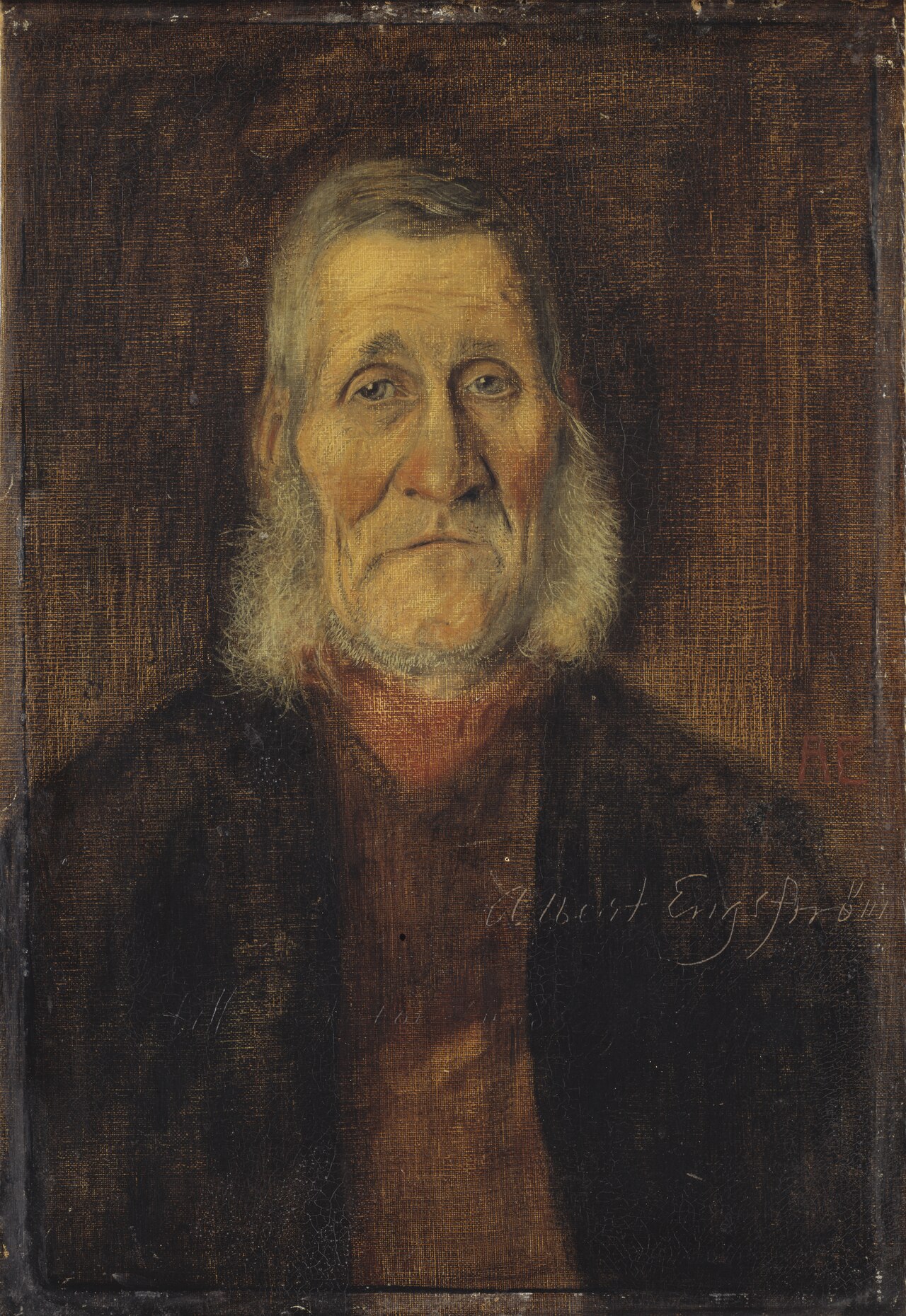
* Kalle‑i‑Sandbäcken, a Småland Personality – This illustration portrays a rustic figure from the Småland region, rendered with affectionate detail. The subject’s weather‑worn clothing and sturdy stance embody the resilience of Swedish country folk.
* The Artist’s Father, Reading a Newspaper (1892) – A humorous domestic scene where an elderly man, engrossed in a newspaper, is juxtaposed with the artist’s studio tools. The work highlights generational contrasts and the everyday absurdities of family life.
* Backyards at Kungsholmen, Stockholm 1893 – A city‑scape that captures the modest backyards of Stockholm’s Kungsholmen district. Engström’s attention to the cluttered gardens, laundry lines, and small animal companions provides a snapshot of urban domesticity at the turn of the century.
* Portrait of Olof Aschberg (early 20th c.) – Engström rendered the financier Olof Aschberg with a subtle blend of realism and caricature, emphasizing the subject’s sharp features while hinting at his business acumen through visual motifs such as ledger books.
* Portrait of Hjalmar Lundbohm (1922) – This later work presents the geologist and industrialist Lundbohm in a dignified pose, the composition reflecting both respect for his scientific contributions and Engström’s characteristic light‑heartedness.
These works illustrate Engström’s capacity to move fluidly between satire and sincere portraiture, always anchored in a keen observation of Swedish society.
Influence and legacy Albert Engström’s impact on Swedish visual culture is multifaceted. As a pioneer of satirical illustration, he set a precedent for later cartoonists and graphic humorists, influencing publications such as *Gubben* and *Puck*. His integration of text and image prefigured modern comic‑strip storytelling, and his emphasis on everyday subjects helped democratise art, making it accessible to a wide public.
Within the literary sphere, Engström’s collections of short stories and travel sketches contributed to the development of a distinctly Swedish narrative voice that celebrated regional dialects and customs. His election to the Swedish Academy cemented his status as a cultural figure whose work bridged the visual and literary arts.
In contemporary Sweden, museums such as the Nationalmuseum in Stockholm and the Albert Engström Museum in Småland preserve his drawings, prints, and personal papers. Scholars continue to study his work for insights into early 20th‑century Swedish social history, and his illustrations remain popular in reproductions, postcards, and educational materials.
Overall, Engström’s legacy endures as a testament to the power of humour, observation, and the line‑drawn figure to capture the spirit of a nation.
---
Frequently asked questions
Who was Albert Engström?
Albert Engström (1869–1940) was a Swedish illustrator, author and humourist, celebrated for his satirical drawings of everyday life and a member of the Swedish Academy from 1922.
What artistic style or movement is he associated with?
Engström is not tied to a single formal movement; his work blends naturalist observation with caricature, reflecting a uniquely Swedish satirical illustration style.
What are his most famous works?
Key works include *Kalle‑i‑Sandbäcken*, *The Artist’s Father, Reading a Newspaper* (1892), *Backyards at Kungsholmen* (1893), and portrait studies of Olof Aschberg and Hjalmar Lundbohm.
Why does Albert Engström matter in art history?
He pioneered modern Swedish cartooning, bridged visual and literary arts, and his socially observant humor helped shape the nation’s cultural identity.
How can I recognise an Albert Engström drawing?
Look for clean, fluid line work, modest black‑and‑white palettes, everyday subjects rendered with gentle exaggeration, and often a caption or speech bubble that completes a witty narrative.