Ma Yuan
1160 – 1225
In short
Ma Yuan (c.1160–1225) was a leading Chinese painter of the Southern Song dynasty, celebrated for his lyrical landscape paintings and co‑founder of the Ma‑Xia school. His work, characterised by elegant compositions and subtle brushwork, influenced later Chinese and Japanese artists.
Notable works


Early life Ma Yuan was born around 1160 in Hangzhou, a cultural hub of the Southern Song empire. Little is recorded about his family background or formal education, but the city's vibrant artistic community would have provided ample exposure to the prevailing courtly and literati painting traditions. Growing up in a period marked by relative political stability, Ma Yuan likely received instruction in calligraphy and painting as part of a broader Confucian education, a common pathway for aspiring scholars‑artists of the time.
Career and style By his twenties, Ma Yuan had entered the service of the imperial court, where he quickly distinguished himself among the elite painters of the Southern Song capital, Lin’an (modern Hangzhou). His career coincided with the reign of Emperor Guangzong and the later years of Emperor Ningzong, during which the court encouraged a return to naturalistic yet poetic depictions of landscape. Ma Yuan’s style is often described as *xieyi* (寫意, “freehand”) – a synthesis of precise observation and expressive brushwork. He favoured asymmetrical compositions, frequently leaving large portions of the picture empty to suggest mist or distance, a technique that created a sense of atmospheric depth. The artist’s palette tended toward subdued ink washes punctuated by occasional touches of colour, reinforcing the contemplative mood of his scenes.
Signature techniques Several technical hallmarks identify a Ma Yuan painting. First, the "one‑corner" composition, in which the main focal point is confined to a corner or side of the picture plane, leaving the rest of the surface open to suggest vastness. Second, the use of delicate, swift brushstrokes to render foliage, rocks and water, often employing a dry‑brush technique that produces textured, almost calligraphic lines. Third, Ma Yuan employed the "wet‑dry" contrast: bold, wet ink washes for atmospheric background elements juxtaposed with dry, crisp strokes for foreground details such as trees or figures. Finally, his works often contain subtle poetic inscriptions, integrating calligraphy and painting in a seamless whole.
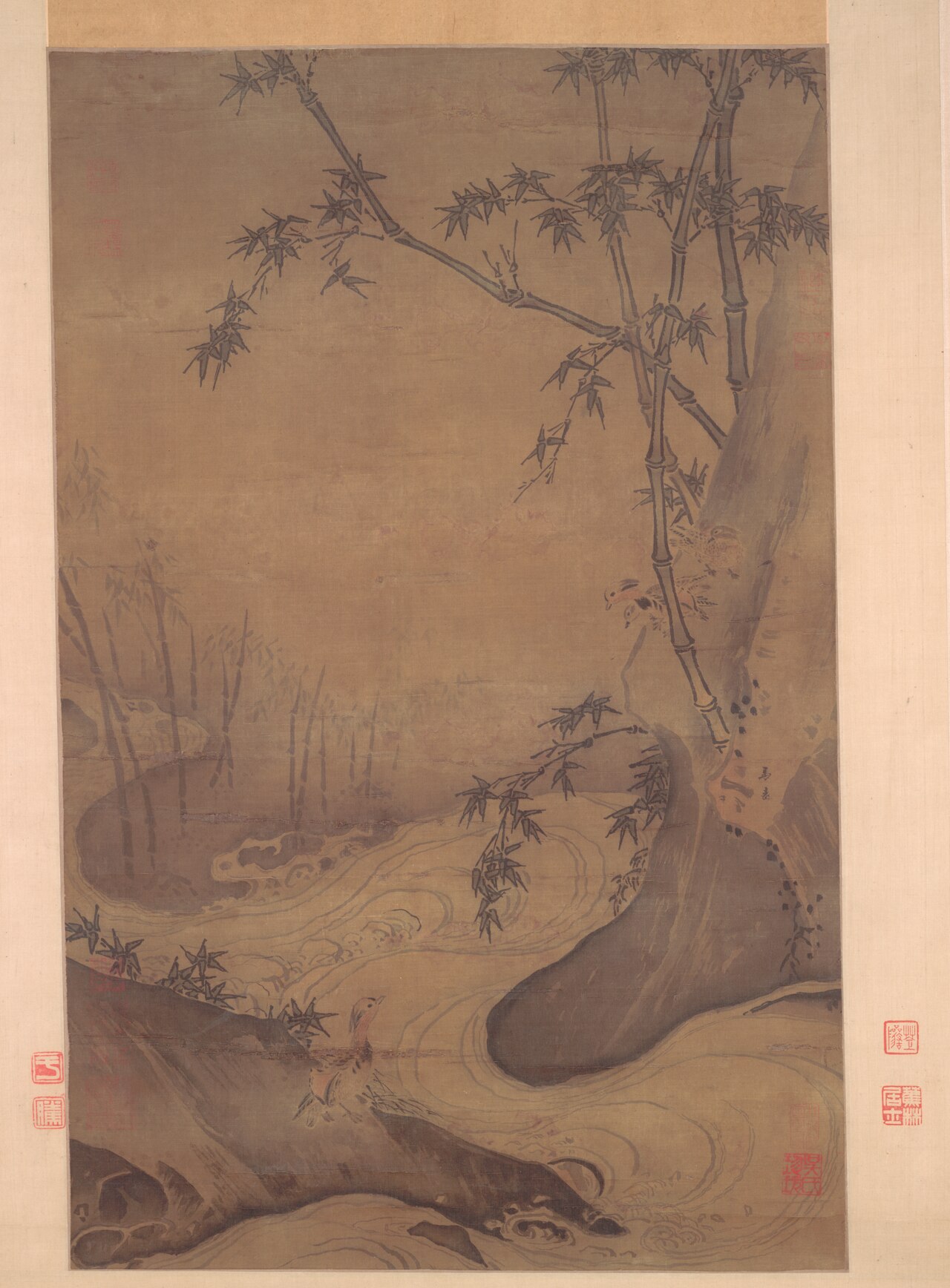
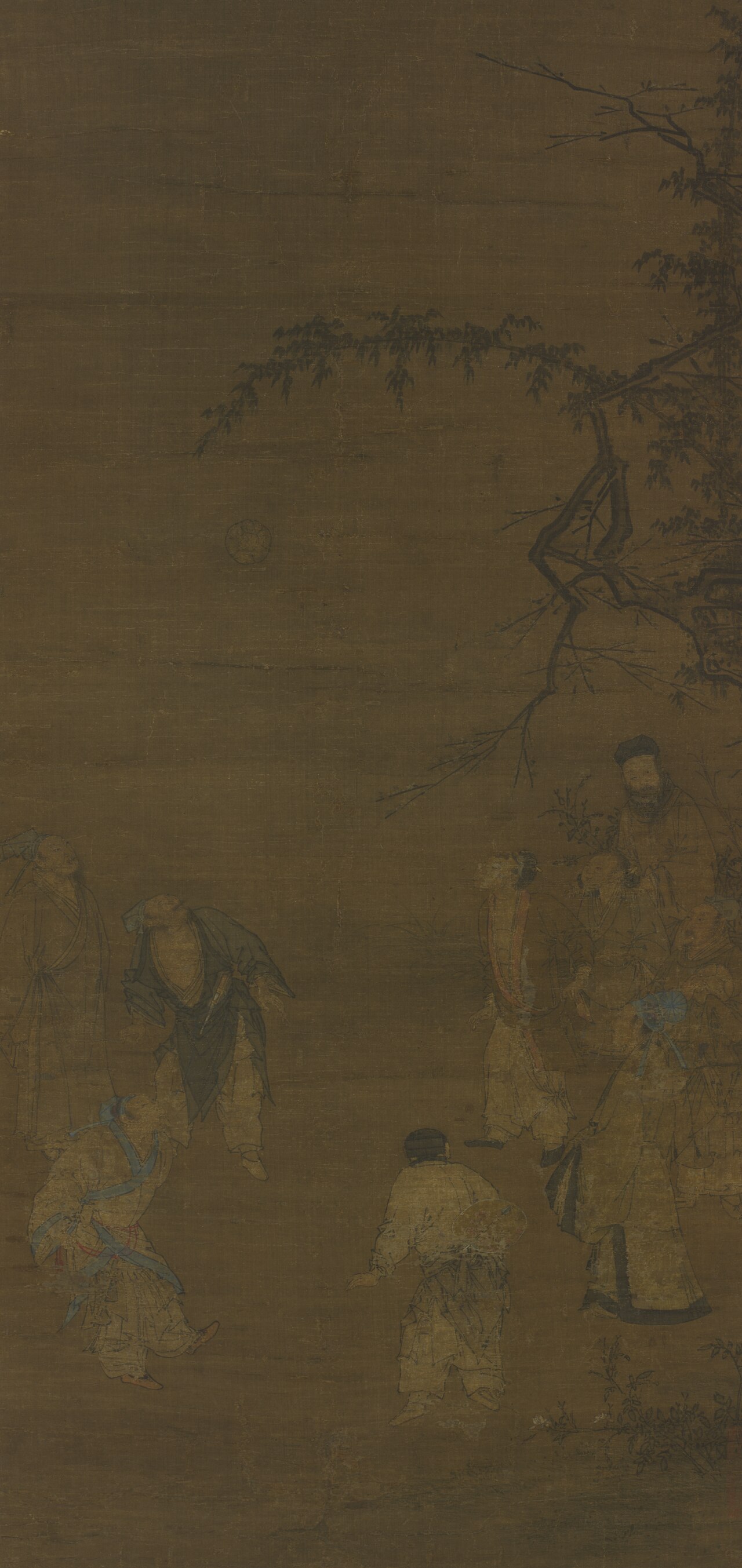
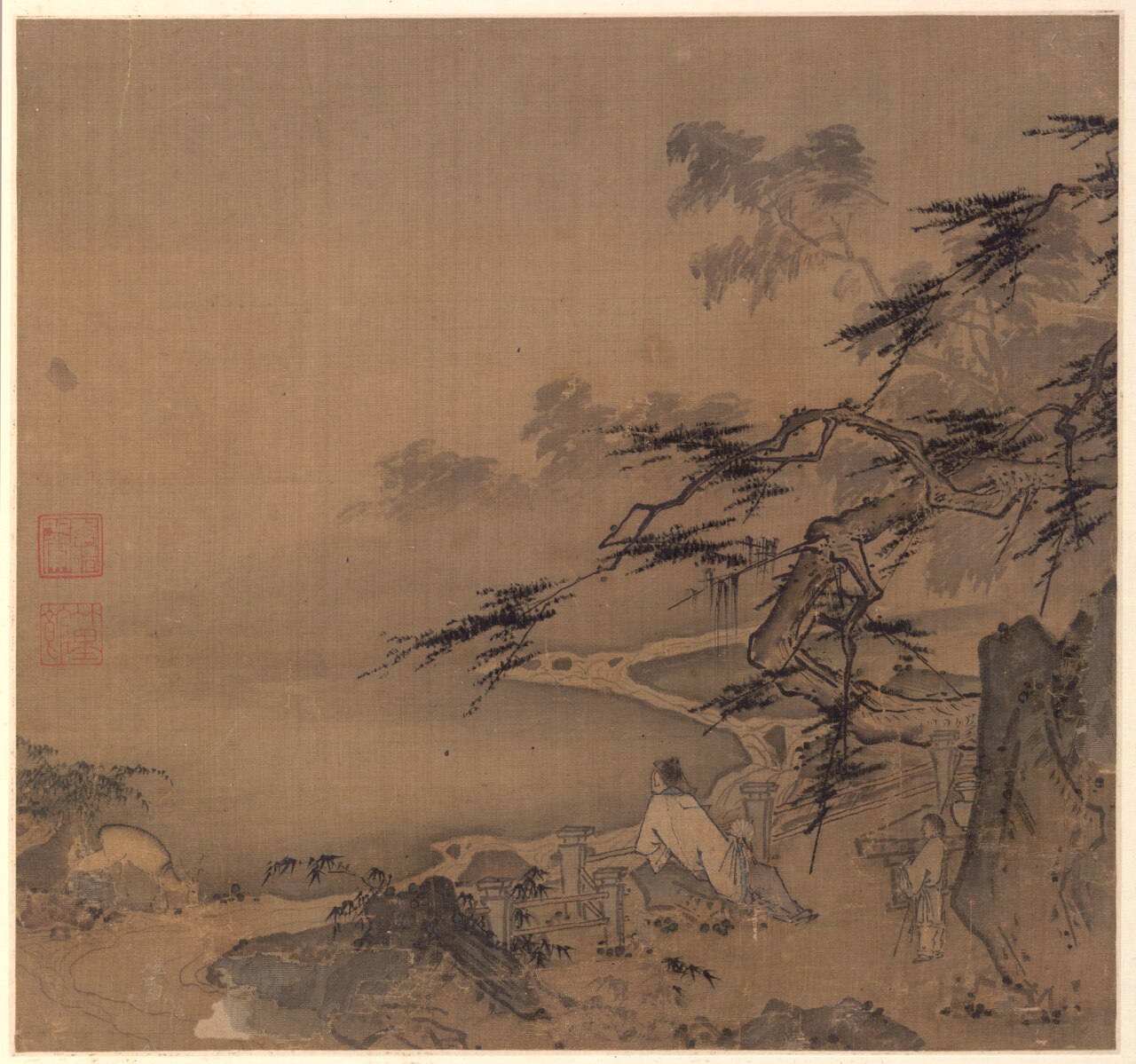
Major works Ma Yuan’s surviving oeuvre includes several dated pieces that illustrate his mature style. **Walking on a Mountain Path in Spring (1190)** depicts a solitary traveller traversing a winding path framed by mist‑cloaked peaks, exemplifying the one‑corner layout and his skillful rendering of vegetation with fine, upward‑curving strokes. **Landscape in Wind and Rain** captures the dramatic interplay of elemental forces, using vigorous ink washes to convey storm‑laden clouds while small, precise brushwork defines the sheltering rocks and trees. **Bamboo and Ducks by a Rushing Stream (1203)** showcases his ability to combine lively fauna with tranquil flora; the ducks are rendered with quick, expressive lines that contrast with the disciplined bamboo shafts. **The Football Players (1207)** is a rare secular genre scene, portraying a group of men engaged in a ball game, rendered with the same atmospheric sensitivity as his landscapes, thereby extending his aesthetic beyond pure nature studies. **Watching the Deer by a Pine Shaded Stream (1203)** demonstrates his mastery of light and shade, with pine needles suggested by fine, dotted strokes and the deer's form hinted at through subtle ink gradations, inviting the viewer into a quiet, contemplative moment.
Influence and legacy Together with his contemporary Xia Gui, Ma Yuan defined the Ma‑Xia school, a dominant force in Southern Song painting that emphasised economical composition, lyrical brushwork and an emphasis on mood over detailed realism. The school’s principles were later adopted by the Zhe school of the Ming dynasty, whose artists expanded upon Ma Yuan’s compositional strategies while retaining his atmospheric sensibility. Beyond China, Ma Yuan’s influence reached Japan, where early Muromachi painters such as Sesshū Tōyō and Shūbun drew upon his techniques to develop the *haboku* (splashed‑ink) style that became central to Japanese ink painting. Today, Ma Yuan is regarded as a master of the Southern Song aesthetic, and his works are prized both for their historical significance and their enduring visual poetry.
---
References (selected): - Cahill, James. *The Painter's Brush in Song China* (1990). - Sullivan, Michael. *The Arts of China* (2008). - Clunas, Craig. *Art in China* (1997).
Frequently asked questions
Who was Ma Yuan?
Ma Yuan (c.1160–1225) was a pre‑eminent Chinese painter of the Southern Song dynasty, known for his lyrical landscapes and co‑founder of the influential Ma‑Xia school.
What style or movement is Ma Yuan associated with?
He is linked to the Ma‑Xia school, a branch of Southern Song painting that favoured asymmetrical compositions, subtle ink washes and expressive brushwork.
What are Ma Yuan’s most famous works?
Key works include *Walking on a Mountain Path in Spring* (1190), *Bamboo and Ducks by a Rushing Stream* (1203), *Watching the Deer by a Pine Shaded Stream* (1203), *Landscape in Wind and Rain*, and the genre scene *The Football Players* (1207).
Why is Ma Yuan important in art history?
His innovative compositions and brush techniques shaped the Southern Song aesthetic, inspired later Chinese schools such as the Zhe school, and influenced early Japanese painters like Sesshū, securing his place as a foundational figure in East Asian art.
How can I recognise a painting by Ma Yuan?
Look for a one‑corner composition, a balance of wet atmospheric washes with dry, crisp strokes, subtle use of empty space to suggest mist, and a poetic, often monochrome palette punctuated by restrained colour.