Cui Bai
1000 – 1074
In short
Cui Bai (1000–1074) was a Chinese painter of the Northern Song dynasty, renowned for his vivid depictions of birds, animals and plants. He served as a court artist under Emperor Shenzong in Kaifeng, earning high praise for his skill while gaining a reputation for eccentric behaviour.
Notable works


Early life Cui Bai was born in 1000 in Fengyang County, a region that today forms part of Anhui Province. Little is recorded about his family background, but the area was known for its scholarly traditions and a flourishing local culture of brush painting. Growing up in the fertile countryside, Cui was exposed to a rich variety of flora and fauna, experiences that later informed his artistic focus on natural subjects. By his teenage years he had begun studying under local painters, mastering the fundamentals of ink work and colour application that were standard in Song‑era artistic training.
Career and style Around the middle of the 11th century Cui travelled to the Song capital, Kaifeng, seeking a position at the imperial court. His talent attracted the attention of Emperor Shenzong (reigned 1067–1085), who appointed him as a court painter. In the imperial workshops Cui was expected to produce works that combined technical precision with the moral and aesthetic ideals of the dynasty. His style is characterised by a naturalistic observation of subjects, a clear compositional balance, and a restrained yet expressive use of colour. While the Song period did not organise artists into formal movements as later Western art did, Cui’s work aligns with the broader Northern Song emphasis on realism and scholarly refinement.
Signature techniques Cui Bai’s paintings are distinguished by several recurring technical traits. He employed a fine, calligraphic brushstroke for outlines, often using a "bone‑like" line (gǔxiàn) that conveyed both structure and vitality. Within the outlines he layered washes of ink and subtle pigments, achieving a sense of depth without heavy shading. A hallmark of his technique was the strategic use of negative space; empty areas of paper were left to suggest atmosphere or to highlight the forms of birds and plants. He also favoured a light, translucent colour palette derived from mineral pigments, allowing the underlying ink to remain visible and to lend a sense of immediacy to the scene. These methods together created works that appear both meticulously observed and poetically rendered.
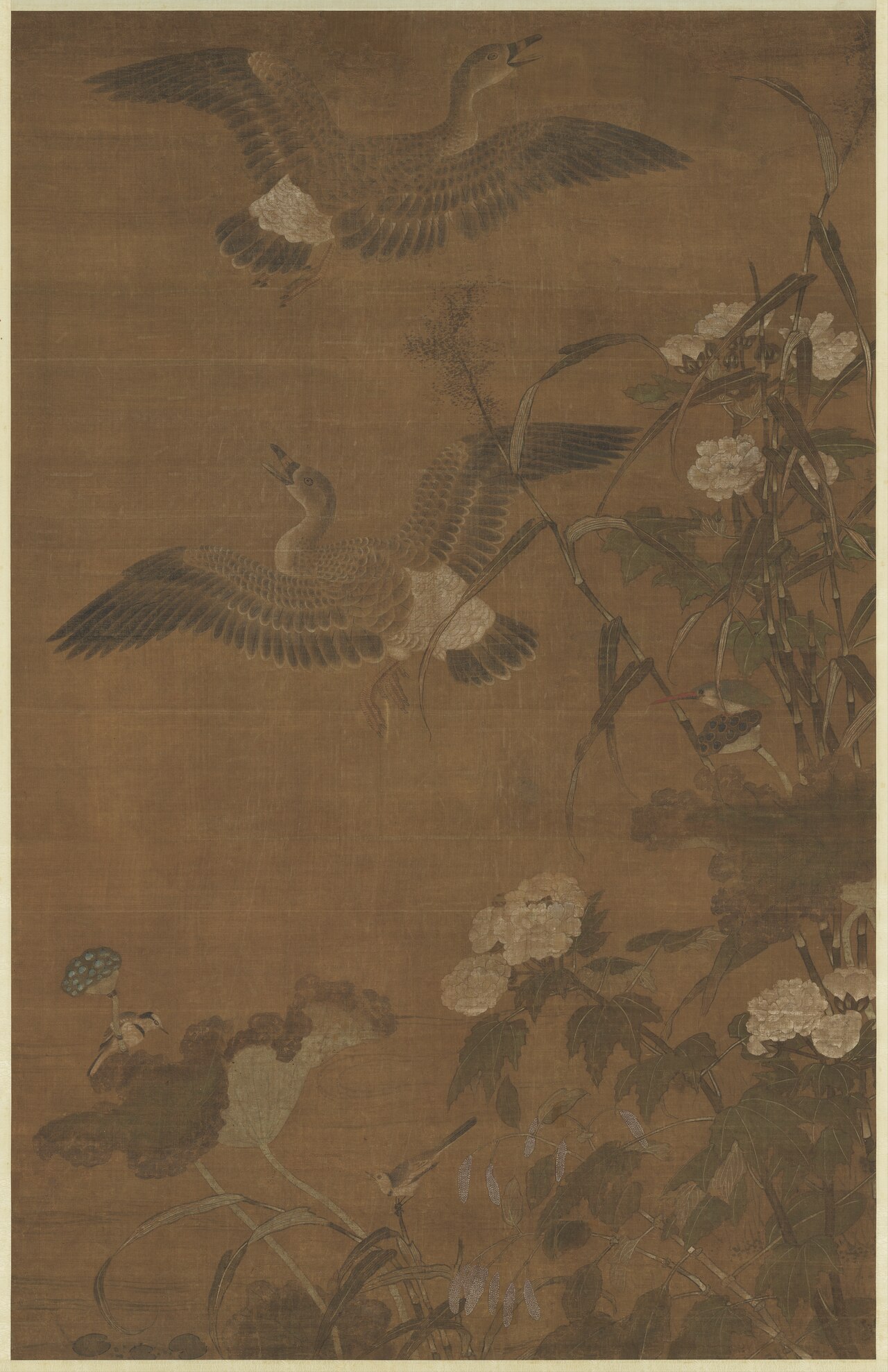
Major works Cui Bai’s extant oeuvre includes several celebrated pieces that exemplify his mastery of animal and botanical subjects. **Magpies and Hare (1061)** portrays a lively interaction between two magpies perched on a branch and a solitary hare below. The composition balances vertical and horizontal elements, while the delicate feather work and the hare’s fur demonstrate Cui’s attentiveness to texture. **Peacocks and a Loquat Tree (1050)** is a vibrant tableau in which the iridescent plumage of the peacocks contrasts with the soft green leaves of the loquat tree, showcasing his skill in rendering colour gradients. **Reeds and Goose (1050)** captures a solitary goose among tall reeds, using restrained brushwork to convey the reeds’ slender elegance and the goose’s poised stance. Finally, **Hibiscus on an Autumn Bank and Geese**—though undated—illustrates a tranquil riverside scene where blooming hibiscus flowers frame a group of geese, highlighting Cui’s ability to integrate flora and fauna within a harmonious landscape. Each of these works reflects his commitment to realistic detail while maintaining an elegant compositional rhythm.
Influence and legacy Cui Bai’s contributions helped to codify the genre of animal painting in Chinese art history. By combining meticulous observation with a refined brush technique, he set a precedent that later scholars and court painters would emulate. His emphasis on the moral symbolism of animals—such as the magpie representing good omen—reinforced the Confucian belief that painting could convey ethical messages. Although his eccentric personal reputation—recorded in contemporary anecdotes of unconventional behaviour—did not diminish his artistic standing, it added a colourful dimension to his legacy, reminding later generations of the delicate balance between talent and temperament in the imperial atelier. Today, Cui Bai is recognised as a pivotal figure in the Northern Song tradition, and his surviving works continue to be studied for their technical brilliance and their insight into the natural world of 11th‑century China.
Frequently asked questions
Who was Cui Bai?
Cui Bai (1000–1074) was a Chinese painter of the Northern Song dynasty, best known for his realistic depictions of birds, animals and plants and for serving as a court artist under Emperor Shenzong.
What artistic style or movement is Cui Bai associated with?
Cui Bai did not belong to a formal movement; his work reflects the Northern Song emphasis on naturalistic observation, scholarly refinement and a balanced, restrained use of colour.
What are Cui Bai’s most famous works?
His most celebrated pieces include *Magpies and Hare* (1061), *Peacocks and a Loquat Tree* (1050), *Reeds and Goose* (1050) and *Hibiscus on an Autumn Bank and Geese*.
Why is Cui Bai important in art history?
He helped establish the conventions of Chinese animal painting, combining precise observation with elegant brushwork, and his court paintings influenced later generations of scholars and artists.
How can I recognise a painting by Cui Bai?
Look for fine, calligraphic outlines, subtle ink‑wash washes, a light mineral colour palette, careful rendering of animal textures, and generous use of empty space to suggest atmosphere.