Guo Xi
1020 – 1085
In short
Guo Xi (1020–1085) was a leading Chinese landscape painter of the Northern Song dynasty, renowned for his sophisticated brushwork and innovative multiple‑perspective techniques. Serving as a court artist in Kaifeng, he authored the treatise “The Lofty Message of Forest and Streams” and produced celebrated works such as Early Spring (1072).
Notable works
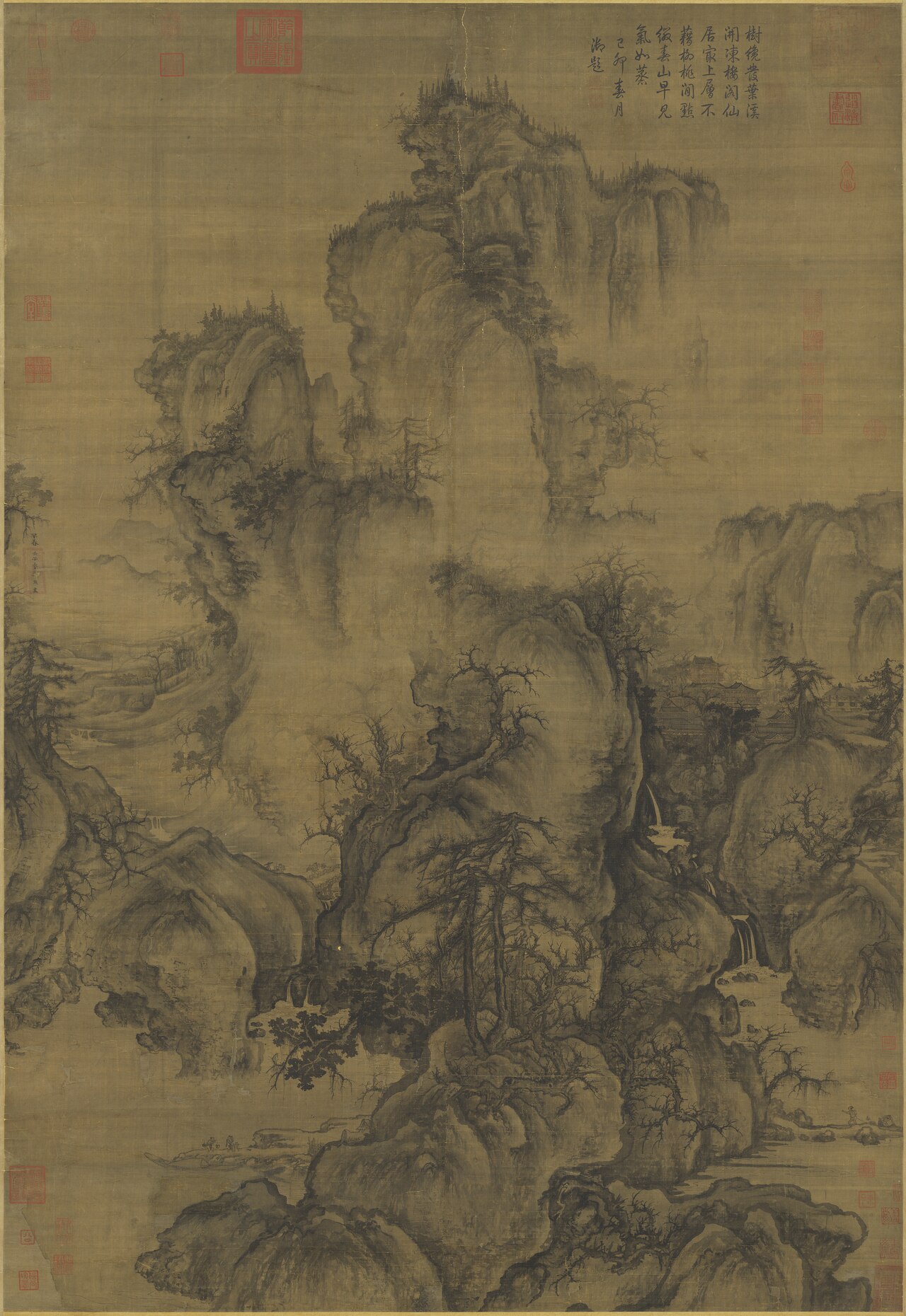


Early life Guo Xi was born in 1020 in Wen County, a district of modern‑day Henan Province, during the Northern Song dynasty. He grew up in a cultured environment that valued literary and artistic pursuits, and he received a classical education that prepared him for a career as a scholar‑official. The intellectual climate of his hometown, noted for its scholarly families, fostered his early interest in painting and calligraphy, laying the foundation for his later role as a court painter.
Career and style Around the middle of the 11th century Guo Xi entered the imperial bureaucracy and was appointed a professional painter at the Song court in Kaifeng, the dynastic capital. In this position he was responsible for producing large‑scale landscape scrolls for imperial spaces and ceremonial occasions. His style reflects the prevailing Song aesthetic that prized naturalism, subtlety, and the harmonious integration of man and nature. Guo Xi’s landscapes are characterised by a delicate balance between fine detail and atmospheric depth, employing layered mountains, mist‑filled valleys, and carefully rendered foliage to evoke a sense of timeless serenity. He pursued an intellectual approach to painting, treating the medium as a vehicle for philosophical reflection on the natural world.
Signature techniques Guo Xi is best known for formalising the concept of the “angle of totality”, a method of presenting a scene from several visual points at once. This “floating perspective” displaces the static eye of the viewer, allowing the composition to be experienced as a series of shifting viewpoints rather than a single, fixed scene. The technique produces a dynamic sense of depth, where foreground, middle ground and background interlace through overlapping planes of rock and water. In his treatise *The Lofty Message of Forest and Streams*, Guo Xi codified a system of idiomatic brushstrokes – from the fine, hair‑like lines used for distant pine needles to the bold, sweeping strokes that render massive cliffs. These brushwork conventions became a reference for later generations of Chinese landscape painters.
Major works - **Early Spring (1072)** – This hand‑scroll is Guo Xi’s most celebrated piece. Executed in ink on silk, it depicts a mountainous valley at the cusp of spring, with mist curling around towering peaks and a scattering of saplings emerging from the earth. The work exemplifies his “angle of totality”, as the viewer can trace the scene from the foreground riverbank up through the mist‑shrouded ridges. - **Old Trees, Level Distance (1080)** – In this later scroll Guo Xi portrays ancient trees standing on a level plain, their gnarled trunks anchored against a distant horizon. The composition emphasises spatial equilibrium, using subtle gradations of ink to convey atmospheric perspective and the passage of time. - **Viewing a Stele** – Though the exact date is unknown, this painting shows a scholar seated before a stone stele amid a rugged landscape. The work highlights the interaction between human culture and the natural environment, a recurring theme in Guo Xi’s oeuvre. - **Mountain Hermitage** – This piece illustrates a secluded hermitage clinging to a cliff face, surrounded by towering peaks and cascading waterfalls. The painting’s use of layered brushwork creates a sense of depth that draws the eye upward, reinforcing the hermitage’s isolation. - **A Wintry Forest** – In this composition Guo Xi renders a forest blanketed in snow, employing muted ink washes to suggest cold and stillness. The subtle variation of tone captures the quiet intensity of winter, while the composition maintains the multiple‑viewpoint approach that characterises his style.
Influence and legacy Guo Xi’s theoretical writings and technical innovations exerted a lasting influence on Chinese landscape painting. His treatise provided a systematic vocabulary for brushwork that later masters such as Xia Gui and Ma Yuan adapted and expanded. The “floating perspective” he championed offered a distinct alternative to the linear perspective dominant in Western art, reinforcing the unique visual language of East Asian painting. Modern scholars regard Guo Xi as a pivotal figure who bridged the literati tradition with courtly artistic production, and his surviving scrolls continue to be studied for their sophisticated compositional strategies. Today his works are housed in major museums worldwide, and his legacy endures in the continued appreciation of Song‑period landscape aesthetics.
Frequently asked questions
Who was Guo Xi?
Guo Xi (1020–1085) was a Chinese landscape painter of the Northern Song dynasty, renowned for his court paintings and his treatise on landscape technique.
What artistic style or movement is Guo Xi associated with?
He worked within the Song court tradition, developing a sophisticated landscape style that emphasised multiple perspectives and subtle brushwork rather than belonging to a later, named movement.
What are Guo Xi’s most famous works?
His best‑known paintings include Early Spring (1072), Old Trees, Level Distance (1080), Viewing a Stele, Mountain Hermitage, and A Wintry Forest.
Why is Guo Xi important in art history?
Guo Xi codified key landscape techniques such as the ‘angle of totality’ and a systematic brushstroke vocabulary, influencing countless subsequent Chinese painters and shaping the visual language of East Asian art.
How can I recognise a painting by Guo Xi?
Look for layered mountain scenery rendered with delicate ink washes, multiple‑viewpoint composition, and the distinctive brushstroke patterns described in his treatise, especially the fine lines for distant foliage and bold strokes for massive cliffs.