Shang Xi
In short
Shang Xi was a Chinese mural and scroll painter of the Ming dynasty, born in Puyang. His exact birth and death dates are unknown, but he is recognised for works such as Guan Yu Captures General Pang De and Garden Scene Painted from Life (1450).
Notable works


Early life Shang Xi was born in the city of Puyang, a region that lay within the borders of the Ming Empire (1368–1644). Contemporary records provide no precise year of birth, and details of his family background remain vague. Puyang, situated near the Yellow River, was a cultural crossroads where Confucian scholarship, Buddhist practice and local folk traditions intermingled, offering a fertile environment for artistic development. It is likely that Shang Xi received his initial training in a local workshop, learning the fundamentals of brushwork, ink preparation and the classical canon of Chinese painting that had been codified during the Song and Yuan periods. The Ming dynasty placed a strong emphasis on the revival of earlier artistic standards, and young painters were often instructed in the copying of celebrated masters as a means of internalising technique and aesthetic principles.
Career and style Shang Xi emerged as a professional painter during the mid‑15th century, a time when court patronage and private literati circles both demanded high‑quality decorative and narrative art. His oeuvre spans both large‑scale murals and more intimate hand‑scroll compositions. The surviving attributions suggest a versatile artist comfortable with the gongbi (meticulous) technique as well as the freer xieyi (ink‑play) approach, allowing him to render both precise architectural detail and atmospheric landscapes. Themes in his work frequently draw on historical and mythological subjects, reflecting the Ming fascination with heroic figures and Daoist immortality. While the precise artistic movement to which he belonged is not recorded, his style aligns with the broader Ming revival of the Song dynasty's naturalism and the Yuan dynasty's expressive brushwork, synthesising these influences into a distinctive visual language.
Signature techniques Shang Xi is noted for a disciplined brush control that produces crisp outlines alongside subtle tonal gradients. In his mural work, he employed layered pigment washes to achieve depth, allowing figures to emerge from richly coloured backgrounds. His scroll paintings often exhibit a delicate balance between line and wash: the outlines are rendered with a fine, steady brushstroke, while the interiors are filled with light ink washes that suggest volume without heavy shading. A characteristic feature is his use of “bone” ink—dark, dense strokes that convey the structural integrity of a figure before the application of colour. This technique, combined with a restrained palette of mineral pigments (such as azurite blue and cinnabar red), gives his paintings a luminous yet controlled appearance. Additionally, Shang Xi occasionally incorporated gold leaf and mica dust to highlight divine or heroic elements, a practice common in Ming court commissions.
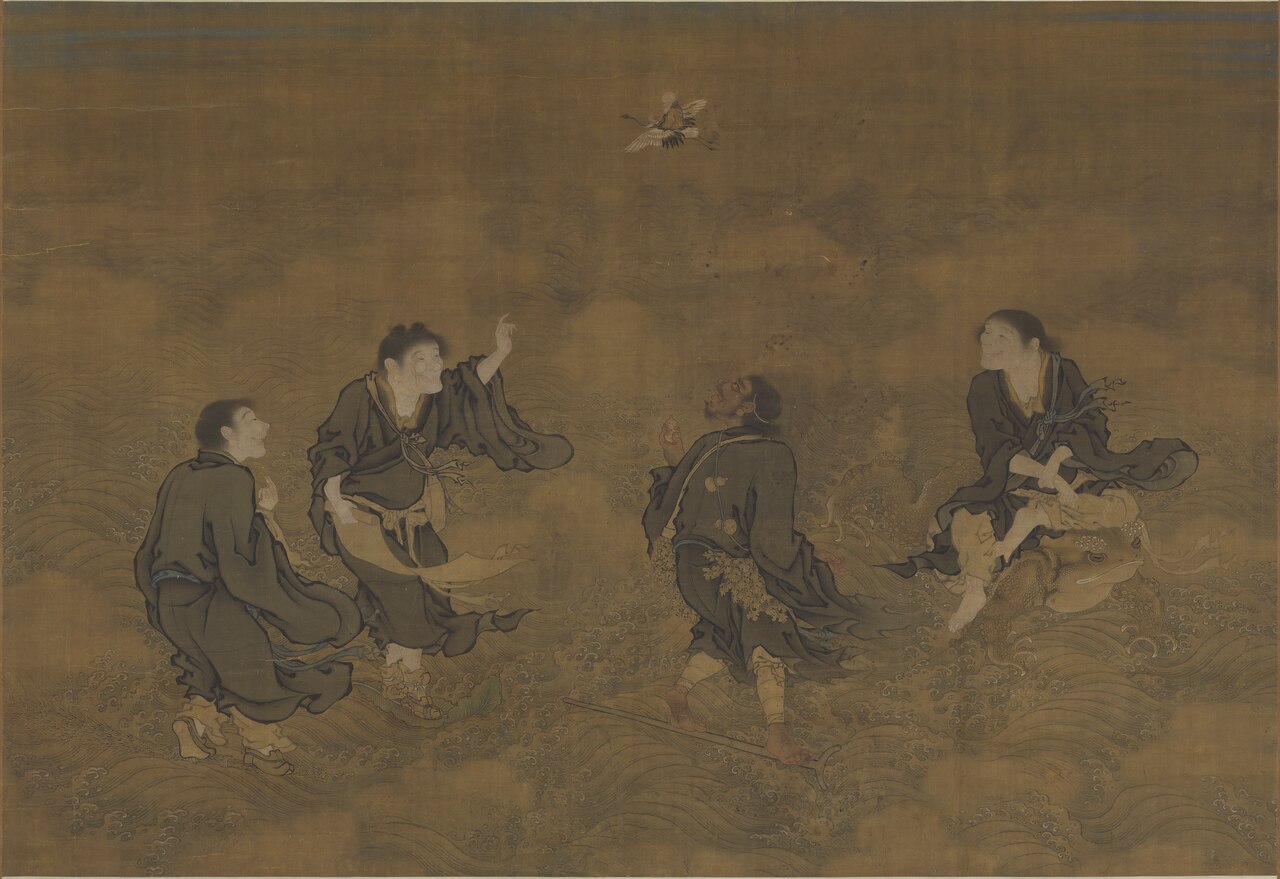
Major works - **Guan Yu Captures General Pang De** – This narrative scroll depicts the famed Three Kingdoms general Guan Yu confronting the loyalist Pang De. Shang Xi renders the clash with dramatic tension, using bold outlines for the warriors and softer washes for the surrounding terrain. The composition is divided into multiple registers, each advancing the story in a sequential manner reminiscent of traditional hand‑scroll storytelling. The work exemplifies his skill in portraying martial vigor while maintaining a refined aesthetic. - **Garden Scene Painted from Life (1450)** – Dated to 1450, this piece is one of the few works that can be anchored to a specific year. It portrays a tranquil garden interior, complete with potted plants, a stone bridge, and scholars engaged in quiet contemplation. The painting demonstrates Shang Xi’s capacity for realistic observation; the foliage is rendered with meticulous brushstrokes that capture the texture of leaves, while the atmospheric mist is suggested through gentle ink washes. The work reflects the growing interest in literati painters to depict everyday settings with both precision and poetic resonance. - **Four Immortals Paying Homage to Longevity** – In this composition, Shang Xi illustrates four Daoist immortals offering tribute to a central figure symbolising longevity. The figures are arranged in a semi‑circular formation, each rendered with individualized facial expressions and elaborate robes. The use of gold leaf to accentuate the immortals’ halos underscores their divine status. The painting’s compositional balance and subtle colour harmonies illustrate Shang Xi’s mature command of symbolic representation and his ability to merge narrative content with decorative elegance.
Influence and legacy Although Shang Xi’s name does not appear in the major official histories of Ming painting, his surviving works have been studied by later scholars for their technical prowess and thematic depth. His integration of meticulous brushwork with expressive washes prefigured the hybrid styles that would dominate late Ming and early Qing court painting. Contemporary Chinese art historians cite his garden scenes as early examples of the “painting from life” approach that became a hallmark of the literati tradition. Moreover, his treatment of heroic and mythological subjects contributed to the visual vocabulary that later painters employed when depicting historical narratives. While direct apprentices or a workshop lineage have not been documented, the stylistic echoes of Shang Xi can be discerned in the works of later Ming painters who adopted his balanced use of line, colour and decorative embellishment. Today, his pieces are valued both for their aesthetic qualities and as cultural artifacts that illuminate the artistic currents of a flourishing Ming dynasty.
Frequently asked questions
Who was Shang Xi?
Shang Xi was a Chinese mural and scroll painter of the Ming dynasty, born in Puyang, whose exact birth and death dates are unknown.
What style or movement is Shang Xi associated with?
He worked within the Ming revival tradition, blending meticulous gongbi brushwork with expressive ink washes, but no specific movement is recorded.
What are Shang Xi's most famous works?
His best‑known pieces include *Guan Yu Captures General Pang De*, *Garden Scene Painted from Life* (1450), and *Four Immortals Paying Homage to Longevity*.
Why does Shang Xi matter in art history?
He exemplifies the technical synthesis of line and colour in Ming painting and influenced later artists’ approaches to narrative and realistic observation.
How can I recognise a Shang Xi painting?
Look for crisp, controlled outlines combined with subtle ink washes, a restrained mineral pigment palette, occasional gold leaf accents, and a balanced composition that often portrays historical or mythological themes.