Dai Jin
1388 – 1462
In short
Dai Jin (1388–1462) was a Chinese painter of the early Ming dynasty, a leading figure of the Zhe School who revived the Southern Song landscape tradition. Based in Hangzhou, he is known for elegant, literati‑style landscapes such as Landscape with Daoist Immortals Playing Weiqi and The Hermit Xu You Resting by a Stream.
Notable works



Early life Dai Jin was born in 1388 in Hangzhou, a cultural centre of the Zhejiang province. His family belonged to the local scholarly class, which afforded him access to the classical education that underpinned the literati painting tradition. From a young age he studied the works of the Southern Song masters, particularly Ma Yuan and Xia Gui, whose restrained brushwork and emphasis on atmospheric perspective left a lasting impression. The political stability of the early Ming period allowed Hangzhou’s artistic community to flourish, and Dai Jin entered the city’s vibrant network of painters, calligraphers and poets.
Career and style By the early 15th century Dai Jin had established himself as a professional painter serving both the imperial court and private patrons. He aligned himself with the Zhe School, a movement that sought to revive the Ma‑Xia (Ma Yuan–Xia Gui) style that dominated Southern Song landscape painting. Unlike the more ornamental Wu School, the Zhe School emphasised a return to the austere, monochrome ink aesthetics of the earlier era while still allowing for personal expression. Dai Jin’s work reflects this synthesis: his compositions are carefully structured, often employing a single, dominant corner of the picture plane to suggest depth, yet they also reveal his own poetic sensibility through subtle variations in brushstroke and ink wash.
Signature techniques Dai Jin’s technical repertoire is characterised by several recurring devices. First, he employed the “axe‑cut” (斧劈) brushstroke, a sharp, angular line that defines rocks and cliffs with a sense of solidity. Second, his use of “wet‑brush” (濕筆) washes created soft, mist‑like atmospheres that veil distant peaks, a technique that evokes the transient quality of nature. Third, he integrated calligraphic strokes into his landscapes, allowing the rhythm of the ink to echo the flow of water or the rustle of foliage. Finally, Dai Jin was known for his strategic use of negative space; empty voids suggest clouds, fog or the uncharted realm beyond the viewer’s eye, reinforcing the Taoist notion of emptiness as a source of potential.
Major works **Landscape with Daoist Immortals Playing Weiqi (1449)** – This ink painting combines a serene mountain setting with a narrative scene of Daoist figures engrossed in the board game weiqi. The composition balances a foreground of craggy rocks rendered with axe‑cut strokes against a mist‑filled middle ground where the figures sit on a small pavilion. The subtle ink wash in the background recedes into an almost abstract suggestion of clouds, emphasising the spiritual rather than the literal.
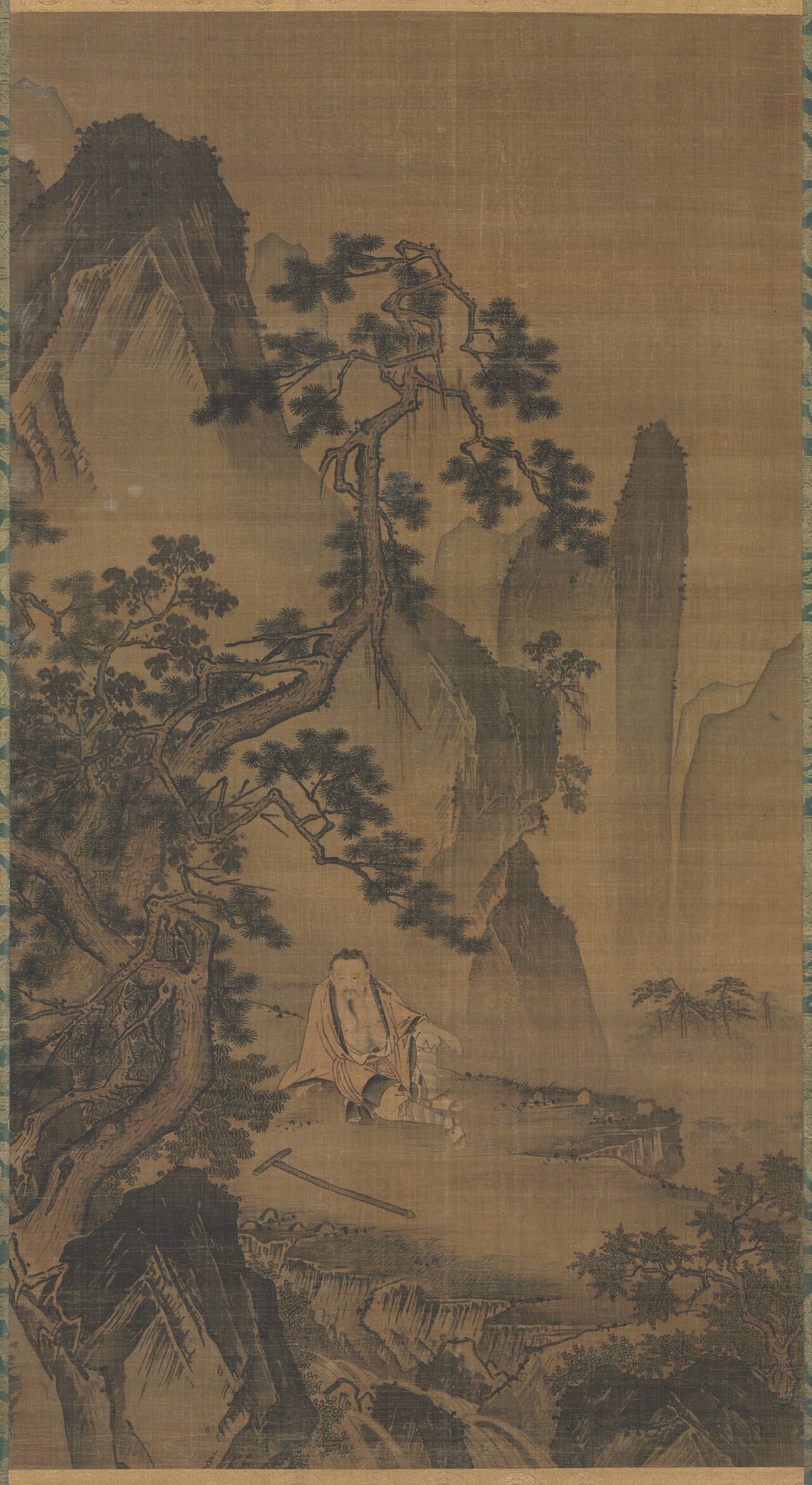
The Hermit Xu You Resting by a Stream (1431) – In this work Dai Jin portrays the legendary hermit Xu You, a symbol of reclusion, seated beside a gently flowing stream. The artist uses delicate wet‑brush washes to render the water’s surface, while the surrounding pine trees are rendered with crisp, calligraphic lines. The painting’s composition is asymmetrical, with the hermit placed at the lower left, inviting the viewer’s eye to wander through the tranquil scenery.
Returning home through the snow (1455) – This winter landscape captures a solitary traveller trudging through deep snow toward a distant village. Dai Jin’s mastery of tonal variation is evident in the gradations of gray ink, which convey the weight of snowfall and the chill of the environment. Sparse brushwork defines the bare branches of trees, while the faint suggestion of a shelter in the background hints at the traveller’s destination.
W drodze do przełęczy – Though the title is Polish, the painting itself follows Dai Jin’s typical Zhe School idiom. It depicts a mountain pass shrouded in mist, with a narrow path winding between steep cliffs. The work demonstrates his ability to convey depth through layered washes and the strategic placement of darker rock forms that guide the viewer’s gaze toward the distant horizon.
Rozmawiający mężowie, tańczące żurawie – pejzaż górski – Translating to “Talking men, dancing cranes – mountain landscape,” this piece integrates a lyrical narrative within a rugged mountainous setting. The cranes, rendered with swift, feather‑like strokes, appear to glide above the peaks, while a small group of scholars converse near a pavilion. The juxtaposition of human activity and natural wildlife reflects the Daoist harmony that permeates Dai Jin’s oeuvre.
Influence and legacy Dai Jin’s contribution to the Ming revival of the Ma‑Xia style cemented his reputation as one of the Zhe School’s foremost exponents. His paintings were widely circulated among literati circles, influencing subsequent generations of landscape artists who sought to balance classical restraint with personal expression. Later Zhe School painters such as Shen Zhou and Tang Yin referenced Dai Jin’s compositional strategies, particularly his use of negative space and the integration of poetic narrative. In modern scholarship, Dai Jin is recognised not only for his technical skill but also for his role in preserving a visual language that linked the Ming dynasty to its Southern Song artistic heritage. His works remain in major museum collections, and their study continues to inform understandings of Chinese ink landscape painting and its philosophical underpinnings.
Frequently asked questions
Who was Dai Jin?
Dai Jin (1388–1462) was a Chinese painter of the early Ming dynasty, best known as a leading figure of the Zhe School who revived the Southern Song landscape tradition.
What style or movement is Dai Jin associated with?
He is associated with the Zhe School, a movement that sought to restore the Ma‑Xia (Ma Yuan–Xia Gui) style of Southern Song landscape painting.
What are Dai Jin’s most famous works?
His most celebrated works include Landscape with Daoist Immortals Playing Weiqi (1449), The Hermit Xu You Resting by a Stream (1431), and Returning home through the snow (1455).
Why does Dai Jin matter in art history?
He played a pivotal role in the Ming revival of classical landscape techniques, influencing later artists and preserving the aesthetic principles of the Southern Song period.
How can I recognise a painting by Dai Jin?
Look for sharp ‘axe‑cut’ rock strokes, soft wet‑brush washes that create misty atmospheres, strategic use of empty space, and the integration of calligraphic lines that convey a poetic, often Daoist, sensibility.