Juran
1000 – 1000
In short
Juran was a Chinese landscape painter and Buddhist monk active in the Southern Tang and Northern Song periods, renowned for his serene mountain scenes and Buddhist-themed works.
Notable works

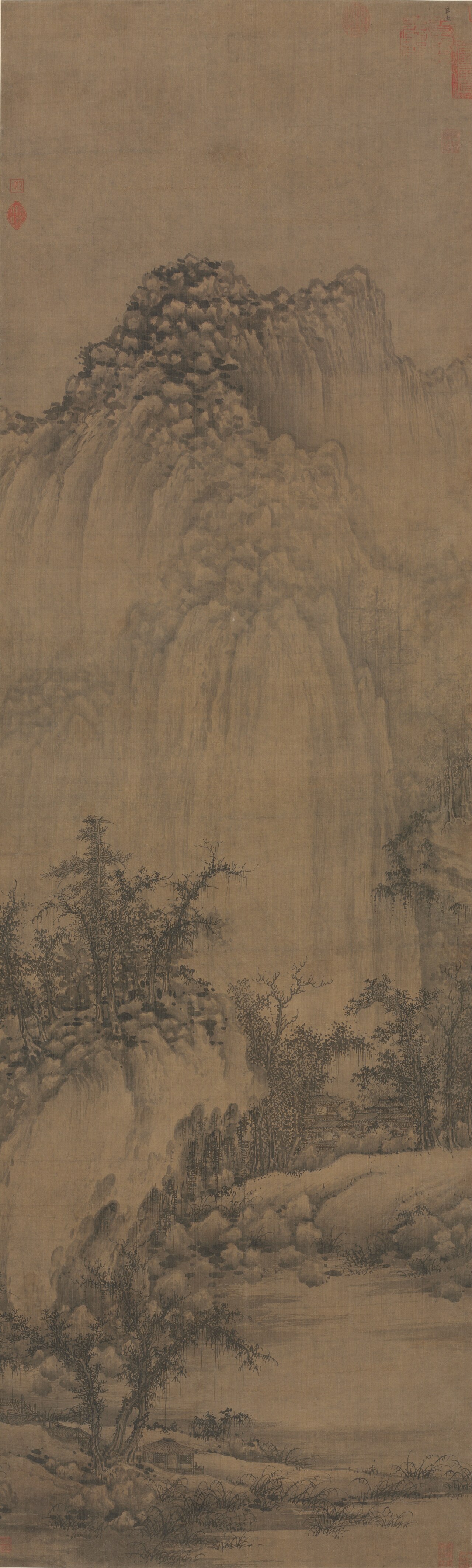


Early life Juran was born in Nanchang around the year 1000, during the late phase of the Southern Tang kingdom. Little is recorded about his family background, but he entered the Buddhist clergy early in life, adopting the monastic name Juran. His upbringing in a region known for its rolling hills and river valleys provided a natural backdrop for his later artistic interests. The cultural milieu of the time combined Confucian scholarship with a growing appreciation for Daoist and Buddhist aesthetics, which shaped his worldview and artistic sensibilities.
Career and style Juran’s career unfolded across the transitional period between the Southern Tang and the Northern Song dynasties. As a monk, he moved between monasteries and courtly circles, where his paintings were valued both for their devotional content and their technical merit. His style is characterised by a restrained, contemplative approach to landscape, favouring muted ink washes over bold colour. The compositions often centre on towering mountains, mist‑filled valleys, and solitary figures, reflecting a synthesis of Buddhist meditation and Daoist reverence for nature. Juran’s brushwork combines fine, calligraphic lines with broader, atmospheric strokes, creating a sense of depth without relying on linear perspective.
Signature techniques Juran employed several techniques that became hallmarks of his oeuvre. He favoured the "wet‑on‑wet" method, laying down diluted ink to suggest mist and distant atmosphere before adding sharper, darker outlines for nearer forms. This layering produced a subtle gradation of tone that conveys the impression of clouds drifting over peaks. In addition, he used a "dry brush" technique for foliage, rendering pine needles and forest canopies with a textured, almost tactile quality. His compositions often incorporate a "void" space, an intentional emptiness that invites the viewer’s imagination to fill the landscape, a principle rooted in Zen Buddhist practice. Finally, he sometimes inscribed poems or Buddhist sutra excerpts on the margins of his works, integrating calligraphy as an integral visual element.
Major works Juran’s extant catalogue includes several works that illustrate his mature style. **Xiao Yi Obtaining the Lanting Manuscript (950)** depicts a scholarly figure amidst a mist‑shrouded valley, the scene serving as an allegory for the transmission of literary heritage. The delicate ink washes convey an ethereal ambience, while the figure’s posture suggests reverence and concentration.
Buddhist Retreat by Stream and Mountains presents a monastic community settled along a winding stream, framed by craggy peaks. The painting balances human activity with the surrounding wildness, emphasizing the harmony between spiritual practice and natural setting. Juran’s use of subtle tonal variations in the water and rock surfaces demonstrates his skill in rendering reflective surfaces.
Seeking after the Tao in Autumn Mountains (950) captures a lone traveller traversing an autumnal landscape of maple‑tinted foliage and rugged cliffs. The composition is deliberately sparse, allowing the viewer to sense the pilgrim’s introspection. The autumnal palette, achieved through restrained ink shading, evokes the transience of life, a theme central to Taoist philosophy.
Snowscape is a monochrome study of a winter mountain scene, where heavy ink washes suggest snow‑laden slopes and bare branches. The contrast between the dark foreground and the lighter, almost white background creates a dramatic sense of depth, while the occasional bright ink splatters hint at the sudden sparkle of snow under moonlight.
Layered Peaks and Dense Forests (950) showcases Juran’s mastery of layered composition. Multiple mountain ridges recede into the distance, each separated by misty bands. Dense forested areas are rendered with fine, stippled strokes, giving the impression of a living, breathing environment. The work exemplifies Juran’s ability to convey both the majesty of the natural world and the contemplative quietude of a monk’s mind.
Influence and legacy Juran’s paintings exerted a lasting influence on later Song landscape artists, who admired his ability to fuse spiritual contemplation with realistic observation. His emphasis on atmospheric perspective and the use of negative space informed the aesthetic principles of the Northern Song academy, where painters such as Guo Xi and Fan Kuan expanded on his techniques. Moreover, his integration of Buddhist iconography within secular landscapes contributed to a broader acceptance of religious themes in elite artistic circles. While many of his original works have been lost or survive only in later copies, the surviving pieces continue to be studied for their technical innovation and philosophical depth. Contemporary scholars regard Juran as a pivotal figure in the evolution of Chinese landscape painting, bridging the lyrical styles of the Five Dynasties period with the more structured approaches of the Song dynasty. His legacy endures in museum collections worldwide, where his serene mountain vistas continue to inspire both artists and viewers seeking a visual meditation on nature and spirit.
Frequently asked questions
Who was Juran?
Juran was a Chinese landscape painter and Buddhist monk who worked during the Southern Tang and Northern Song periods, known for his tranquil mountain scenes.
What artistic style or movement is Juran associated with?
He is linked to the early Song landscape tradition, blending Buddhist contemplative aesthetics with a restrained ink‑wash technique.
What are Juran's most famous works?
His notable works include Xiao Yi Obtaining the Lanting Manuscript (950), Buddhist Retreat by Stream and Mountains, Seeking after the Tao in Autumn Mountains (950), Snowscape, and Layered Peaks and Dense Forests (950).
Why is Juran important in art history?
Juran helped shape the conventions of Chinese landscape painting, influencing later Song masters with his atmospheric perspective, use of negative space, and integration of Buddhist themes.
How can I recognise a painting by Juran?
Look for misty, layered mountains rendered with soft ink washes, subtle tonal gradations, and occasional Buddhist inscriptions, all combined with a calm, contemplative composition.