Jan Miel
1599 – 1663
In short
Jan Miel (1599–1663) was a Flemish Baroque painter and engraver from the Southern Netherlands who spent most of his career in Italy. He started with the Bamboccianti genre scene tradition in Rome and later shifted to classicising history paintings, producing works such as Charlatan (1650) and Triumph of Peace (1662).
Notable works


Early life Jan Miel was born in 1599 in the town of Beveren, in the Southern Netherlands (now Belgium). Little is recorded about his family background, but like many young artists from the Low Countries he would have received a basic artistic apprenticeship in his native region, likely working in the workshops of local masters who taught the fundamentals of drawing, oil painting and engraving. The early 17th‑century Flemish artistic environment was characterised by a strong tradition of genre painting, landscape, and a vibrant market for small, affordable works, which would later inform Miel’s own oeuvre.
Career and style Around the 1620s Miel moved to Italy, a common destination for Flemish artists seeking patronage and exposure to the Italian Baroque. He settled in Rome, where he became part of a loosely organised circle of Dutch and Flemish painters known as the *Bamboccianti*. The Bamboccianti specialised in low‑brow genre scenes—street vendors, tavern revelries, beggars, and other quotidian subjects—rendered with a naturalistic eye and a modest palette. Within this group, Miel distinguished himself by combining the Northern attention to detail with an Italianate sense of colour and light.
During the 1630s and 1640s Miel’s work increasingly reflected the influence of contemporary Roman artists such as Pietro da Cortona and the classicising tendencies of the Carracci school. He began to receive commissions for larger, more prestigious subjects, moving away from the purely genre‑focused Bamboccianti repertoire. By the 1650s he was producing history paintings that employed a more polished, academic style, incorporating classical architecture, allegorical figures and a clearer narrative structure. This stylistic shift mirrors a broader trend among expatriate Flemish painters who sought to align themselves with the dominant Roman taste for grand, moralising subjects.
Signature techniques Miel’s paintings are marked by several recurring technical features: - **Controlled chiaroscuro**: He employed a balanced contrast of light and shadow to model forms, often using a warm, golden illumination that recalls the Italian Baroque while retaining the subtle tonal gradations of Flemish painting. - **Compact composition**: Even in larger history canvases, Miel favoured a relatively tight arrangement of figures, ensuring that each character contributes to the narrative without overwhelming the viewer. - **Detail in costume and texture**: His training in the Northern tradition is evident in the meticulous rendering of fabrics, armour and everyday objects, which lend authenticity to both genre and historical scenes. - **Engraving sensibility**: As an engraver, Miel had a keen eye for line and contour; this translates into a clear delineation of edges in his oil paintings, giving them a crisp, graphic quality. - **Colour palette**: He often used a restrained palette of earth tones, ochres and muted reds, punctuated by occasional bright accents (e.g., a red sash or a golden halo) that draw the eye to focal points.
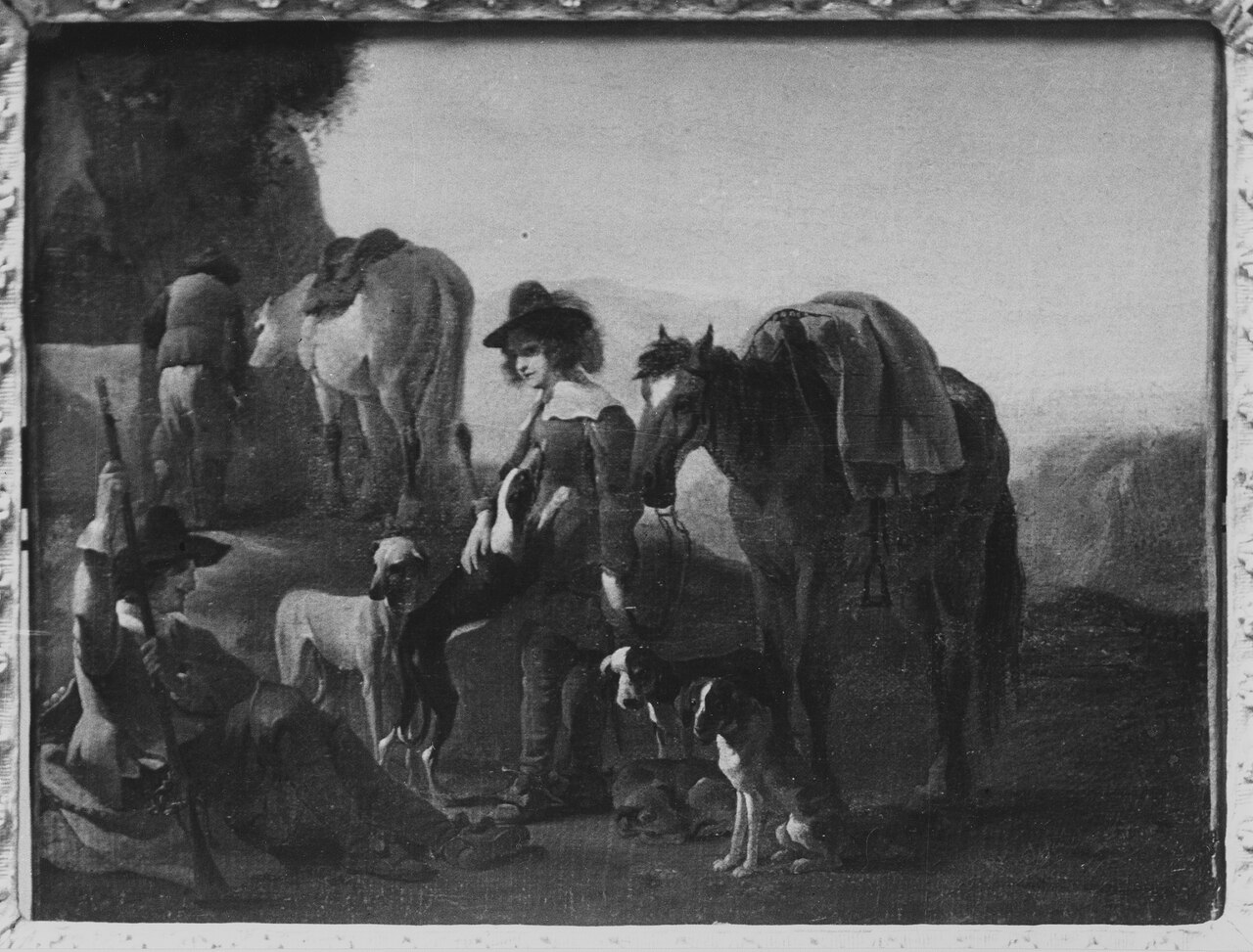
Major works - **Charlatan (1650)** – This small oil on canvas depicts a street charlatan surrounded by an intrigued crowd. The work combines the Bamboccianti’s interest in popular subjects with Miel’s developing classicising compositional balance. The figure’s exaggerated gestures and the careful rendering of the surrounding architecture illustrate Miel’s synthesis of Northern genre realism and Roman theatricality. - **Figures Feasting at a Fair in Prati, Outside the Walls of Rome, with the Saint Peter's Basilica and Monte Mario Beyond (1650)** – A complex scene that juxtaposes a bustling fair with a distant view of St. Peter’s Basilica. The painting showcases Miel’s ability to integrate topographical accuracy with narrative depth, positioning the viewer between the immediate festivities and the monumental backdrop of Rome. - **Hunters Resting** – Although the exact date is uncertain, this work portrays a group of hunters taking a pause in a wooded landscape. The composition reflects the influence of Flemish landscape traditions, while the treatment of light through the trees signals an Italianate sensibility. - **Hannibal’s Dream (1661)** – A history painting that illustrates the Carthaginian general Hannibal receiving a prophetic vision. Miel employs a classical architectural setting, dramatic lighting and a restrained colour scheme to convey the weight of the moment. The work demonstrates his mature classicising approach, aligning with the tastes of Roman patrons for moralising subjects. - **Triumph of Peace (1662)** – One of Miel’s most ambitious canvases, this painting celebrates the idea of peace as a victorious figure. It features allegorical figures, a triumphal arch and a serene landscape, all rendered with the polished technique characteristic of his later period. The composition underscores Miel’s successful transition from genre painter to a creator of grand, allegorical narratives.
Influence and legacy Jan Miel occupies a transitional niche in 17th‑century art history. As a Flemish expatriate, he contributed to the cross‑fertilisation of Northern realism and Italian Baroque classicism. His early Bamboccianti works helped popularise genre scenes among Roman collectors, while his later history paintings demonstrated that a Northern artist could master the grand allegorical language favoured by the papal court.
Miel’s influence is most evident in the work of subsequent Flemish painters who settled in Italy, such as Pieter van Laer’s younger followers and the later generation of the *Bamboccianti* who adopted a more academic style. Moreover, his careful handling of texture and his balanced compositional strategies anticipated the approaches of later Baroque painters who sought to merge narrative clarity with painterly richness.
Although Jan Miel is not as widely recognised today as contemporaries like Rubens or Caravaggio, his surviving oeuvre provides valuable insight into the artistic exchanges between the Low Countries and Italy. His paintings are held in several European collections, and they continue to be studied for their hybrid visual language that bridges two major artistic traditions of the 17th century.
In summary, Jan Miel’s career reflects the fluidity of artistic identity in the Baroque era, illustrating how a Flemish painter could navigate the demands of Roman patronage, evolve from genre to history painting, and leave a modest but enduring mark on the visual culture of his time.
Frequently asked questions
Who was Jan Miel?
Jan Miel (1599–1663) was a Flemish Baroque painter and engraver from the Southern Netherlands who spent most of his career in Italy, initially working with the Bamboccianti genre painters before turning to classicising history subjects.
What artistic movement or style is Jan Miel associated with?
Miel is linked to the Flemish Baroque tradition and, in Italy, to the Bamboccianti genre movement; later in his career he adopted a classicising, academic style for history and allegorical paintings.
What are Jan Miel’s most famous works?
Among his best‑known paintings are *Charlatan* (1650), *Figures Feasting at a Fair in Prati* (1650), *Hannibal’s Dream* (1661), *Triumph of Peace* (1662) and the genre piece *Hunters Resting*.
Why is Jan Miel important in art history?
Miel illustrates the cultural exchange between the Low Countries and Italy in the 17th century, helping to spread genre painting in Rome and later demonstrating that a Flemish artist could successfully adopt the grand, allegorical style favoured by Roman patrons.
How can I recognise a painting by Jan Miel?
Look for a balanced composition, precise rendering of fabrics and textures, a warm chiaroscuro, and often a mix of Northern realism with Italianate architecture; his later works feature allegorical figures and a restrained colour palette.