Pierre-Joseph Redouté
1759 – 1840
In short
Pierre-Joseph Redouté (1759–1840) was a Southern‑Netherlands painter and botanist celebrated for his exquisite watercolour illustrations of flowers, especially roses and lilies, produced for royal patrons and published in lavish botanical volumes.
Notable works
.png)

_and_Safran_Jaune,_Plate_196_from_Les_Liliac%C3%A9es_-_B2012.33.3_-_Yale_Center_for_British_Art.jpg)

Early life Pierre‑Joseph Redouté was born in 1759 in Saint‑Hubert, a town in the Southern Netherlands (then part of the Austrian Netherlands). Little is recorded about his family background, but he displayed an early aptitude for drawing and a keen interest in plants. In his teenage years he moved to Paris, the cultural centre of Europe, where he sought training in the arts. The city’s flourishing horticultural scene, with its royal gardens and exotic plant collections, offered a fertile environment for a young artist who combined artistic skill with botanical curiosity.
Career and style Redouté’s professional break came when he entered the service of Empress Joséphine de Beauharnais, the wife of Napoleon Bonaparte. At the Château de Malmaison she commissioned him to document the extensive gardens, which were famed for their roses, lilies and other ornamental species. Working under her patronage, Redouté produced a series of watercolour paintings that combined scientific accuracy with an aesthetic delicacy that set a new standard for botanical illustration.
Although Redouté is not formally linked to a specific artistic movement, his work reflects the Enlightenment’s rational approach to nature and the Romantic era’s reverence for beauty. His images are characterised by meticulous rendering of form, subtle gradations of colour, and an emphasis on the elegance of each flower’s structure. This blend of precision and poetics earned him the nickname "the Raphael of flowers" and secured his reputation as the pre‑eminent botanical illustrator of his time.
Signature techniques Redouté’s hallmark technique was the use of fine watercolour washes applied to a prepared vellum or paper support. He employed a stipple engraving process for many of his published plates: after completing a painting, the image was transferred onto a copper plate, where a skilled engraver reproduced the delicate tonal variations using stipple dots. The prints were then hand‑coloured, often by Redouté himself, ensuring that the final product retained the subtle hues of the original watercolour.
His mastery of botanical accuracy stemmed from a disciplined observation of living specimens. He would often work directly from fresh flowers, sometimes arranging them in glass vessels to study their three‑dimensional form and translucency. This practice gave his illustrations a lifelike vitality that distinguished them from the more stylised depictions of earlier centuries.
Major works Redouté’s oeuvre includes several landmark publications and individual plates that remain reference points for both artists and horticulturists.
- Choix des plus belles fleurs et de quelques branches des plus beaux fruits (1827) – A lavishly illustrated collection that showcases a wide variety of ornamental plants. The volume is notable for its sumptuous colour plates, each rendered with the same precision that characterized Redouté’s earlier court commissions.
- Flowers in a Glass Vase (1796) – One of his earliest surviving watercolours, this work captures a small grouping of blossoms arranged in a transparent container. The piece demonstrates Redouté’s skill in rendering light and shadow on delicate petals, as well as his interest in the interplay between flora and domestic objects.
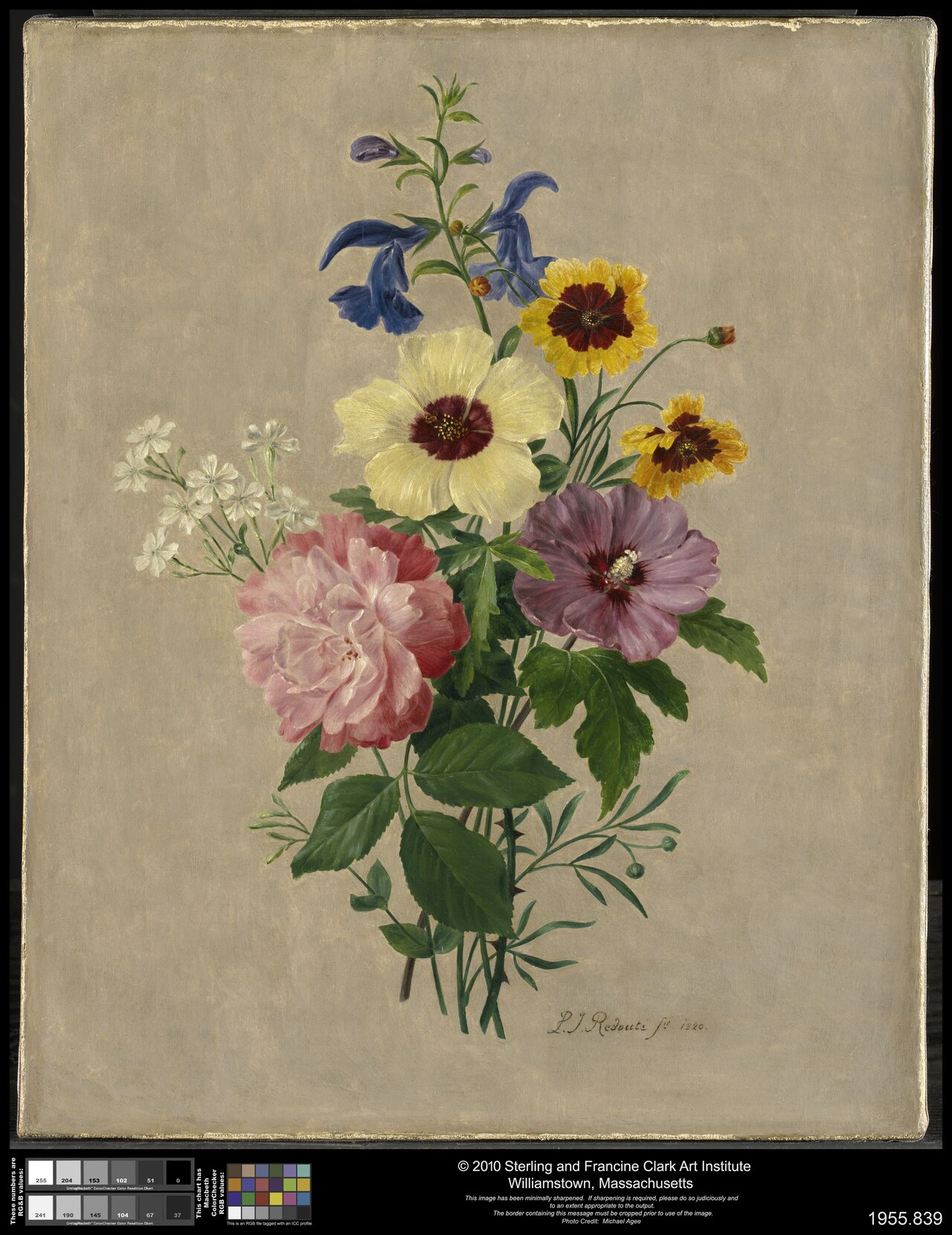
- Flowers (1820) – A further compilation of floral studies, this publication continued Redouté’s partnership with leading French publishers. The plates combine scientific labeling with artistic flourish, making the work both an educational resource and a decorative object.
- Crocus Luteus (Crocus Aureus or Golden Crocus) and Safran Jaune, Plate 196 from Les Liliacées, volume 4 (1809) – Part of the monumental *Les Liliacées* series, this plate exemplifies Redouté’s capacity to depict early‑spring bulbs with vivid colour and exacting detail. The juxtaposition of the golden crocus with the saffron crocus highlights his ability to differentiate closely related species.
- Eucomis Punctata, Plate 208 from Les Liliacées, volume 4 (1809) – Another contribution to *Les Liliacées*, this illustration captures the distinctive rosette of the Eucomis genus. The work is praised for its faithful rendering of the plant’s texture and the subtle shading that conveys its three‑dimensional form.
These works, together with numerous other plates, cemented Redouté’s status as a leading figure in the transition from purely scientific illustration to a more artistic, aesthetically driven approach to documenting nature.
Influence and legacy Redouté’s influence extended far beyond his lifetime. His watercolours set a benchmark for botanical illustration that persisted throughout the 19th century, inspiring contemporaries such as John James Audubon and later horticultural artists. The clarity and elegance of his images aided the spread of horticultural knowledge across Europe, contributing to the popularity of roses and lilies among both aristocratic and amateur gardeners.
In the modern era, Redouté’s plates continue to be reproduced in textbooks, garden guides, and decorative prints. Museums and libraries often feature his work in exhibitions that explore the intersection of art and science. Scholars regard his contributions as a vital link between Enlightenment‑era natural history and the Romantic appreciation of nature’s beauty. Moreover, his techniques—particularly the combination of stipple engraving with hand‑colouring—remain a reference point for contemporary printmakers and illustrators seeking to emulate the tactile quality of his prints.
Redouté’s legacy is also evident in the way his name is invoked in horticultural circles; many rose cultivars bear the appellation "Redouté" in homage to his unparalleled depictions of the flower. As a result, his work endures not only as an artistic achievement but also as a lasting resource for botanists, gardeners, and collectors worldwide.
Frequently asked questions
Who was Pierre‑Joseph Redouté?
Pierre‑Joseph Redouté (1759–1840) was a Southern‑Netherlands painter and botanist renowned for his precise and beautiful watercolour illustrations of flowers, especially roses and lilies.
What artistic style or movement is Redouté associated with?
Redouté is not tied to a formal movement; his work blends Enlightenment scientific accuracy with Romantic elegance, creating a distinctive botanical illustration style.
What are Redouté’s most famous works?
His celebrated publications include *Choix des plus belles fleurs* (1827), *Flowers in a Glass Vase* (1796), *Flowers* (1820), and plates from *Les Liliacées* such as Crocus Luteus (1809) and Eucomis Punctata (1809).
Why is Redouté important in art and science?
He set the standard for botanical illustration, merging scientific detail with artistic beauty, and his images helped popularise horticulture while influencing later artists and printmakers.
How can I recognise a Redouté illustration?
Look for delicate watercolour washes, fine stipple engraving, accurate botanical detail, and a graceful composition that often features flowers in glass vessels or against subtle backgrounds.