Denys Calvaert
1540 – 1619
In short
Denys Calvaert (1540–1619) was a Flemish painter born in Antwerp who spent most of his career in Italy, becoming a key figure of the early Baroque in Bologna. He is known for his sophisticated compositions, rich colour, and for training a generation of Italian masters.
Notable works
_Mattes_2022-03-24_Batch_(83).jpg)


Early life Denys Calvaert was born in 1540 in Antwerp, a thriving commercial hub of the Southern Netherlands. His family belonged to the modest middle class, and his early education included the usual humanist curriculum of Latin and geometry. Antwerp in the mid‑16th century was a centre of artistic exchange, and the young Calvaert was exposed to the work of leading Flemish masters such as Pieter Bruegel the Elder and Frans Floris. He entered a local workshop, where he received rigorous training in drawing, perspective, and the fundamentals of painting. His apprenticeship included study of architectural drawing and anatomical dissection, reflecting the era’s growing interest in scientific observation.
Career and style In his mid‑twenties Calvaert moved to Italy, a common pilgrimage for Northern artists seeking patronage and artistic development. He first arrived in Rome, where he encountered the works of Michelangelo and Raphael, before settling permanently in Bologna around 1575. In Bologna he adopted the Italian name Dionisio Fiammingo ("the Flemish") and quickly became associated with the city’s burgeoning artistic community. The Bolognese scene was dominated by a synthesis of classicist idealism and emerging naturalism; Calvaert’s own style merged his Flemish training with this Italian sensibility. He produced works that combined meticulous draftsmanship, a balanced compositional structure, and a palette that favoured warm, saturated tones. His paintings display a clear influence of the Counter‑Reformation’s didactic aims, employing narrative clarity and emotional restraint to convey religious themes.
Signature techniques Calvaert’s technique is characterised by several recurring elements:
* Chiaroscuro modelling – He used strong contrasts of light and shadow to give three‑dimensionality to figures, a practice he refined through study of Caravaggio’s early works. * Precise anatomy – His earlier study of anatomy allowed him to render musculature and facial expression with a naturalistic accuracy that set his figures apart from many contemporaries. * Complex composition – Calvaert arranged his subjects in layered, often triangular groupings, guiding the viewer’s eye through a logical visual hierarchy. * Rich colour harmonies – He favoured deep reds, verdant greens and luminous golds, employing glazing techniques that produced a subtle depth of colour. * Fine surface finish – His canvases display a smooth, almost polished surface, the result of meticulous underdrawing and careful brushwork.
These technical choices created works that were both intellectually rigorous and visually appealing, positioning Calvaert as a bridge between Northern realism and Italian Baroque exuberance.
Major works Calvaert’s oeuvre, though not extensive, includes several celebrated pieces that illustrate his artistic evolution.
1. Saint Cecilia (1580) – This altarpiece portrays the patron saint of music in a serene, contemplative pose. The composition is anchored by a luminous halo and a delicate musical instrument, while the background architecture recedes with linear perspective. The work demonstrates Calvaert’s mastery of colour, with deep blues and golds accentuating the saint’s sanctity.
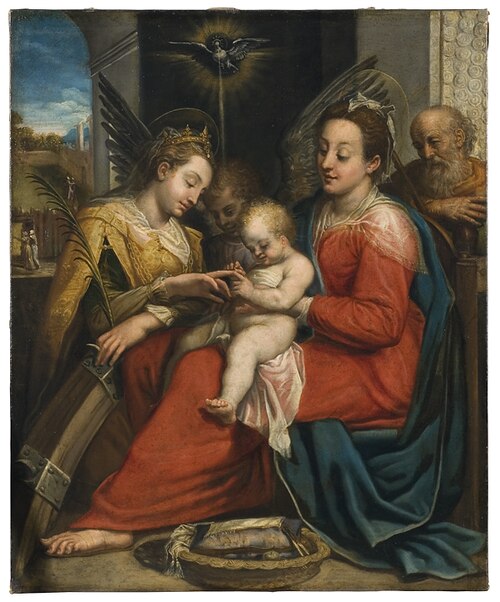
2. The Mystic Marriage of St Catherine – In this narrative, Saint Catherine is shown receiving a symbolic ring from the infant Christ, a motif popular in Counter‑Reformation art. Calvaert renders the figures with a tender intimacy, employing soft lighting to highlight the spiritual bond. The painting’s balanced arrangement of three central figures reflects his classical compositional training.
3. Saint John the Baptist in the Wilderness (1609) – One of his later works, this painting depicts a rugged, isolated John pointing toward a distant horizon. The stark landscape and the dramatic chiaroscuro convey a sense of asceticism. The work’s colour palette is more restrained, emphasising earthy browns and muted greens, signalling a mature, contemplative style.
4. Judith with the Head of Holofernes – Calvaert captures the biblical heroine Judith at the moment of triumph, holding the severed head of Holofernes. The scene is rendered with vivid drama: Judith’s determined expression, the blood‑red head, and the darkened background create an emotional intensity that anticipates later Baroque dramatism.
5. The Adoration of the Shepherds – This nativity scene showcases a rustic tableau of shepherds kneeling before the infant Christ. Calvaert populates the composition with a variety of textures—rough wool, soft infant skin, and glimmering manger straw—demonstrating his skill in rendering material detail. The work’s warm lighting and harmonious colour scheme underline the devotional purpose of the piece.
These works collectively illustrate Calvaert’s ability to fuse narrative clarity with sophisticated visual technique, securing his reputation among both patrons and peers.
Influence and legacy Denys Calvaert’s lasting impact lies as much in his teaching as in his paintings. His Bologna studio attracted a number of talented apprentices, most notably Guido Reni, Domenichino, and Francesco Albani. These pupils later became leading figures of the Bolognese Baroque, spreading Calvaert’s synthesis of Flemish precision and Italian expressiveness across Europe. While his own output was modest compared with contemporaries such as Annibale Carracci, Calvaert’s role as a conduit for cross‑cultural exchange helped to shape the visual language of the early 17th‑century Baroque.
Art historians regard Calvaert as a transitional figure: his work preserves the meticulous detail of Northern Renaissance painting while embracing the dynamism and emotional resonance that define Baroque art. Modern exhibitions continue to include his paintings alongside those of his Italian students, highlighting the enduring relevance of his technique and his contribution to the evolution of European painting.
In scholarly discourse, Calvaert is cited as an exemplar of the “Flemish‑Italian” hybrid style, a testament to the fluidity of artistic borders in the late Renaissance. His paintings remain in major collections across Italy, the Low Countries and beyond, where they are valued for their technical excellence, devotional intensity, and historical significance.
Frequently asked questions
Who was Denys Calvaert?
Denys Calvaert (1540–1619) was a Flemish painter born in Antwerp who spent most of his career in Bologna, Italy, and became a prominent early Baroque artist.
What artistic movement is Calvaert associated with?
Calvaert is linked to the Baroque movement, blending Flemish realism with the emerging dynamism and emotional depth of Italian Baroque painting.
What are his most famous works?
His best‑known paintings include Saint Cecilia (1580), The Mystic Marriage of St Catherine, Saint John the Baptist in the Wilderness (1609), Judith with the Head of Holofernes, and The Adoration of the Shepherds.
Why is Calvaert important in art history?
He acted as a cultural bridge between Northern and Italian styles, taught influential artists such as Guido Reni and Domenichino, and helped define the early Baroque aesthetic.
How can I recognise a Calvaert painting?
Look for balanced, triangular compositions, precise anatomical detail, rich yet restrained colour harmonies, smooth surface finishes and a subtle use of chiaroscuro that together create a calm, devotional atmosphere.