Joachim Patinir
1475 – 1524
In short
Joachim Patinir (1475–1524) was a Flemish Renaissance painter from the Southern Netherlands, recognised as the first Netherlandish artist to specialise in landscape painting. He pioneered the ‘world landscape’ format, combining expansive panoramic scenery with biblical and mythological narratives.
Notable works



.jpg)
Early life Joachim Patinir was born in 1475 in Dinick (now Dinant), a town on the Meuse River in the Walloon region of the Southern Netherlands. Little is known about his family background, but contemporary records suggest he was the son of a modest craftsman. Patinir spent his formative years in a region where the rugged river valleys and steep cliffs would later become a hallmark of his painted scenery. In the early 1490s he moved to Antwerp, the bustling commercial and artistic centre of the Low Countries, where he entered the workshop of a leading painter—most likely a member of the Guild of Saint Luke. This apprenticeship provided him with the technical training in oil painting and the exposure to the flourishing market for devotional and secular images that characterised Antwerp at the turn of the 16th century.
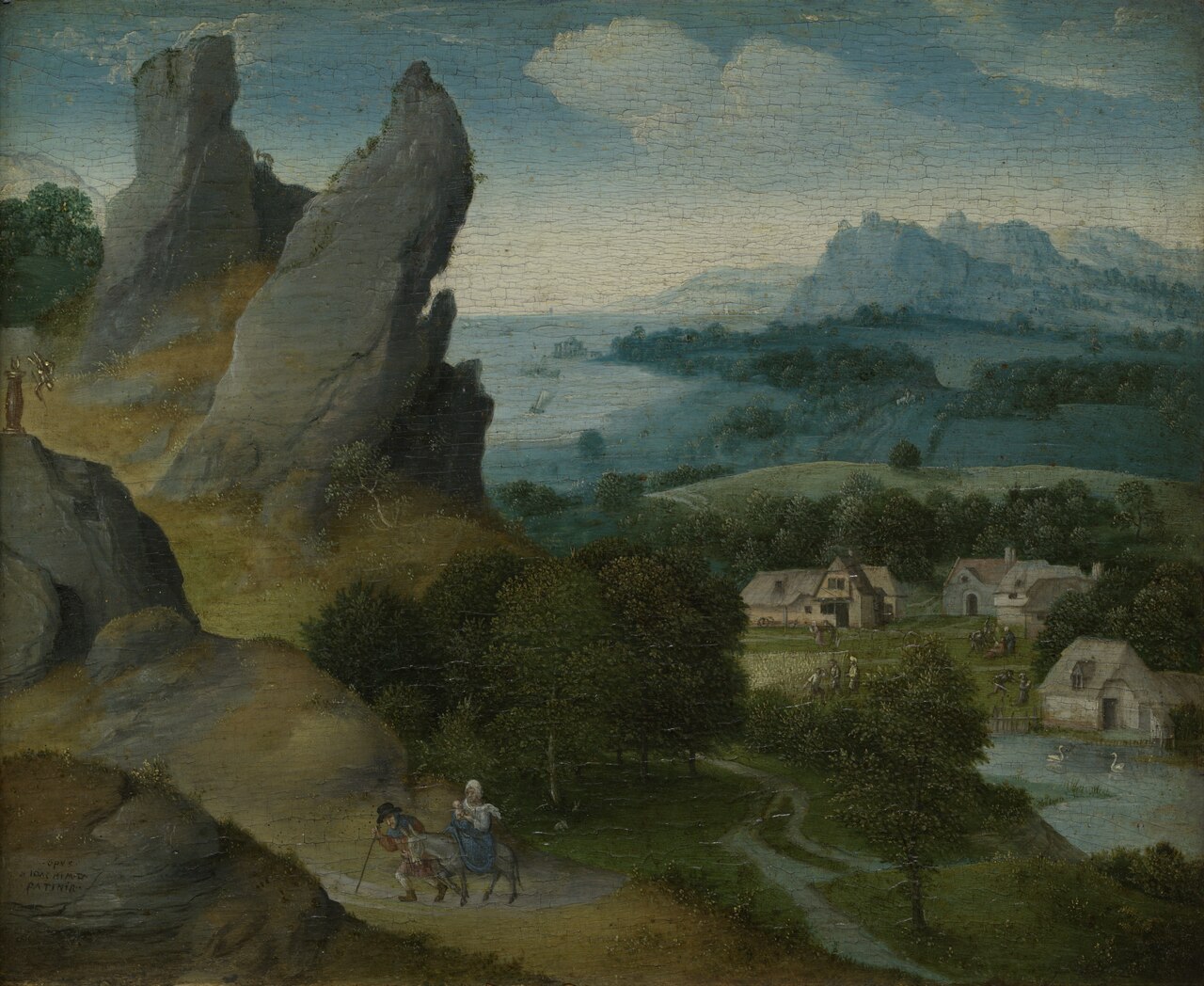
Career and style By the first decade of the 1500s Patinir had established himself as an independent painter. Unlike most of his Flemish contemporaries, who identified primarily as portraitists or history painters, Patinir marketed himself as a landscape specialist. He worked closely with the leading Antwerp workshop of Gerard David, contributing the figures in David’s compositions while supplying the expansive backgrounds that bore his distinctive hand. Patinir’s style is characterised by a panoramic, almost cinematic view of the natural world, a format later termed the ‘world landscape’. These compositions are built on a high‑angled perspective that opens onto a vast vista of rolling hills, distant mountains, and a sky that dominates the upper half of the picture. The foreground typically contains a small narrative scene—often a biblical episode or a classical myth—set within a sweeping, almost idealised landscape.
Patinir’s colour palette is notable for its stark contrasts: luminous blues and greens in the distant atmosphere are juxtaposed with warm, earthy tones in the nearer terrain. He often employed a subtle gradation of colour to suggest atmospheric depth, a technique that anticipates later developments in landscape painting. Though his figures are generally modest in scale and executed with a relatively flat modelling, the surrounding scenery is rendered with a careful attention to natural detail—trees, rocks, and water are depicted with a degree of observation that was unusual for the period.
Signature techniques Patinir’s paintings reveal several recurring technical approaches:
1. Elevated viewpoint – A high horizon line creates a sense of vastness, allowing the viewer to look down on a landscape that stretches into the distance. 2. Layered atmospheric perspective – By progressively muting colour and detail, Patinir conveys depth, a method that would become a cornerstone of later landscape theory. 3. Integration of narrative and topography – The human or divine story is embedded within the environment rather than dominating it, signalling a shift toward treating landscape as a subject in its own right. 4. Use of the ‘golden’ division – Many of his compositions are divided into three zones—foreground, middle ground, and background—each with distinct tonal values, echoing contemporary treatises on proportion. 5. Texture through glaze – Patinir employed thin glazes of oil to achieve luminous effects in water and sky, enhancing the sense of atmospheric clarity.
These techniques, combined with his penchant for dramatic, often allegorical subjects, gave his works a distinctive visual identity that collectors and patrons could readily recognise.
Major works Patinir’s surviving oeuvre includes a handful of dated panels that illustrate his mature style.
- Landscape with Charon Crossing the Styx (1515) – This painting depicts the mythological ferryman Charon transporting souls across the river Styx. The composition is anchored by a dark, turbulent river that bisects the canvas, while the surrounding cliffs and distant mountains recede into a misty horizon. The small, ghostly figures in the boat contrast with the monumental scale of the landscape, underscoring Patinir’s belief that the natural world frames human destiny.
- Landscape with the Flight into Egypt (1515) – Here Patinir combines a biblical narrative with his signature panoramic scenery. The Holy Family is rendered as a diminutive group travelling along a winding path that snakes through a richly detailed countryside. The sky occupies the upper half of the panel, rendered in a luminous blue that fades into a hazy distance, while the foreground is populated by trees and rocky outcrops that frame the journey.
- The Baptism of Christ (1510) – Although the central event—John the Baptist baptising Jesus—occupies the lower centre of the composition, the surrounding landscape dominates the visual field. A river flows across the centre, mirroring the act of baptism, while distant hills and a cloud‑filled sky suggest a divine presence. Patinir’s handling of water, with reflective glazes, demonstrates his skill in rendering reflective surfaces.
- The Temptations of Saint Anthony the Abbot (1515) – In this work Patinir presents a series of surreal, often grotesque, temptations set against a desolate, rocky terrain. The saint is a small figure dwarfed by the barren landscape, emphasizing his spiritual isolation. The painting’s dramatic lighting and stark colour contrasts heighten the sense of otherworldly menace.
- Rest on the Flight to Egypt (1520) – This later panel shows the Virgin and Child resting beneath a modest shelter amidst a lush, gently rolling landscape. The composition is more tranquil than his earlier, more dramatic works, suggesting a gradual softening of his palette. Yet the elevated viewpoint and the expansive horizon remain hallmarks of Patinir’s style.
These works collectively illustrate Patinir’s commitment to integrating narrative with a meticulously constructed environment, and they provide a clear chronology of his artistic development from the early 1510s to the early 1520s.
Influence and legacy Patinir’s impact on the trajectory of Western art is considerable. By foregrounding landscape as a primary subject, he paved the way for later Netherlandish artists such as Herri met de Bles and later, the Dutch Golden Age masters who would specialise in landscape painting. His ‘world landscape’ format—characterised by a high horizon, atmospheric depth, and a blend of real and imagined geography—became a template for artists across Europe, influencing the work of Albrecht Altdorfer in Germany and the Venetian painters who began to explore expansive vistas in the 16th century.
Moreover, Patinir’s approach to integrating biblical and mythological narratives within a natural setting anticipated the Romantic fascination with the sublime, where nature is portrayed as a powerful, sometimes overwhelming force. Art historians credit him with advancing the theoretical understanding of perspective in landscape, a development that would later be codified in the manuals of the Baroque period.
Patinir’s paintings remained in the collections of aristocratic patrons and religious institutions throughout the 16th and 17th centuries, ensuring that his innovative vision continued to be seen by successive generations of artists. Contemporary scholarship recognises him as a foundational figure in the history of landscape art, and his works are regularly exhibited in major museums as exemplars of early Northern Renaissance innovation.
In sum, Joachim Patinir’s legacy rests on his daring redefinition of the painter’s role—from a chronicler of human events to a creator of immersive, atmospheric worlds. His pioneering vision established landscape as a legitimate and compelling genre, a contribution that continues to shape artistic practice to this day.
Frequently asked questions
Who was Joachim Patinir?
Joachim Patinir (1475–1524) was a Flemish Renaissance painter from the Southern Netherlands, best known as the first Netherlandish artist to specialise in landscape painting.
What style or movement is Patinir associated with?
Patinir worked within the Northern Renaissance but is most closely linked to the development of the ‘world landscape’ genre, a panoramic style that blends biblical or mythological scenes with expansive natural settings.
What are Patinir’s most famous works?
Among his most celebrated paintings are *Landscape with Charon Crossing the Styx* (1515), *Landscape with the Flight into Egypt* (1515), *The Baptism of Christ* (1510), *The Temptations of Saint Anthony the Abbot* (1515) and *Rest on the Flight to Egypt* (1520).
Why is Patinir important in art history?
Patinir pioneered landscape as an independent genre, invented the ‘world landscape’ format, and advanced the use of atmospheric perspective, influencing generations of European artists.
How can I recognise a painting by Patinir?
Look for a high‑angled, panoramic view with a dominant sky, a small narrative scene set within a vast, detailed landscape, and a colour palette that contrasts luminous distant hues with warm, earthy foreground tones.