Albert Küchler
1803 – 1886
In short
Albert Küchler (1803–1886) was a Danish painter of the Danish Golden Age, noted for finely rendered genre scenes and portraits; later in life he converted to Catholicism, joined the Franciscan order and spent his final decades in Rome.
Notable works
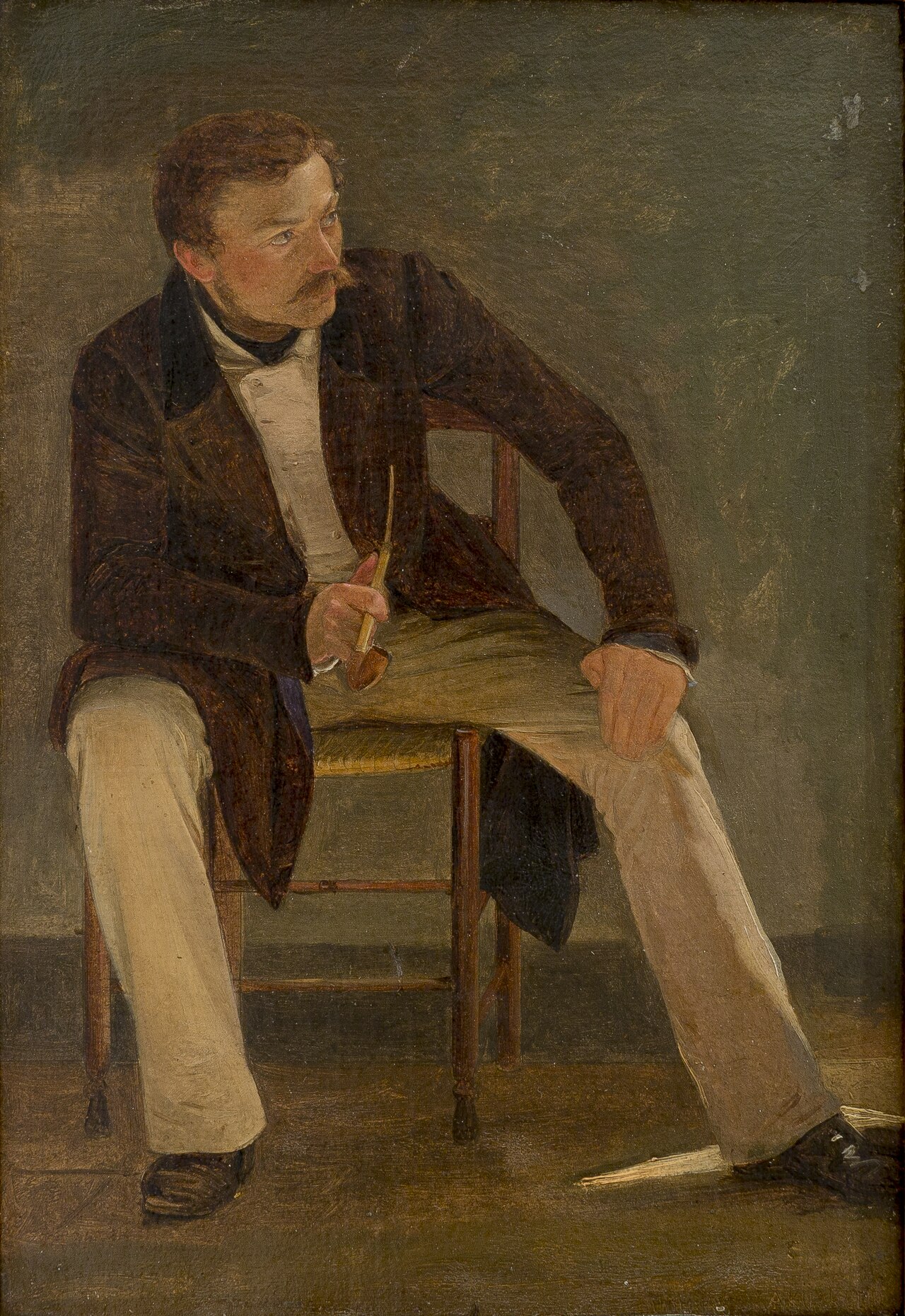


Early life Albert Küchler was born on 5 December 1803 in Copenhagen, the capital of the Kingdom of Denmark. He grew up in a modest household that encouraged artistic pursuits, and he entered the Royal Danish Academy of Fine Arts in his early teens. At the Academy he received a rigorous grounding in drawing, anatomy and perspective, following the curriculum established by the influential teacher Christoffer Wilhelm Eckersberg. This academic training, characterised by an emphasis on precise observation and balanced composition, formed the technical foundation of Küchler’s later work.
Career and style Küchler debuted publicly in the 1820s, exhibiting at the Academy’s annual exhibitions. His early output consisted largely of genre scenes that captured everyday moments with a calm, almost narrative quality. He also painted portraits for private patrons, a genre that brought him considerable commissions and a reputation for capturing the inner character of his sitters.
Operating within the Danish Golden Age, Küchler’s style combined the neoclassical clarity of his academic training with a sensitivity to colour and light that reflected the influence of Dutch genre painters and the emerging Romantic sensibility. His work often conveys a quiet dignity, favouring restrained palettes and harmonious arrangements over overt dramatics.
In the early 1830s Küchler travelled to Rome, a common destination for Danish artists seeking exposure to classical antiquity and the Italian masters. The Italian capital offered a vibrant community of Scandinavian expatriates and a wealth of artistic resources. While in Rome he continued to paint Danish subjects, yet his palette lightened and his handling of fabric and skin grew increasingly nuanced.
Signature techniques Küchler’s paintings are distinguished by several technical hallmarks. First, his brushwork is meticulous; he renders textures such as silk, wool and marble with a fine, almost tactile precision. Second, he employs a subtle chiaroscuro that models forms without harsh contrasts, giving his figures a three‑dimensional presence. Third, his colour scheme typically centres on muted earth tones punctuated by modest highlights of ochre, vermillion or deep blue, creating a balanced visual harmony. Finally, his compositions often place the main subject slightly off‑centre, allowing secondary details—such as objects in a studio or gestures of a companion—to enrich the narrative without distracting from the focal point.
Major works - **The Painter Constantin Hansen (1837)** – This portrait depicts Küchler’s contemporary and fellow Golden Age painter Constantin Hansen at his easel. The work is notable for its intimate studio setting, the careful rendering of Hansen’s thoughtful expression, and the delicate treatment of light falling on the painter’s palette and canvas. - **A Girl Selling Fruit in an Artist's Studio (1828)** – One of Küchler’s early genre scenes, this painting presents a young woman offering fruit to a viewer within a cluttered artist’s workshop. The composition balances the domestic activity with the artistic environment, while the figure’s modest attire and the soft lighting underscore the painter’s interest in everyday realism. - **A Young Italian Woman being Adorned by her Mother (1835)** – Executed during Küchler’s Roman period, the canvas captures a tender moment of a mother dressing her daughter. The work showcases his refined handling of fabric folds and the warm, sun‑lit atmosphere of an Italian interior, reflecting his assimilation of local colouristic influences. - **The merchant Isaac Unna (1821)** – This portrait of the Jewish merchant Isaac Unna demonstrates Küchler’s early mastery of portraiture. The sitter is rendered with careful attention to facial features and attire, and the subtle background suggests a study rather than a formal studio setting, indicating the painter’s interest in portraying the individuality of his subjects. - **Kunstnerens moder ved spinderokken (1852)** – Translating to “The Artist’s Mother at the Spinning Wheel,” this later work returns to a domestic Danish theme. The painting is distinguished by its calm, almost nostalgic mood, the precise depiction of the spinning apparatus, and the gentle, dignified portrayal of the mother figure, embodying Küchler’s lifelong commitment to genre subjects.
Influence and legacy During his lifetime Albert Küchler was highly regarded by his peers; contemporary critics praised his technical skill and his ability to convey the quiet dignity of ordinary life. However, after his conversion to Catholicism in the late 1840s and his entry into the Order of Friars Minor—where he took the religious name Peter of Copenhagen—his artistic output diminished as he devoted himself to religious duties.
Küchler’s legacy is twofold. Artistically, he remains a representative figure of the Danish Golden Age, embodying the period’s blend of academic rigour and empathetic genre painting. His works provide valuable insight into the social and cultural milieu of early‑nineteenth‑century Denmark and Italy, and they continue to be studied for their compositional balance and refined technique.
Culturally, his personal journey from celebrated painter to Franciscan friar illustrates the broader currents of spiritual searching that affected many artists of his generation. Though his name is less prominent in popular art histories today, his paintings are preserved in Danish national collections and continue to be exhibited, offering modern audiences a window into a nuanced, cross‑cultural artistic practice.
In scholarly discourse, Küchler is recognised for his contribution to the development of Danish portraiture and genre painting, and for the way his later religious vocation adds a distinctive narrative layer to the study of Golden Age art. His works are regularly cited in discussions of Nordic artists in Rome, and his life story enriches the understanding of how artistic identity and personal faith intersected in the nineteenth century.
Frequently asked questions
Who was Albert Küchler?
Albert Küchler (1803–1886) was a Danish painter of the Golden Age, known for genre scenes and portraits, who later became a Franciscan friar and spent his final years in Rome.
What style or movement did he belong to?
He worked within the Danish Golden Age, combining neoclassical academic training with a focus on everyday domestic subjects and meticulous portraiture.
What are his most famous works?
His most cited paintings include *The Painter Constantin Hansen* (1837), *A Girl Selling Fruit in an Artist's Studio* (1828), *A Young Italian Woman being Adorned by her Mother* (1835), *The merchant Isaac Unna* (1821) and *Kunstnerens moder ved spinderokken* (1852).
Why does he matter in art history?
Küchler exemplifies the technical excellence of the Danish Golden Age while his later conversion to Catholicism and life in Rome illustrate the cultural exchange and personal spiritual shifts that shaped nineteenth‑century European art.
How can I recognise a painting by Albert Küchler?
Look for finely rendered textures, a restrained colour palette, subtle chiaroscuro, and compositions that centre on intimate domestic or portrait subjects with meticulous attention to detail.