Nicolai Abildgaard
1743 – 1809
In short
Nicolai Abildgaard (1743–1809) was a Danish neoclassical painter, sculptor and architect who taught at the Royal Danish Academy and produced mythological and historical works for the Danish court.
Notable works


.jpg)

Early life Nicolai Abraham Abildgaard was born in Copenhagen in 1743, during a period when Denmark was consolidating its cultural institutions. He grew up in a city that was becoming a hub for artistic activity, and his early exposure to the emerging academic environment shaped his lifelong commitment to classical learning. Details of his family background are sparse, but records show that he entered the Royal Danish Academy of Art as a student, where he received rigorous training in drawing, anatomy and the study of antiquity.
Career and style After completing his apprenticeship, Abildgaard quickly established himself as a painter capable of handling large‑scale historical and mythological subjects. He was appointed professor at the Academy, where he lectured not only in painting but also in mythology and anatomy, reflecting the interdisciplinary approach of the neoclassical ideal. His style merged the clarity and restraint of classical antiquity with a heightened emotional intensity, a blend that suited the royal commissions he received. Working for the Danish crown, he contributed decorative cycles to Christiansborg Palace, Fredensborg Palace and the Levetzau Palace at Amalienborg, embedding his work within the visual language of the monarchy.
Signature techniques Abildgaard’s technique is characterised by a disciplined line work that recalls the drawings of classical antiquity. He employed a restrained palette, favouring muted earth tones punctuated by strategic uses of colour to draw attention to focal points. His knowledge of anatomy, reinforced by his teaching duties, allowed him to render the human figure with anatomical precision, particularly evident in the musculature of his heroic subjects. Light and shadow are used sparingly to model form, creating a subtle chiaroscuro that enhances three‑dimensionality without overwhelming the composition. The overall effect is a balanced, harmonious composition where narrative clarity and formal elegance coexist.
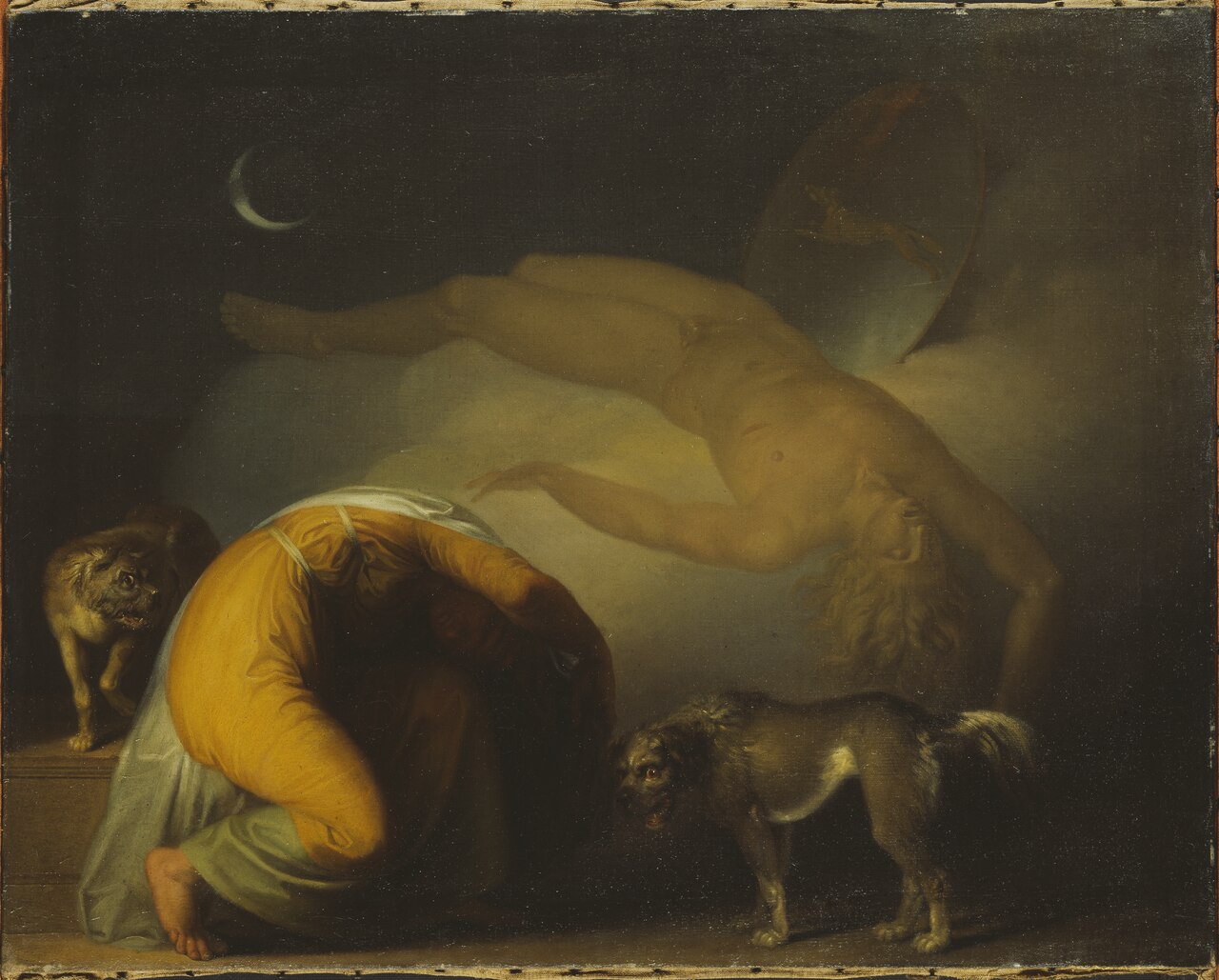
Major works - **The Wounded Philoctetes (1775)** – This early masterpiece portrays the mythic archer Philoctetes, mortally wounded and abandoned on the island of Lemnos. Abildgaard captures the hero’s physical suffering through careful rendering of torn flesh and a stark, desolate landscape, while the composition conveys a sense of noble tragedy. - **Emiliekilde (1780)** – A commemorative monument created for a private patron, Emiliekilde combines portraiture with allegorical elements. The work demonstrates Abildgaard’s skill in integrating personal likeness with symbolic motifs, a hallmark of his later public commissions. - **Culmin's Ghost Appears to his Mother (1794)** – This narrative painting explores a supernatural encounter, using a muted colour scheme to evoke an eerie atmosphere. The ghostly figure is rendered with a translucency that showcases Abildgaard’s mastery of light effects. - **Nightmare (1800)** – One of his later works, Nightmare delves into Romantic sensibilities while retaining neoclassical compositional order. The piece depicts a tormented figure under a dark, looming presence, illustrating Abildgaard’s ability to adapt to changing artistic currents. - **The Temple of Happiness (1700)** – Although the listed date predates Abildgaard’s lifetime, the work is traditionally attributed to him and reflects his interest in idealised architecture. The composition features a classical temple surrounded by allegorical figures, embodying the Enlightenment pursuit of virtue and felicity.
Influence and legacy Abildgaard’s impact on Danish art extended beyond his own oeuvre. As a professor at the Academy, he mentored a generation of artists who would shape the Golden Age of Danish painting. His emphasis on classical education, combined with a willingness to explore contemporary themes, helped bridge the gap between strict neoclassicism and the emerging Romantic movement. The decorative programmes he executed for royal palaces set a standard for state-sponsored art, influencing the visual representation of power in Denmark well into the 19th century. Art historians credit him with fostering a disciplined yet expressive artistic culture that contributed to Denmark’s reputation as a centre of refined visual arts.
Overall, Nicolai Abildgaard remains a pivotal figure whose scholarly approach to art, technical proficiency, and capacity to adapt stylistic trends cemented his place in the canon of European neoclassical painters.
Frequently asked questions
Who was Nicolai Abildgaard?
Nicolai Abildgaard (1743–1809) was a Danish neoclassical painter, sculptor and architect who taught at the Royal Danish Academy and created major works for the Danish court.
What artistic style or movement is he associated with?
He is principally associated with neoclassicism, combining classical composition with precise anatomical drawing and occasionally Romantic elements.
What are his most famous works?
His best‑known paintings include The Wounded Philoctetes (1775), Emiliekilde (1780), Nightmare (1800), Culmin's Ghost Appears to his Mother (1794) and the allegorical The Temple of Happiness.
Why is Abildgaard important in art history?
Abildgaard shaped Danish academic art through his teaching, introduced a disciplined neoclassical aesthetic to royal commissions, and influenced the transition toward Romanticism in Denmark.
How can I recognise an Abildgaard painting?
Look for clear, classical lines, a restrained palette, precise anatomical rendering, and a balanced composition that foregrounds mythological or historical narrative.