Yu Zhiding
1647 – 1709
In short
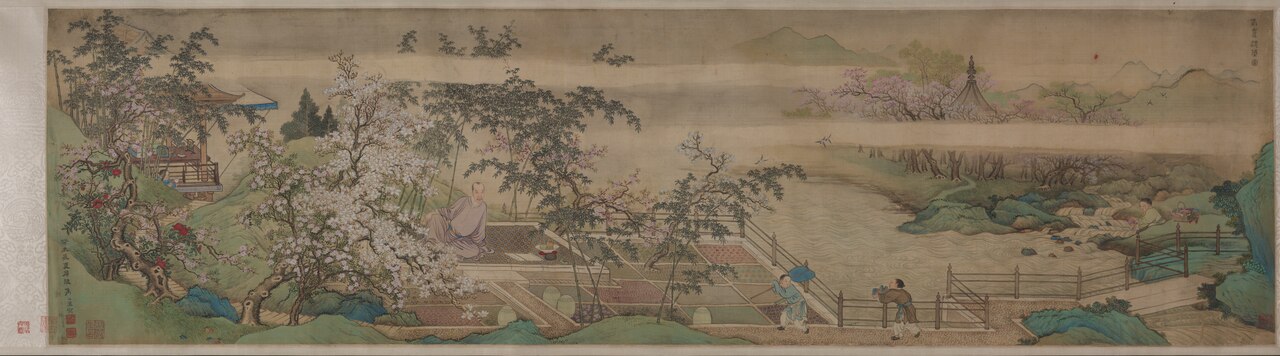
Yu Zhiding (1647–1709) was a Qing‑dynasty Chinese painter born in Xinghua and active in the imperial capital Beijing. He is noted for court paintings and portraits such as 'Cleansing Medicinal Herbs in the Stream on a Spring Day' (1703) and the portrait of Zhu Yizun.
Notable works


Early life
Yu Zhiding was born in 1647 in Xinghua, a county in the Jiangsu region of what would become the Qing dynasty. Little is known about his family background, but contemporary records indicate that he received a classical education typical of the literati class, learning calligraphy, poetry and the fundamentals of painting from an early age. The cultural environment of Jiangsu, with its rich tradition of scholar‑official painters, provided a fertile ground for his artistic development. By his early twenties, Yu had moved to Beijing, the political centre of the empire, where he sought patronage at the imperial court.
Career and style
In Beijing, Yu Zhiding entered the service of the Qing court, a position that required both technical skill and the ability to navigate the sophisticated aesthetic expectations of the emperor and his officials. His career flourished under the reigns of the Kangxi Emperor, who valued paintings that combined scholarly refinement with realistic representation. Yu’s style reflects this dual demand: he blended the literati emphasis on brushwork and personal expression with the meticulous detail favored by court painters. His subjects ranged from lyrical landscapes and genre scenes to formal portraits of scholars and officials. The compositions often display a balanced, harmonious layout, employing a restrained palette that enhances the contemplative mood of the works.
Signature techniques
Yu Zhiding is distinguished by several recurring technical approaches. He favoured a controlled ink wash, applying layers of diluted ink to create atmospheric depth while preserving the clarity of line. In his brushwork, he employed both fine, hair‑like strokes for delicate foliage and broader, more forceful strokes for structural elements such as rocks and architectural forms. Subtle colour washes—often derived from mineral pigments—were applied sparingly to accentuate key details without overwhelming the monochrome foundation. Yu also demonstrated a keen sense of perspective, using overlapping planes and shifting tonal values to suggest spatial recession, a technique that aligned with the court’s preference for realistic representation.
Major works
- Cleansing Medicinal Herbs in the Stream on a Spring Day (1703) – This landscape depicts a tranquil spring scene where figures gather medicinal herbs beside a gently flowing stream. The painting exemplifies Yu’s ability to integrate human activity within an idealised natural setting, using soft ink washes to render water and foliage, while the figures are rendered with precise, modest detail. The work is celebrated for its lyrical atmosphere and the harmonious balance between narrative content and landscape.
- Portrait of Zhu Yizun – A formal portrait of the noted scholar‑official Zhu Yizun, this piece showcases Yu’s skill in rendering facial features with subtle gradations of ink and light colour. The portrait conveys the sitter’s intellectual stature through a composed pose, a scholarly robe, and a background that hints at a modest study. Yu’s restrained palette and careful attention to the texture of the subject’s hair and beard underline his capacity for nuanced portraiture.
- Wang Shizhen Liberates the Silver Pheasant (1700) – This narrative painting illustrates a legendary or historical episode in which Wang Shizhen frees a silver pheasant. The composition is dynamic, with figures in motion and the bird captured mid‑flight. Yu employs vigorous brushstrokes for the figures and a more delicate touch for the bird, creating a contrast that highlights the central act of liberation. The work reflects the Qing court’s interest in moralised stories that celebrate virtue and benevolence.
These three works together demonstrate the breadth of Yu’s oeuvre, encompassing landscape, portraiture, and narrative painting, each executed with a consistent aesthetic sensibility.
Influence and legacy
Yu Zhiding’s paintings occupy an important place in the development of Qing‑dynasty art. By successfully marrying the literati tradition with the demands of court patronage, he helped to define a style that would influence subsequent generations of official painters. His approach to integrating subtle colour with ink wash and his balanced compositional strategies were echoed by later artists who sought to maintain scholarly authenticity while serving imperial tastes. Although not as widely known internationally as some of his contemporaries, Yu’s works are regularly exhibited in major Chinese museums and continue to be studied by scholars interested in the interplay between personal expression and official art in the early Qing period. His legacy endures in the continued appreciation of his refined brushwork and his ability to convey both narrative depth and poetic serenity within a single frame.
Frequently asked questions
Who was Yu Zhiding?
Yu Zhiding (1647–1709) was a Qing‑dynasty Chinese painter who worked in Beijing as a court artist, known for landscapes, portraits and narrative scenes.
What style or movement is Yu Zhiding associated with?
He blended the literati brushwork tradition with the realistic, detailed style favoured by the Qing imperial court, creating a hybrid style that balanced personal expression and official aesthetics.
What are Yu Zhiding’s most famous works?
His best‑known paintings include 'Cleansing Medicinal Herbs in the Stream on a Spring Day' (1703), the portrait of the scholar Zhu Yizun, and the narrative piece 'Wang Shizhen Liberates the Silver Pheasant' (1700).
Why is Yu Zhiding important in art history?
He exemplifies the successful negotiation between scholarly art and court expectations in early Qing China, influencing later official painters and contributing to the development of a distinctive imperial aesthetic.
How can I recognise a painting by Yu Zhiding?
Look for a restrained colour palette, delicate ink washes, precise yet understated brushwork, and compositions that balance narrative detail with a calm, harmonious landscape background.