Lan Ying
1585 – 1664
In short
Lan Ying (1585–1664) was a Chinese painter from Hangzhou who worked across the late Ming and early Qing periods, specialising in landscape, figure, flower and bird paintings. He is noted for his reverent reproductions of Song, Yuan and earlier masters, as well as for a handful of dated works such as the 1642 landscapes and the Autumn Landscape of 1653.
Notable works

_-_1958.395.b_-_Art_Institute_of_Chicago.jpg)


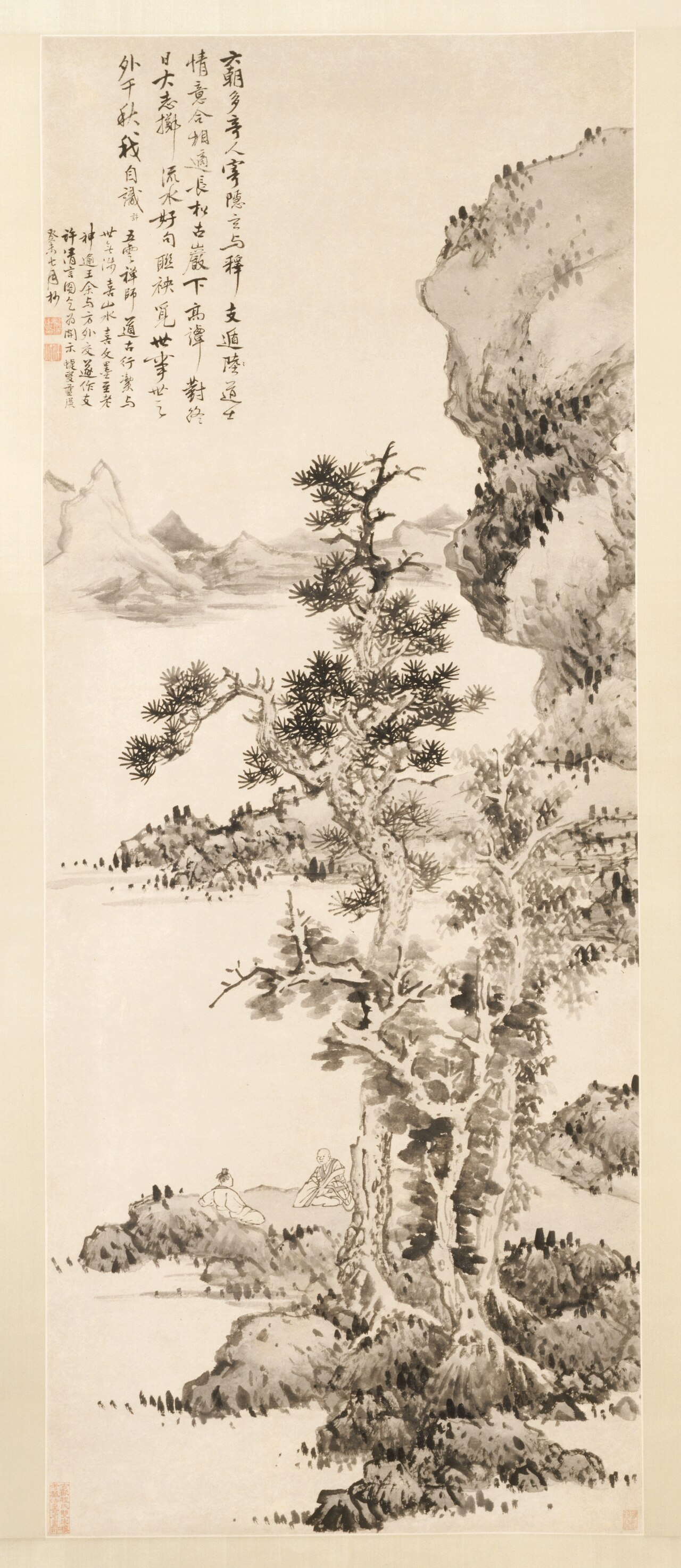
Early life Lan Ying was born in 1585 in Hangzhou, a city long celebrated for its artistic heritage and scenic beauty. Details of his family background are sparse, but the cultural environment of Hangzhou—rich in classical gardens, poetry circles and painting ateliers—provided a fertile ground for his early exposure to the visual arts. By the turn of the 17th century, Lan was already receiving instruction from local masters who emphasized the literati tradition, a mode of painting that prized personal expression and scholarly allusion over strict realism.
Career and style Lan Ying’s professional life unfolded during a period of profound political upheaval. The waning years of the Ming dynasty (1368–1644) saw a flourishing of artistic activity, while the establishment of the Qing dynasty in 1644 introduced new patronage networks. Lan navigated this transition, continuing to produce works that reflected the aesthetic values of the late Ming court and the scholarly circles that survived the regime change.
His oeuvre is characterised by a deep engagement with the classical canon. Lan repeatedly turned to the great landscape masters of the Song (960–1279) and Yuan (1271–1368) dynasties, reproducing their compositions with meticulous fidelity. At the same time, he infused these copies with his own brush‑stroke vigor, creating a hybrid style that honoured tradition while allowing for individual nuance. Beyond landscapes, Lan painted human figures, flowers and birds, each rendered with a delicate balance of line and wash that aligns him with the broader literati school.
Signature techniques Lan Ying’s technique is distinguished by several recurring elements:
* Dry‑brush rendering – He often employed a dry, textured brush to suggest rock outcrops and foliage, a method that produces a sense of atmospheric depth. * Layered ink washes – By building successive layers of diluted ink, Lan achieved subtle tonal transitions that convey mist and distant horizons. * Calligraphic strokes – His brushwork mirrors the rhythm of classical Chinese calligraphy, particularly in the rendering of tree trunks and mountain ridges. * Replication of master compositions – Lan would copy the compositional scaffolding of earlier masters, then re‑interpret the details, a practice that required both technical skill and an intimate knowledge of historic precedent.
These techniques collectively underline his reputation as a painter capable of bridging the past and his contemporary context.
Major works The surviving dated works of Lan Ying provide clear insight into his artistic priorities.
* Landscapes after Song and Yuan masters (1642) – This series demonstrates Lan’s reverence for the canonical landscape tradition. He selects motifs from renowned Song and Yuan paintings, reproducing their structural layout while applying his own brush‑stroke vigor. The works are valued for their scholarly fidelity and for the way they preserve the visual language of earlier periods.
* Landscape in the Style of Ancient Masters: after Gao Kegong (1248‑1310) (1642) – In this piece Lan pays homage to the Yuan‑era painter Gao Kegong, known for his bold compositional schemes. Lan’s rendition retains Gao’s dramatic mountain forms but softens the edges with his characteristic ink washes, creating a harmonious blend of the ancient and the contemporary.
* Autumn Landscape (1653) – One of Lan’s later dated works, the Autumn Landscape captures the seasonal shift through a palette of muted browns and ochres. The painting’s composition is anchored by a winding river and distant peaks, while the foliage is rendered with fine, dry‑brush strokes that suggest falling leaves.
* Landscape in the style of Li Tang – Although undated, this work reflects Lan’s study of the Northern Song master Li Tang, whose robust brushwork and strong structural outlines were hallmarks of his style. Lan adopts Li’s vigorous tree trunks and rock formations, yet his own softer ink tones impart a more lyrical quality.
* Zhi and Xu's Pure Conversation (1643) – This composition, dated 1643, merges landscape with a narrative element, depicting scholars engaged in intellectual exchange amid a tranquil natural setting. The painting exemplifies the literati ideal of merging poetry, calligraphy and painting, and showcases Lan’s ability to integrate human activity within a carefully constructed landscape.
Each of these works illustrates Lan Ying’s dual commitment to historical fidelity and personal expression, reinforcing his status as a conduit for the transmission of classical Chinese painting.
Influence and legacy Lan Ying’s legacy lies chiefly in his role as a preserver and interpreter of the Song‑Yuan landscape tradition during a period of dynastic change. By reproducing and subtly re‑imagining the compositions of earlier masters, he ensured that their visual vocabularies remained active in the collective artistic memory of the early Qing era. Subsequent generations of Qing painters, particularly those associated with the "Orthodox School," drew upon Lan’s examples when seeking to balance reverence for the past with contemporary innovation.
His works are now held in several major Chinese and international collections, where they serve as reference points for scholars studying the transmission of landscape motifs across dynasties. Moreover, Lan’s approach—meticulous copying combined with personal brushwork—continues to influence modern practitioners who value the dialogue between tradition and individuality in Chinese ink painting.
In sum, Lan Ying stands as a pivotal figure who bridged the late Ming artistic sensibility with the emerging Qing aesthetic, ensuring the endurance of a centuries‑old visual language through his disciplined yet expressive paintings.
Frequently asked questions
Who was Lan Ying?
Lan Ying (1585–1664) was a Chinese painter from Hangzhou who worked during the late Ming and early Qing periods, known for his landscapes, figures, flowers and birds.
What style or movement is Lan Ying associated with?
He is linked to the literati tradition, especially the practice of copying and re‑interpreting Song and Yuan landscape masters within a Ming‑Qing context.
What are Lan Ying’s most famous works?
Key works include the 1642 "Landscapes after Song and Yuan masters", "Landscape in the Style of Ancient Masters: after Gao Kegong" (1642), "Autumn Landscape" (1653), his "Landscape in the style of Li Tang", and "Zhi and Xu's Pure Conversation" (1643).
Why is Lan Ying important in art history?
He helped preserve and transmit the visual language of earlier Chinese landscape masters, influencing Qing‑era painters and providing a crucial link between Ming and Qing artistic practices.
How can I recognise a Lan Ying painting?
Look for meticulous replication of classic landscape compositions combined with dry‑brush rock textures, layered ink washes, and calligraphic brush strokes that give his works a scholarly yet personal feel.