Wu Li
1632 – 1718
In short
Wu Li (1632–1718) was a Qing‑dynasty Chinese landscape painter, poet, calligrapher and Jesuit missionary priest from Jiangsu. He blended traditional Chinese brushwork with Christian themes, producing a body of work that includes several noted paintings such as Reciting Poetry before the Yellowing of Autumn and Travelers among Streams and Mountains.
Notable works




Early life Wu Li was born in 1632 in the city of Changshu, located in Jiangsu province. Little is recorded about his family background, but it is known that he received a classical Chinese education, mastering the literary arts of poetry and calligraphy. His formative years coincided with the early Qing period, a time of political transition that also saw the arrival of Jesuit missionaries in China. By his early twenties, Wu had entered the Jesuit order, adopting the name "SJ" as a marker of his status as a Society of Jesus priest. This affiliation would shape the remainder of his life, providing both a spiritual framework and a conduit for cultural exchange.
Career and style As a Jesuit missionary, Wu Li served in various capacities across Jiangsu and the surrounding regions, often acting as a cultural intermediary between the Chinese literati and European missionaries. His artistic output reflects this dual identity. He continued the tradition of Chinese landscape painting (shanshui) while infusing his work with Christian symbolism and a contemplative lyricism derived from his poetry. The resulting style is difficult to categorise within a single movement; it can be described as a synthesis of classical Chinese brush techniques and the spiritual introspection encouraged by Jesuit teaching. Wu’s paintings typically depict serene natural scenes—mountains, rivers, and pine‑laden valleys—rendered with a restrained palette of ink and light washes, yet they occasionally contain subtle references to biblical narratives or Christian virtues.
Signature techniques Wu Li’s brushwork is characterised by fluid, expressive strokes that convey both the solidity of rock formations and the fleeting quality of mist. He employed the "wet‑brush" technique (shui mao) to achieve soft transitions in atmospheric elements, a method that enhances the sense of depth in his compositions. In calligraphy, he favoured the regular script (kaishu) for its clarity, often integrating poetic verses directly onto the painted surface. This integration of text and image is a hallmark of his oeuvre, reflecting the Chinese tradition of literati painting where poetry, calligraphy and brushwork are interdependent. Additionally, Wu occasionally used a stippling technique (cai) to suggest foliage and distant textures, a practice that adds a delicate granularity to his landscapes.
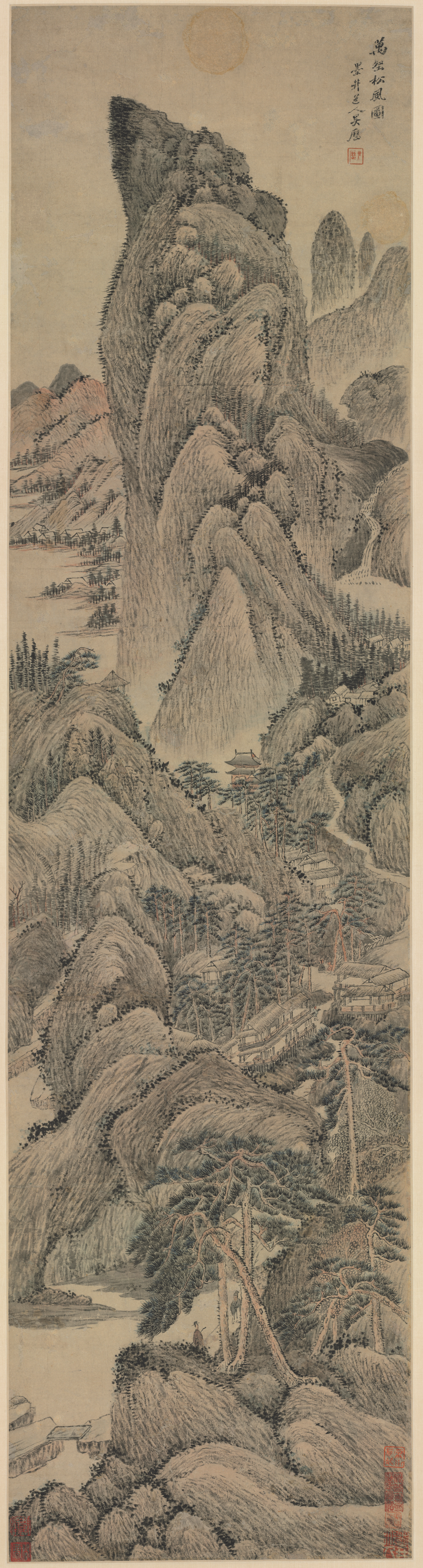
Major works Wu Li’s surviving catalogue includes several works that exemplify his artistic and spiritual concerns. **Reciting Poetry before the Yellowing of Autumn (1674)** portrays a solitary scholar seated beneath a gnarled pine, surrounded by fallen leaves that hint at the passage of time. The painting is accompanied by a short poem in Wu’s own hand, meditating on mortality and divine providence. **Travelers among Streams and Mountains (1674)** presents a group of figures navigating a winding river flanked by towering cliffs, evoking themes of pilgrimage and the journey of faith. **Whiling Away the Summer (1679)** captures a tranquil garden scene where scholars engage in study and contemplation, the composition balanced by careful use of negative space. The **Album**—a collection of smaller works—demonstrates Wu’s versatility, ranging from detailed ink studies of bamboo to more expansive panoramic vistas. Finally, **Pine Wind from Myriad Villages (1778)**, though dated after Wu’s death, is believed to be a posthumous reproduction or a later copy of an original composition; it continues the motif of wind‑swept pines and reinforces his enduring reputation. Across these pieces, Wu’s integration of poetic inscription and nuanced brushwork creates a contemplative atmosphere that invites viewers to reflect on both nature and spirituality.
Influence and legacy Wu Li occupies a distinctive niche in Qing‑dynasty art history as one of the few Chinese artists whose practice was explicitly informed by Christian ideology. While his name does not appear in the major canon of court painters, his works were circulated among Jesuit circles and Chinese literati who were curious about foreign religious ideas. This cross‑cultural exchange contributed to a modest but lasting awareness of Christian motifs within Chinese painting, predating the more extensive syncretism of the 19th century. Contemporary scholars regard Wu as an early example of cultural hybridity, and his paintings are occasionally exhibited in museums that explore the interaction between East and West. Moreover, his calligraphic style, noted for its clarity and integration with poetry, continues to be studied by students of Chinese brush art. Though not prolific in the sense of producing large numbers of works, Wu Li’s surviving pieces provide valuable insight into the intellectual and artistic currents of his time, and they remain a point of reference for researchers examining the role of missionary artists in Chinese art history.
Frequently asked questions
Who was Wu Li?
Wu Li (1632–1718) was a Qing‑dynasty Chinese painter, poet, calligrapher and Jesuit missionary priest from Jiangsu, known for blending traditional landscape painting with Christian themes.
What artistic style or movement is Wu Li associated with?
He is not linked to a specific Chinese art movement; his work fuses classical Chinese shanshui techniques with the contemplative spirituality of Jesuit Christianity.
What are Wu Li's most famous works?
His best‑known paintings include Reciting Poetry before the Yellowing of Autumn (1674), Travelers among Streams and Mountains (1674), Whiling Away the Summer (1679), the Album of assorted studies, and the later‑dated Pine Wind from Myriad Villages (1778).
Why is Wu Li important in art history?
Wu Li exemplifies early cultural exchange between China and the West, showing how Christian ideas could be integrated into Chinese literati painting, and his works provide insight into the intellectual climate of the early Qing period.
How can I recognise a painting by Wu Li?
Look for serene landscape scenes rendered with fluid ink strokes, subtle atmospheric washes, and integrated poetic inscriptions in clear regular script, often featuring pine trees, misty mountains and occasional Christian symbolic references.