Wang Shishen
1686 – 1759
In short
Wang Shishen (1686–1759) was a Qing‑dynasty Chinese painter and calligrapher renowned for his delicate depictions of plum blossoms, landscapes and flowers. His work combines literati brushwork with a subtle, expressive palette, and his paintings such as the Plum Blossom Album remain celebrated examples of 18th‑century Chinese art.
Notable works


Early life Wang Shishen was born in 1686 in She County, a region that is now part of modern‑day Anhui Province. The area was known for its scholarly traditions and natural scenery, both of which would later inform his artistic sensibility. Little is recorded about his family background, but contemporary sources suggest that he received a classical education in the Confucian canon, a typical path for aspiring scholars‑officials of the Qing period. This education would have included instruction in calligraphy, poetry, and the fundamentals of brush painting, laying the groundwork for his later career as a literati artist.
Career and style Wang Shishen emerged as a professional painter and calligrapher during the early decades of the 18th century, a time when the Qing court encouraged the revival of classical styles while also tolerating a degree of personal expression. Unlike many court painters who specialised in large scale imperial commissions, Wang cultivated a reputation among private collectors and literati circles. His style is best described as a synthesis of the orthodox literati tradition and a personal, more spontaneous brushwork. He favoured a restrained colour palette, often employing ink washes punctuated by subtle touches of colour to highlight blossoms or foliage. This approach allowed him to convey both the structural rigour of classical painting and the emotive qualities of a more individualised aesthetic.
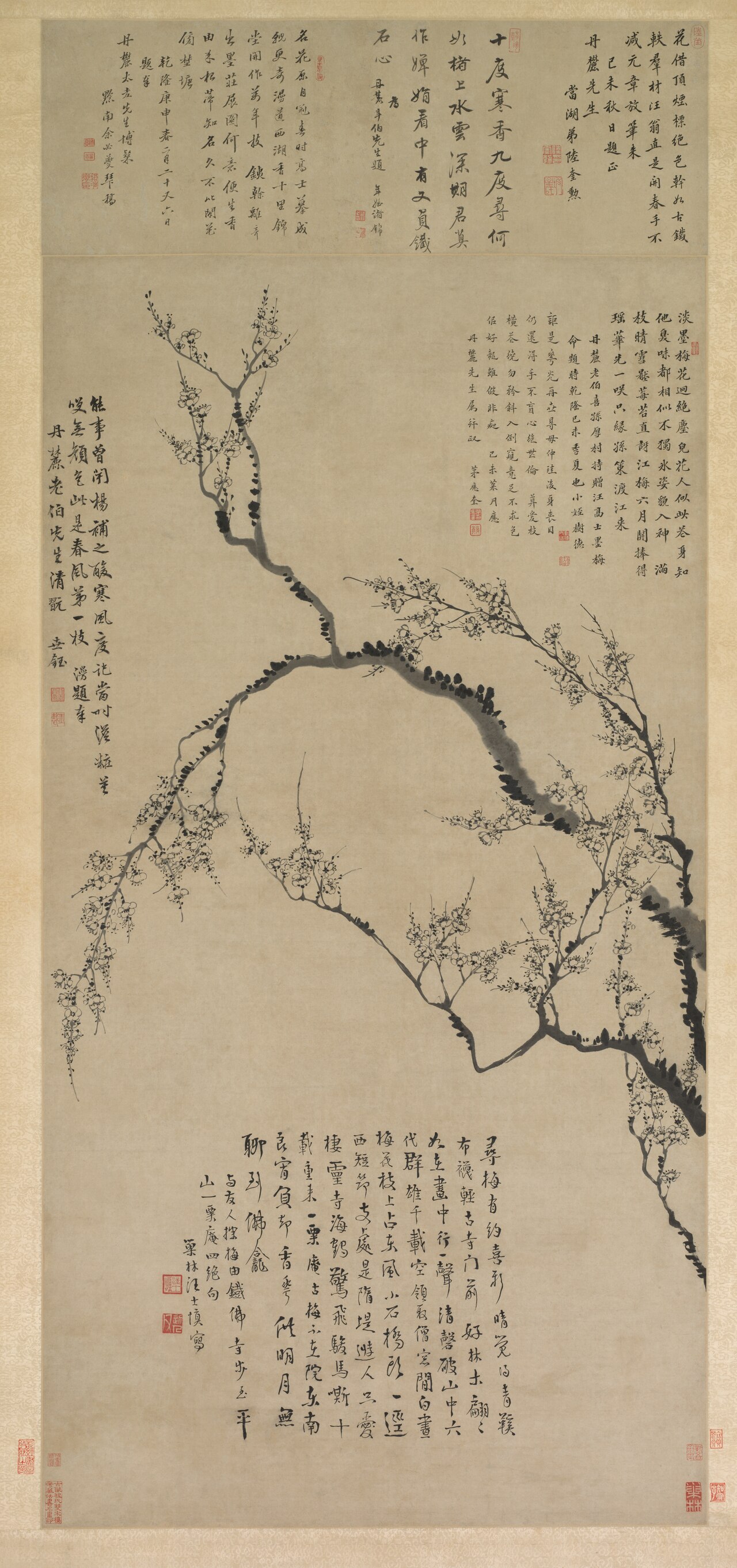
Signature techniques Wang Shishen’s technique is characterised by several recurring elements. First, his brushstrokes are notably fluid yet controlled; he often employed the "bone" (骨, gǔ) technique, where the strength of the brush line suggests the underlying structure of the subject. Second, his handling of plum blossoms demonstrates a mastery of "dotting" and "splattering" – small, precise ink dots that evoke the delicate buds, combined with occasional washes that suggest mist or the fleeting quality of spring. Third, in his landscape compositions, he used a layered approach: a light, almost transparent underpainting to establish atmospheric depth, over which he added more defined rock forms and foliage. Finally, his calligraphy, which frequently accompanied his paintings, was executed in a semi‑cursive script that mirrored the rhythm of his visual brushwork, reinforcing the unity of text and image.
Major works Wang’s extant oeuvre includes several celebrated pieces that exemplify his artistic concerns. The *Plum Blossom Album* is a collection of small, intimate paintings that each focus on a single branch of plum trees. The works are unified by a consistent compositional rhythm and a restrained colour scheme, allowing viewers to contemplate the quiet elegance of the blossoms. *Plum Blossoms* (1739) is a larger hand‑scroll that expands on the album’s theme, presenting a more expansive view of plum trees against a misty background. The piece is noted for its subtle gradations of ink and the way the blossoms appear to float within the negative space, a technique that underscores Wang’s command of atmospheric effects.
*Landscapes and Flowers* (1745) demonstrates Wang’s versatility. While the title suggests a combination of subjects, the work primarily presents a landscape scene punctuated by clusters of flowering plants. The composition balances the solidity of rock formations with the softness of blossoms, reflecting the artist’s interest in the interplay between permanence and transience. Across these works, Wang’s consistent use of restrained colour, delicate brushwork, and poetic inscriptions reveals a harmonious integration of visual and literary arts, a hallmark of literati painting.
Influence and legacy Wang Shishen’s paintings continued to be collected and admired long after his death in 1759. His approach to plum blossom painting, in particular, influenced subsequent generations of artists who sought to capture the spirit of the season with minimal yet expressive strokes. While he did not found a formal school, his works were circulated among scholarly circles, where they served as exemplars of the ideal balance between technical skill and personal expression. Modern art historians regard Wang as an important figure in the transition from the highly decorative court styles of early Qing to the more introspective, scholar‑painter tradition that flourished in the later 18th century. His paintings are held in major museum collections worldwide, and they remain a reference point for scholars examining the evolution of Chinese brush painting during a period of cultural consolidation and artistic experimentation.
In contemporary exhibitions, Wang’s works are often presented alongside those of his contemporaries to illustrate the diversity of artistic practice within the Qing dynasty. His legacy endures not only through the surviving pieces but also through the continued study of his technique, which offers insight into the nuanced relationship between calligraphy and painting that defined literati culture. For students of Chinese art, Wang Shishen exemplifies how a painter can maintain fidelity to classical models while infusing personal sensibility, thereby achieving a timeless quality that resonates across centuries.
Frequently asked questions
Who was Wang Shishen?
Wang Shishen (1686–1759) was a Qing‑dynasty Chinese painter and calligrapher known for his refined depictions of plum blossoms, landscapes, and flowers.
What artistic style or movement is Wang Shishen associated with?
He worked within the literati tradition, blending classical brush techniques with a personal, expressive touch that emphasised subtle colour and atmospheric effects.
What are Wang Shishen’s most famous works?
His most celebrated pieces include the *Plum Blossom Album*, *Plum Blossoms* (1739), and *Landscapes and Flowers* (1745).
Why is Wang Shishen important in Chinese art history?
He exemplifies the shift toward introspective scholar‑painter aesthetics in the Qing era, influencing later artists with his delicate brushwork and integration of poetry and painting.
How can I recognise a painting by Wang Shishen?
Look for fluid, controlled brushstrokes, restrained ink‑wash backgrounds, delicate dotting of plum blossoms, and poetic calligraphic inscriptions that echo the visual rhythm of the painting.