Otto Sinding
1842 – 1909
In short
Otto Sinding (1842–1909) was a Norwegian painter, illustrator, poet and dramatist known for his vivid depictions of Norway’s rugged coastlines, Arctic scenes and folk life. He worked mainly in Munich, producing works such as The Outermost Skerries and Spring Day in Lofoten, and is recognised for his naturalist approach to landscape painting.
Notable works


Early life Otto Ludvig Sinding was born on 24 December 1842 in the mining town of Kongsberg, Norway, into a cultured family that valued the arts. His father, Matthias Wilhelm Sinding, was a mining engineer, while his mother, Elisabeth Cathrine Hansen, encouraged artistic pursuits. Sinding’s early education took place in Kongsberg and later in Christiania (now Oslo), where he was exposed to the burgeoning national romantic movement that celebrated Norwegian nature and folklore. He showed an aptitude for drawing from a young age, producing sketches of local landscapes and folk scenes that hinted at his future thematic interests.
In the early 1860s, Sinding enrolled at the Royal School of Drawing in Christiania, studying under the influential painter Johan Christian Dahl, a leading figure of Norwegian Romanticism. Dahl’s emphasis on dramatic natural scenery left a lasting impression on the young Sinding, who began to develop a personal affinity for the stark, atmospheric qualities of the Norwegian coast and the Arctic north.
Career and style After completing his studies in Norway, Sinding travelled to Düsseldorf in 1865, joining the city’s renowned art academy. The Düsseldorf School was known for its precise drawing technique, attention to detail, and narrative composition—qualities that would become hallmarks of Sinding’s work. While in Germany he absorbed the academic rigour of the German tradition, but he also maintained his fascination with Scandinavian subjects.
In 1870, Sinding settled in Munich, the cultural hub of Central Europe, where he remained for the rest of his career. Munich offered a vibrant market for landscape painters, and Sinding quickly found patronage among collectors interested in exotic and northern European vistas. His style can be described as naturalist with a romantic undercurrent: he rendered the sea, ice, and sky with meticulous observation, yet infused his canvases with a sense of awe and narrative depth.
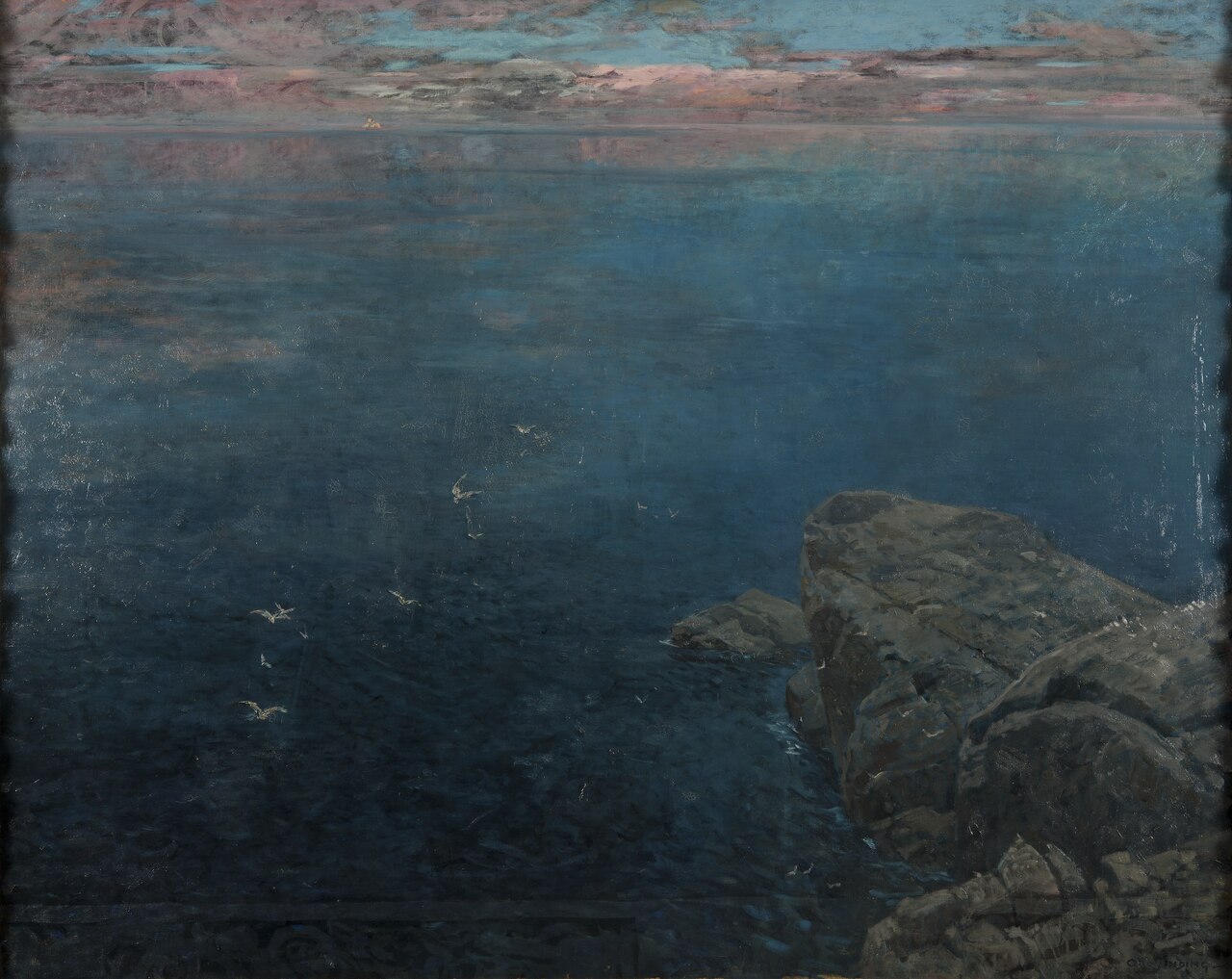
Sinding’s subject matter centred on three main themes: the dramatic coastline of Norway, the life of fishermen and coastal communities, and the stark, icy realms of the Arctic. He often combined a documentary eye for detail with a poetic sensibility, portraying both the beauty and the hardship of life in these environments. His colour palette was dominated by cool blues, greys and muted earth tones, punctuated by occasional warm highlights that draw the viewer’s focus to human figures or sunlit ice.
Signature techniques Sinding’s technique was grounded in a disciplined draftsmanship inherited from his Düsseldorf training. He employed a layered approach: an initial underdrawing in charcoal or pencil established the composition, followed by successive glazes of oil paint that built atmospheric depth. This method allowed him to capture the translucency of sea‑foam, the shimmer of ice, and the subtle gradations of a winter sky.
His handling of light was particularly noteworthy. Sinding often painted at dawn or twilight, moments when the low sun creates long shadows and a cool, diffused illumination. By juxtaposing cool shadows with the warm glow of sunrise, he achieved a visual tension that heightens the emotional impact of his scenes.
Another recurring device was the inclusion of small human or animal figures within vast natural settings. These figures, rendered with precise detail, serve both as narrative anchors and as scale references, emphasizing the enormity of the surrounding landscape.
Major works - **The Outermost Skerries** – This canvas presents a cluster of jagged rocks extending into a turbulent sea under a brooding sky. The composition showcases Sinding’s skill in rendering the interplay of rock, water and atmosphere, and it epitomises his fascination with the boundary between land and sea. - **Spring Day in Lofoten (1882)** – One of Sinding’s most celebrated works, it captures the fleeting light of early spring in the Lofoten archipelago. The painting juxtaposes bright, thawing waters against lingering snow‑capped peaks, highlighting the transitional nature of the season. - **Boats on the Beach (1883)** – In this piece, Sinding depicts a quiet coastal scene where wooden fishing boats rest on a sandy shore. The meticulous rendering of the boats’ weathered hulls and the soft, muted tones of the beach convey a sense of stillness and anticipation before the next tide. - **Ice Floes in the Arctic Ocean (1895)** – This later work reflects Sinding’s continued interest in the far north. Massive blocks of ice dominate the canvas, their surfaces rendered with delicate brushwork that suggests both solidity and fragility. The cold palette reinforces the inhospitable environment. - **From the Arctic Ocean (1895)** – Complementing the previous painting, this work offers a broader view of the Arctic sea, with distant icebergs receding into a hazy horizon. Sinding’s use of atmospheric perspective underscores the vastness and isolation of the polar landscape.
These works collectively demonstrate Sinding’s commitment to portraying Norway’s natural extremes with both scientific accuracy and lyrical imagination.
Influence and legacy Otto Sinding occupies a distinct niche in 19th‑century Scandinavian art. While he did not align himself with a single formal movement, his oeuvre bridges Romantic nationalism and emerging naturalism, offering a visual record of Norway’s coastal and Arctic environments at a time when such subjects were scarcely represented in European galleries.
His paintings influenced a generation of Norwegian artists who sought to depict their homeland’s rugged terrain with authenticity. By integrating the disciplined techniques of the Düsseldorf School with a personal, emotive vision of the north, Sinding helped shape a uniquely Norwegian approach to landscape painting.
Beyond his visual contributions, Sinding was also active as a poet and dramatist, producing verses that celebrated the same themes as his paintings. This interdisciplinary engagement reinforced his reputation as a cultural figure deeply connected to Norway’s natural heritage.
Sinding’s works remain in major public collections, including the National Museum in Oslo and several German institutions. They continue to be studied for their technical mastery and for the way they document a period of rapid social and environmental change along Norway’s coast. Contemporary scholars regard him as an essential figure for understanding the development of Northern European landscape art and the broader narrative of national identity formation in the late 19th century.
--- In sum, Otto Sinding’s paintings serve as both artistic achievements and historical documents, preserving the visual language of Norway’s seascapes and Arctic frontiers for future generations.
Frequently asked questions
Who was Otto Sinding?
Otto Sinding (1842–1909) was a Norwegian painter, illustrator, poet and dramatist best known for his naturalist landscapes of Norway’s coast and Arctic regions.
What artistic style or movement is Otto Sinding associated with?
Sinding is linked to a blend of Romantic nationalism and naturalism, combining the dramatic flair of Romanticism with the precise observation of the Düsseldorf School.
What are Otto Sinding’s most famous works?
His most celebrated paintings include The Outermost Skerries, Spring Day in Lofoten (1882), Boats on the Beach (1883), Ice Floes in the Arctic Ocean (1895) and From the Arctic Ocean (1895).
Why is Otto Sinding significant in art history?
He provided a rare, detailed visual record of Norway’s coastal and Arctic landscapes, influencing later Scandinavian artists and contributing to the formation of a national artistic identity.
How can I recognise an Otto Sinding painting?
Look for cool, muted colour palettes, meticulous draftsmanship, atmospheric light at dawn or twilight, and small human or boat figures set within expansive, dramatic seascapes or icy terrains.