Peder Severin Krøyer
1851 – 1909
In short
Peder Severin Krøyer (1851–1909) was a Danish painter born in Stavanger, Norway, who became a central figure of the Skagen Painters and a leading exponent of Impressionism in Scandinavia.
Notable works



Early life Peder Severin Krøyer was born on 23 July 1851 in Stavanger, a coastal town that at the time lay within the Danish‑Norwegian union. His father, a merchant, encouraged his early interest in drawing, and Krøyer received his first formal instruction from a local artist before moving to Copenhagen in 1869. There he enrolled at the Royal Danish Academy of Fine Arts, where he studied under the historicist painter Wilhelm Marstrand and the later‑impressionist Carl Bloch. The rigorous academic training gave Krøyer a solid foundation in drawing, composition and the handling of colour, which he would later adapt to the freer techniques of Impressionism.
Career and style After completing his studies, Krøyer travelled extensively in Europe, absorbing the latest artistic currents. A scholarship in 1877 took him to Paris, where he encountered the work of the French Impressionists, particularly Claude Monet and Camille Pissarro. The emphasis on light, atmosphere and the fleeting moment resonated with Krøyer’s own fascination with the northern coastline. Returning to Denmark, he settled in the fishing village of Skagen in 1882, joining a community of artists who were attracted by its bright, unfiltered daylight and the camaraderie of the local community. The Skagen Painters, as they became known, pursued a naturalistic style that merged academic discipline with the impressionistic concern for light and colour.
Krøyer’s mature style is characterised by luminous palette, delicate brushwork and a subtle treatment of atmospheric effects. He often employed a soft, almost hazy focus to convey the shimmering quality of sea‑air, while retaining a keen eye for the psychological depth of his subjects. His compositions balance a careful arrangement of figures with an expansive sense of space, allowing the viewer to feel both the intimacy of a gathering and the vastness of the surrounding landscape.
Signature techniques Krøyer’s technical repertoire includes several hallmarks that help to identify his work. He frequently painted en plein air, directly from the coastal scenery, capturing the changing quality of light in rapid, broken brushstrokes. In studio pieces, he layered translucent glazes to achieve a luminous depth, particularly in sky and water. A distinctive feature is his use of a bright, almost white, underpainting that allows the overlying colours to glow from within. He also incorporated subtle tonal variations in the flesh of his figures, giving them a warm, naturalistic presence. Finally, his compositional devices often involve a central focal point—such as a figure or a bundle of objects—surrounded by a loose, rhythmic arrangement that guides the eye across the canvas.
Major works Krøyer’s most celebrated paintings exemplify his command of light and social narrative.
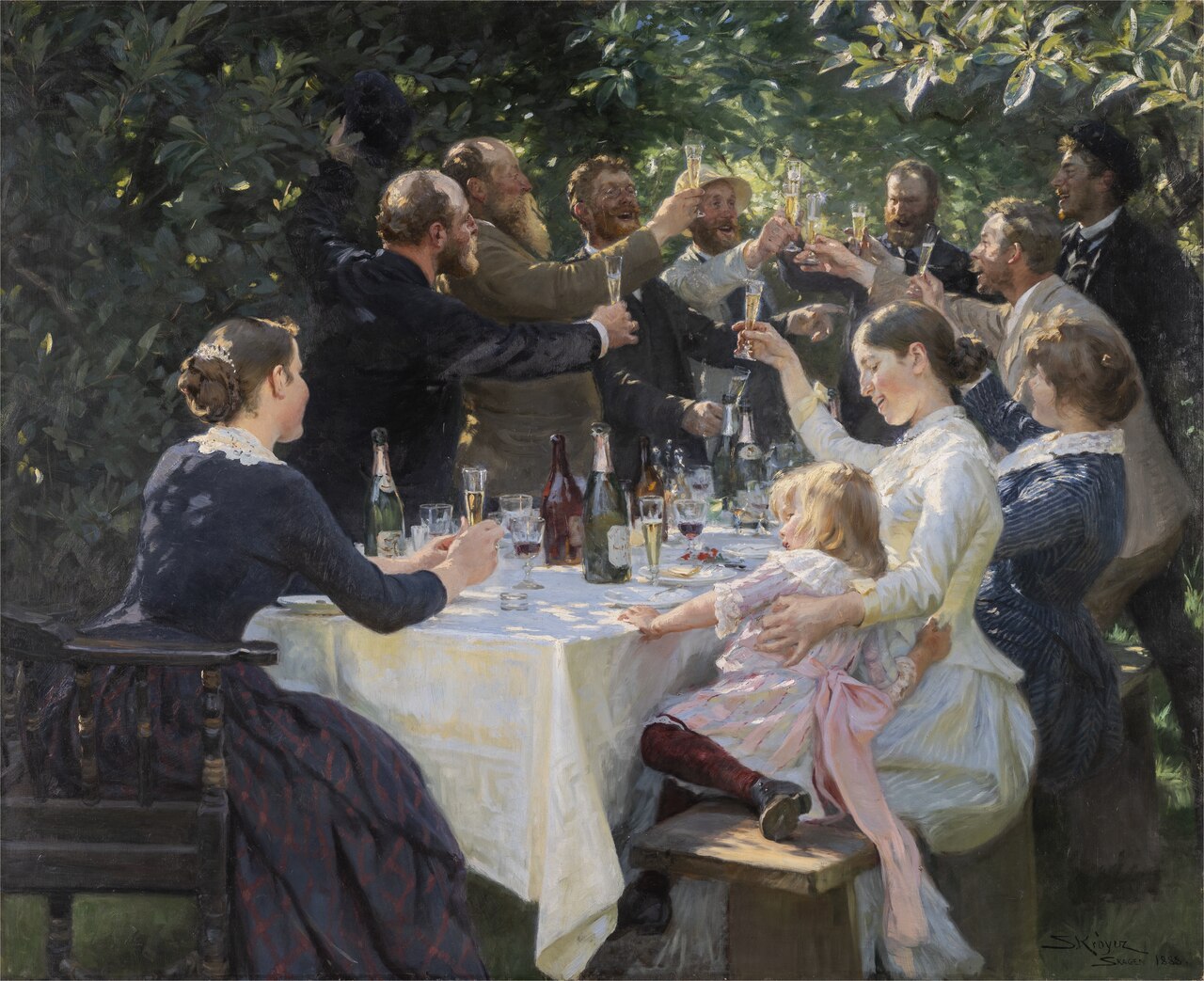
- Hip, Hip, Hurrah! (1888) – This large canvas depicts a festive gathering of the Skagen artists at the home of the painter Michael Ancher. The work is famed for its vibrant depiction of sunlight filtering through the open doors, the joyous expressions of the participants, and the rhythmic brushwork that captures the lively atmosphere of the evening.
- Summer Evening on Skagen's Southern Beach (1893) – In this tranquil scene, Krøyer portrays a group of friends strolling along the beach at dusk. The muted pinks and blues of the sky reflect on the wet sand, while the figures are rendered with a soft focus that underscores the fleeting quality of the moment.
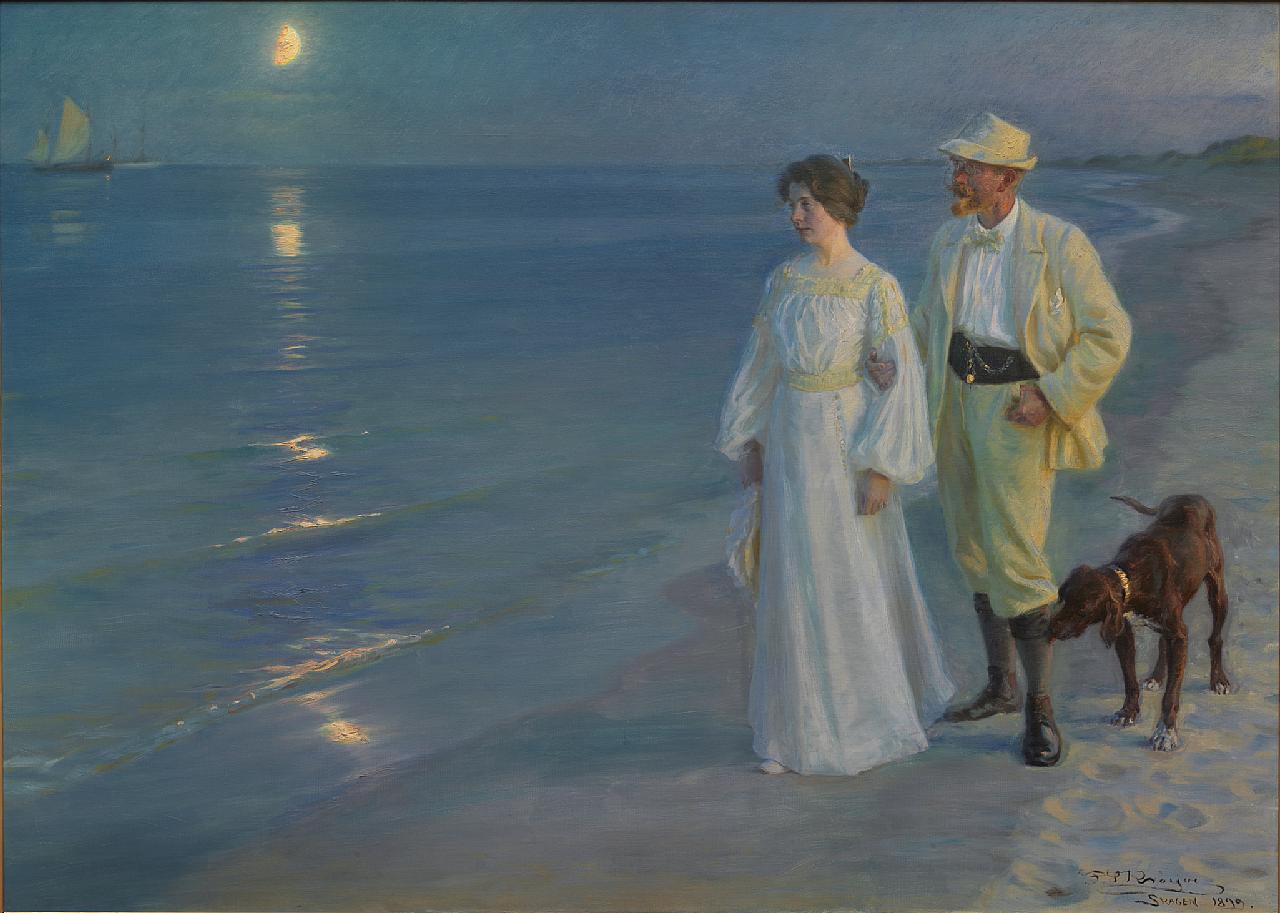
- Summer Evening at Skagen Beach – The Artist and his Wife (1899) – This intimate work shows Krøyer and his wife, Marie, walking hand‑in‑hand along the shoreline. The composition balances the couple’s silhouettes against a luminous horizon, conveying both personal affection and the broader sense of harmony between humanity and nature.
- Summer Evening at Skagen. The Artist's Wife and Dog by the Shore (1892) – Here, Marie Krøyer is shown with a small dog, standing on a rocky outcrop. The painting’s delicate handling of light on the sea and the subtle expression on Marie’s face exemplify Krøyer’s skill in rendering both landscape and portraiture within a single frame.
- Roses (1893) – Departing from his coastal subjects, this still‑life presents a bouquet of pink roses rendered with luminous colour and a gentle, almost impressionistic blur. The work demonstrates Krøyer’s versatility and his ability to convey texture and light even in confined, indoor settings.
These works, together with numerous portraits and seascapes, cement Krøyer’s reputation as an artist capable of marrying the immediacy of Impressionism with the narrative depth of the Danish Golden Age.
Influence and legacy Krøyer’s impact on Scandinavian art was profound. By integrating French Impressionist techniques with a distinctly northern sensibility, he helped to modernise Danish painting at the turn of the twentieth century. His teaching at the Royal Academy and his leadership within the Skagen community fostered a generation of artists who embraced plein‑air practice and a colouristic approach to light. The legacy of his social scenes—particularly *Hip, Hip, Hurrah!*—continues to symbolize the collaborative spirit of artistic colonies.
After his death in Skagen on 21 March 1909, Krøyer’s works entered major museum collections, most notably the Skagens Museum and the National Gallery of Denmark. Contemporary scholars regard his paintings as essential visual documents of late‑nineteenth‑century coastal life, while his technique continues to inspire modern painters seeking to capture atmosphere with subtle brushwork and luminous colour.
Overall, Peder Severin Krøyer remains a pivotal figure whose synthesis of academic training and impressionistic vision produced a body of work that is both historically significant and aesthetically enduring.
Frequently asked questions
Who was Peder Severin Krøyer?
Peder Severin Krøyer (1851–1909) was a Danish painter of Norwegian birth, best known as a leading member of the Skagen Painters and a key representative of Impressionism in Scandinavia.
What artistic style or movement is he associated with?
Krøyer is closely linked to Impressionism, adapting its focus on light and colour while maintaining a naturalistic, narrative approach rooted in the Danish Golden Age.
Which of his works are the most famous?
His most celebrated paintings include *Hip, Hip, Hurrah!* (1888), *Summer Evening on Skagen's Southern Beach* (1893), *Summer Evening at Skagen Beach – The Artist and his Wife* (1899), *Summer Evening at Skagen. The Artist's Wife and Dog by the Shore* (1892) and the still‑life *Roses* (1893).
Why is Krøyer considered important in art history?
Krøyer modernised Danish art by merging French Impressionist techniques with a northern sensibility, influencing subsequent generations and documenting the cultural life of Skagen’s artistic community.
How can I recognise a painting by Krøyer?
Look for luminous, pastel‑toned palettes, soft brushwork that captures fleeting light, often coastal or social scenes with a gentle focus, and a subtle use of glazes that give the surface a glowing depth.