Peter Nicolai Arbo
1831 – 1892
In short
Peter Nicolai Arbo (1831–1892) was a Norwegian painter renowned for his historical canvases and portraits, especially works that draw on Norse mythology such as The Wild Hunt of Odin. He combined academic training with a national‑romantic interest in Norwegian legends, leaving a lasting influence on 19th‑century Scandinavian art.
Notable works

_by_Peter_Nicolai_Arbo.png)


Early life Peter Nicolai Arbo was born on 18 January 1831 in the manor of Gulskogen, near Drammen in Norway. He came from a prosperous family; his father, a merchant, encouraged his early interest in drawing. Arbo received his first formal instruction at the drawing school of the Royal Norwegian Academy of Arts in Christiania (now Oslo), where he was exposed to the academic traditions that dominated European painting in the mid‑19th century. In 1852 he travelled to Copenhagen to study at the Royal Danish Academy of Fine Arts, a common path for Norwegian artists seeking a broader artistic environment. The Danish capital offered him access to the works of the Danish Golden Age, reinforcing his grounding in realistic portraiture and historical narrative.
Career and style After completing his studies, Arbo returned to Norway and began exhibiting at the annual Autumn Exhibition in Christiania. He quickly established a reputation as a portraitist, receiving commissions from the emerging bourgeoisie and the royal court. His style blended the precise draftsmanship of academic training with a growing fascination for national themes. Throughout the 1860s and 1870s, Arbo turned increasingly to subjects drawn from Norse mythology and early Norwegian history, reflecting the broader national‑romantic movement that sought to define a distinct cultural identity for Norway.
Arbo’s compositions are characterised by dramatic lighting, strong anatomical rendering, and a clear, narrative focus. While he never aligned himself formally with a specific avant‑garde movement, his work can be situated within the Romantic‑historical tradition, sharing affinities with contemporaries such as Hans Gude and Adolph Tidemand, who also explored mythic and historical subjects. Arbo’s palette often employed deep earth tones punctuated by luminous highlights, a choice that heightened the emotional intensity of his mythic scenes.
Signature techniques Arbo’s technical approach was anchored in meticulous drawing. He employed a tight underdrawing before applying layers of oil, ensuring that figures retained anatomical correctness even in highly charged, fantastical settings. His handling of drapery demonstrates a keen observation of fabric behaviour, creating a realistic sense of weight and movement. In many of his mythological works, Arbo used chiaroscuro to accentuate the supernatural atmosphere: the interplay of light and shadow serves both compositional and narrative purposes, guiding the viewer’s eye toward focal points such as the central deity or heroic figure.
Another notable technique is his use of atmospheric perspective to convey depth. In large canvases like The Wild Hunt of Odin, distant figures and landscape elements recede into cooler, less saturated tones, enhancing the drama of the foreground action. Arbo also incorporated fine details—such as intricate armour, weaponry, and heraldic symbols—to reinforce the historical authenticity of his subjects, even when the narrative itself was mythological.
Major works Arbo’s most celebrated pieces revolve around the Norse legend of the Wild Hunt, a spectral procession led by Odin that sweeps across the sky. The first version, *Wild Hunt of Odin* (1868), was exhibited in Christiania and attracted considerable attention for its dynamic composition and vivid portrayal of the god’s mounted entourage. A later, larger version, *The Wild Hunt of Odin* (1872), now hangs in the National Gallery in Oslo. This canvas expands the original concept, placing Odin on a towering horse amid a storm‑laden sky, surrounded by a legion of hunters. The work epitomises Arbo’s ability to fuse mythic grandeur with disciplined academic technique.
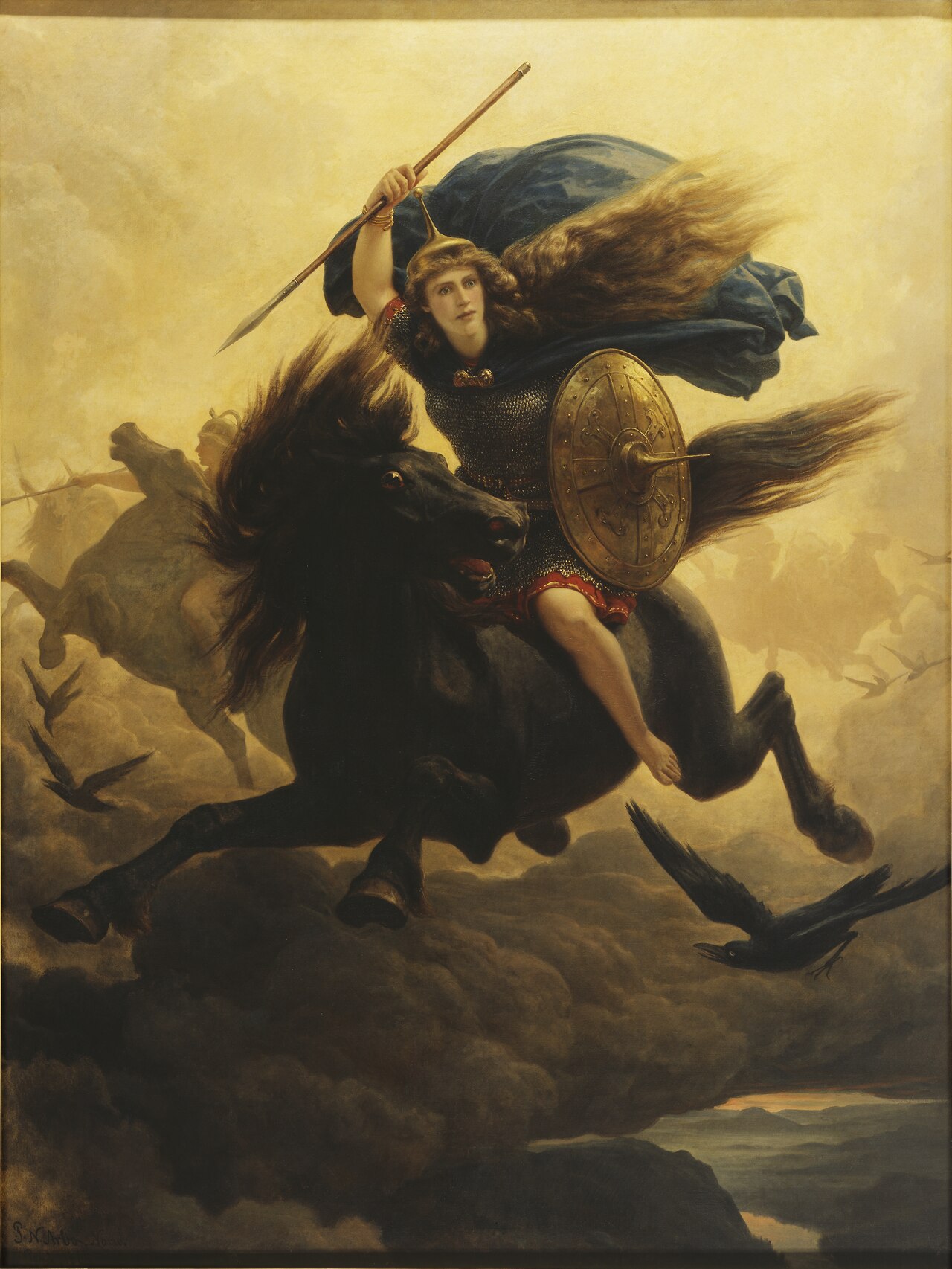
*Valkyrie* (1865) presents a solitary female figure from Norse myth, rendered with a blend of realism and idealisation. The painting captures the warrior’s resolve through a poised stance and a carefully modelled armour, while the background suggests a misty battlefield, underscoring the Valkyrie’s role as chooser of the slain.
Arbo’s portraiture includes the *Portrait of the Painter Hans Johan Frederik Berg* (1869), a respectful yet intimate depiction of his fellow artist. The painting demonstrates Arbo’s skill in capturing personality through subtle facial expression and the nuanced rendering of textures such as linen and hair. Another notable portrait, *Portrait of Dagny Kiær* (1885), shows a young Norwegian woman in a domestic setting; the work is praised for its delicate colour harmony and the sitter’s contemplative gaze, reflecting Arbo’s continued engagement with contemporary society even as he pursued mythic subjects.
These works collectively illustrate Arbo’s range—from grand, myth‑laden histories to sensitive, individualized portraiture—highlighting his contribution to the visual articulation of Norwegian identity in the 19th century.
Influence and legacy Peter Nicolai Arbo’s legacy rests on his synthesis of academic technique with national‑romantic content. By rendering Norse myths with the same rigor applied to historical portraiture, he helped legitise mythic themes as worthy of high art, influencing subsequent generations of Scandinavian painters. Artists such as Erik Werenskiold and Harriet Backer, who later explored Norwegian folklore and landscape, inherited Arbo’s commitment to marrying narrative depth with technical precision.
Arbo’s works remain central to Norwegian cultural heritage; *The Wild Hunt of Odin* is frequently reproduced in textbooks and tourism materials, serving as a visual emblem of Norway’s mythic past. The paintings continue to be exhibited in major institutions, and scholarly interest persists, particularly in studies of 19th‑century nationalism and the visual representation of myth. Through his portraits, Arbo also documented the faces of Norway’s emerging middle class, providing valuable sociocultural insight into the period.
Overall, Arbo’s career exemplifies the 19th‑century artist’s role as both chronicler and creator, preserving historical memory while shaping contemporary aesthetic values. His body of work remains a touchstone for scholars and art lovers seeking to understand the intersection of academic painting and national identity in Norway.
Frequently asked questions
Who was Peter Nicolai Arbo?
Peter Nicolai Arbo (1831–1892) was a Norwegian painter known for his historical canvases and portraits, especially those depicting Norse mythological scenes.
What artistic style or movement is Arbo associated with?
Arbo worked within the academic‑historical tradition and is linked to the national‑romantic movement that celebrated Norwegian history and mythology.
What are his most famous works?
His best‑known paintings are the two versions of *The Wild Hunt of Odin* (1868 and 1872) and *Valkyrie* (1865), alongside notable portraits such as *Portrait of the Painter Hans Johan Frederik Berg* (1869).
Why does Arbo matter in art history?
He helped legitise mythological subjects in fine art, influencing later Scandinavian artists and contributing to the visual definition of Norwegian national identity.
How can I recognise an Arbo painting?
Look for precise draftsmanship, dramatic chiaroscuro, detailed armour or clothing, and a narrative focus that often combines realistic portraiture with mythic or historical themes.