Hans Gude
1825 – 1903
In short
Hans Gude (1825–1903) was a Norwegian romantic landscape painter best known for his depictions of fjords, mountains and coastal scenes. He taught at the Düsseldorf Academy and later in Berlin, influencing generations of Scandinavian artists.
Notable works




Early life Hans Fredrik Gude was born on March 13, 1825, in Christiania (now Oslo), Norway, into a modest family with a strong appreciation for the natural world. His father, a merchant, encouraged young Hans to sketch the surrounding countryside, a habit that would become the foundation of his artistic career. After completing basic schooling, Gude enrolled at the Royal School of Drawing in Christiania, where he received his first formal instruction in drawing and perspective. His talent for rendering atmospheric effects quickly attracted the attention of established artists, and in 1842 he earned a scholarship to study abroad, a common path for promising Norwegian painters of the period.
Career and style In 1842 Gude travelled to the German city of Düsseldorf, the centre of a flourishing school of landscape painting. There he entered the studio of Johann Wilhelm Schirmer, a leading figure of the Düsseldorf school, and absorbed the academy’s emphasis on meticulous observation, compositional balance and the lyrical treatment of light. Gude’s early works already displayed a synthesis of Norwegian romanticism with the academic rigour of his German mentors. By the late 1840s he had secured a reputation as a painter capable of translating the dramatic topography of Norway into images that appealed to both domestic and European audiences.
After a brief return to Norway, where he completed his first major commission—a scene of a bridal procession on the Hardangerfjord (1848)—Gude accepted a professorship at the Kunstakademie Düsseldorf in 1855. His tenure there lasted more than two decades; he taught drawing, composition and the principles of plein‑air observation, mentoring a generation of Scandinavian artists including his compatriot Johan Christian Dahl. In 1880 Gude relocated to Berlin, accepting a senior teaching post at the Prussian Academy of Arts. The move reflected both his growing stature in the German art world and his desire to influence a broader European audience.
Throughout his career Gude remained committed to the ideals of National Romanticism, a movement that celebrated the unique landscape, folklore and cultural identity of Norway. While his subject matter was firmly rooted in the natural environment, his approach blended realistic detail with an idealised, almost poetic atmosphere. This duality allowed his paintings to serve both as documentary records of Norway’s coastal and mountainous terrain and as visual embodiments of 19th‑century Romantic sentiment.
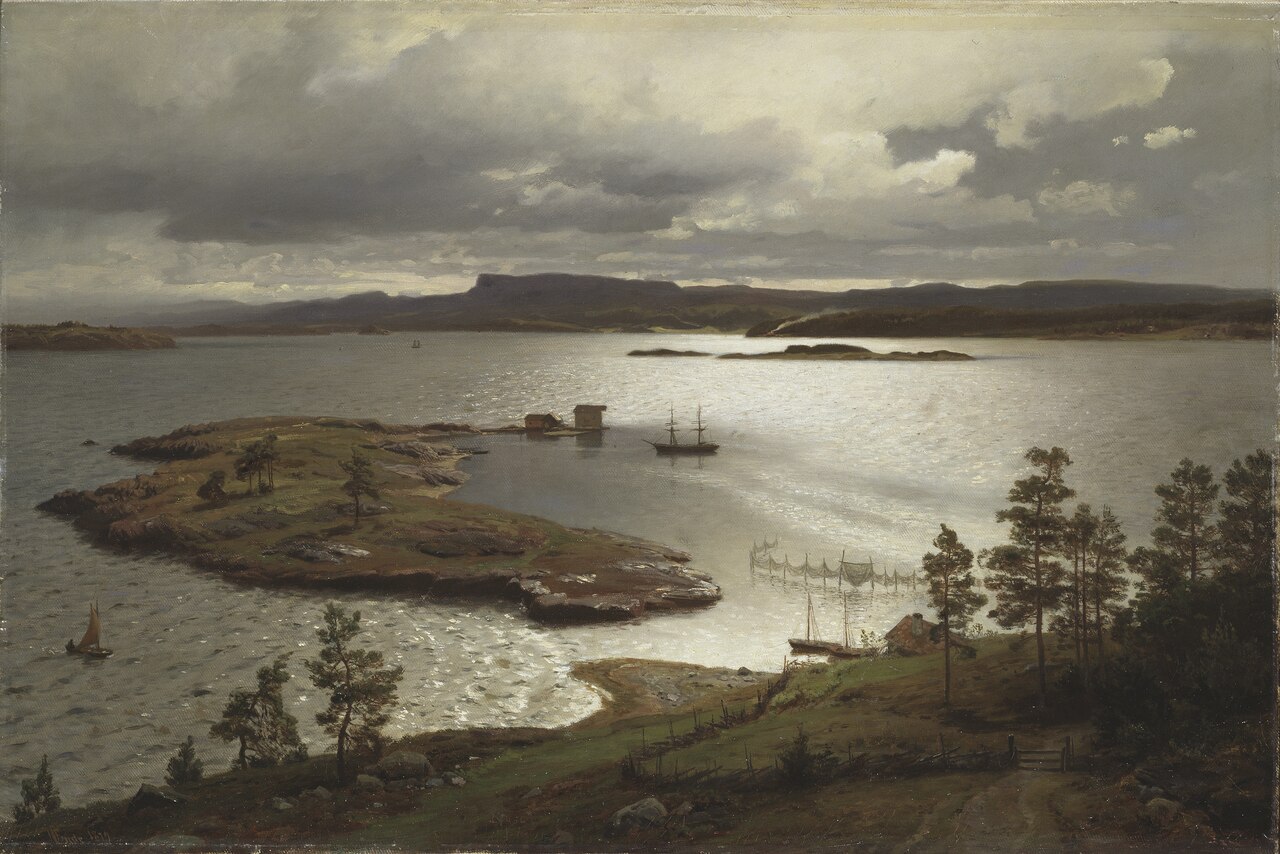
Signature techniques Gude’s paintings are distinguished by several recurring technical strategies. First, he employed a precise handling of light, often depicting the soft, diffused illumination that characterises early morning or twilight in northern latitudes. He achieved this effect through layered glazes and delicate colour modulation, creating a sense of depth that draws the viewer into the landscape. Second, his compositional structures frequently used a low horizon line, allowing the sky and water to dominate the frame and accentuate the grandeur of the surrounding cliffs and fjords. Third, Gude’s brushwork varied between tight, controlled strokes for architectural elements—such as the wooden houses in his coastal scenes—and looser, more expressive applications for clouds, water and atmospheric haze. This contrast heightened the realism of human habitation while preserving the sublime qualities of the natural world.
Another hallmark of Gude’s oeuvre is his careful rendering of atmospheric perspective. By subtly desaturating colours and reducing contrast in distant elements, he conveyed the vast scale of Norwegian landscapes and the sense of space that viewers experience when standing on a fjord’s edge. Finally, his occasional forays into genre painting—most notably the work *Woman Reading a Letter* (1882)—demonstrate an ability to integrate narrative content within his landscape framework, using figures to provide emotional context without detracting from the surrounding environment.
Major works Gude’s catalogue contains several works that have become emblematic of his artistic vision. *Bridal Procession on the Hardangerfjord* (1848) illustrates a ceremonial scene set against the towering cliffs of the Hardanger region, combining meticulous detail in the figures’ costumes with a sweeping vista of the fjord’s reflective waters. *Nødhavn Ved Norskekysten* (1873) portrays a storm‑tossed harbour where ships seek refuge, displaying Gude’s mastery of turbulent sea‑foam and the dramatic interplay of wind‑blown clouds.
In *The Sandvik Fiord* (1879), Gude captures the tranquil beauty of a lesser‑known inlet, employing his characteristic low horizon line to foreground the sky’s pastel hues. The same year he produced a series of illustrations for Asbjørnsen’s *Adventure*, a collection of Norwegian folk tales; these drawings demonstrate his skill in adapting a landscape sensibility to narrative illustration, using line work to suggest both setting and mood.
*Woman Reading a Letter* (1882) marks a departure from pure landscape, introducing a solitary figure within a domestic interior. Yet even here Gude’s treatment of light through a nearby window echoes the atmospheric concerns that dominate his outdoor scenes, linking the intimate genre piece to his broader artistic preoccupations.
These works, together with numerous lesser‑known paintings and sketches, cement Gude’s reputation as a painter who could render both the majesty of Norway’s natural scenery and the subtle drama of everyday life.
Influence and legacy Hans Gude’s influence extended far beyond his own prolific output. As a professor at two of Europe’s most prestigious art academies, he shaped the training of countless artists from Scandinavia, Germany and beyond. His emphasis on careful observation, combined with a Romantic reverence for the landscape, helped to define the visual language of Norwegian National Romanticism. Many of his students, such as Theodor Kittelsen and Erik Werenskiold, went on to become leading figures in the development of modern Norwegian art.
Gude’s paintings also played a pivotal role in promoting Norway’s natural heritage to an international audience during a period when the country was seeking cultural recognition. By presenting the fjords, mountains and coastlines with both scientific accuracy and poetic resonance, he contributed to the formation of a national identity rooted in the environment.
In contemporary art history, Gude is regularly cited as a bridge between the German Düsseldorf school’s academic tradition and the emerging Nordic aesthetic that would later influence Symbolist and Expressionist movements. His works remain part of major museum collections, including the National Museum in Oslo and the Berlin State Museums, and continue to be studied for their technical mastery and cultural significance.
Overall, Hans Gude’s legacy endures as a testament to the power of landscape painting to convey both place and feeling, and as a cornerstone in the narrative of 19th‑century European art.