Frits Thaulow
1847 – 1906
In short
Frits Thaulow (1847–1906) was a Norwegian painter who became a leading figure in European Impressionism. He is celebrated for his naturalistic landscapes, especially winter scenes, rendered with subtle colour and atmospheric light. His work bridges Norwegian tradition and French Impressionist technique.
Notable works


.PNG)
Early life Frits Thaulow was born on 5 October 1847 in Christiania, the capital of Norway (now Oslo). He grew up in a middle‑class family that valued education and the arts. After completing his primary schooling, Thaulow enrolled at the Royal Drawing School in Christiania, where he received a solid foundation in drawing and composition. In his late teens he moved to Düsseldorf, Germany, to study at the Kunstakademie, a centre for the German Romantic school of landscape painting. The Düsseldorf period exposed him to a disciplined approach to rendering nature, which would later be tempered by the looser brushwork he encountered in France.
Career and style In 1872 Thaulow travelled to Paris, the epicentre of the modern art world. He enrolled at the Académie Julian and attended the ateliers of Jean‑Louis Ernest Meissonier and later the studio of Léon Bonnat. It was in Paris that Thaulow encountered the burgeoning Impressionist movement, meeting artists such as Claude Monet and Camille Pissarro. He was particularly drawn to their emphasis on light, colour, and the fleeting effects of weather. While he never exhibited with the core group of Impressionists, he adopted their plein‑air methodology, painting outdoors to capture atmospheric conditions directly.
Throughout the 1880s and 1890s Thaulow split his time between Norway, France, and Italy. He maintained a studio in Paris but returned regularly to his native country to paint its distinctive landscapes—snow‑covered fjords, frozen rivers, and misty forests. His work is characterised by a restrained palette, meticulous observation of water and ice, and a calm, almost lyrical mood. Unlike the more radical French Impressionists, Thaulow preserved a degree of realism, making his paintings accessible to both academic audiences and the growing market for modern art.
Signature techniques Thaulow’s technique combined the disciplined underdrawing of his German training with the loose brushwork of French Impressionism. He often sketched the composition on site, then refined the painting in the studio, allowing him to balance spontaneity with structural control. A hallmark of his approach was the nuanced rendering of water and ice; he layered thin washes of colour to suggest translucency, using cooler blues and greys for shadows and warmer ochres for reflected light. Light was treated as a separate, almost atmospheric element, with subtle gradations that convey the time of day and weather conditions. Thaulow also employed a muted tonal range, avoiding the vivid, saturated hues typical of some of his French contemporaries, which gave his works a serene, timeless quality.
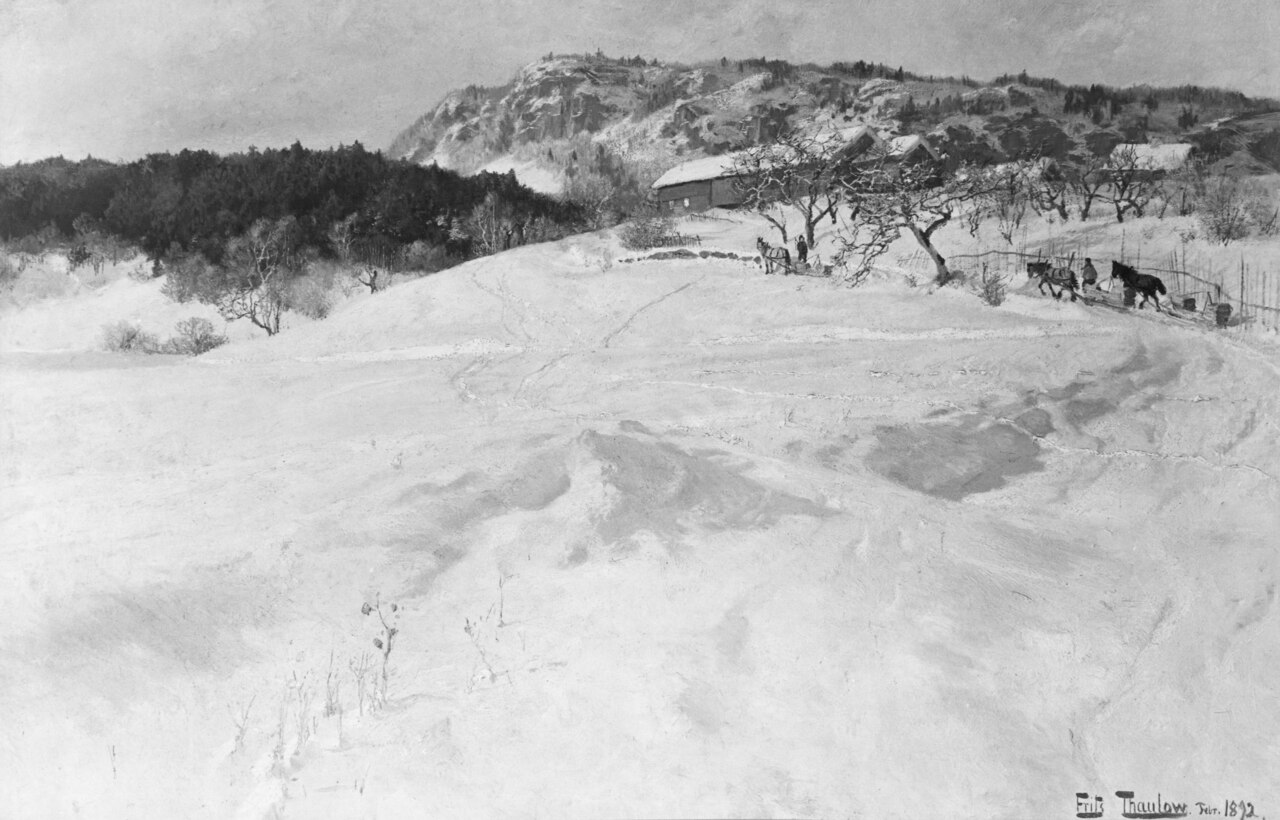
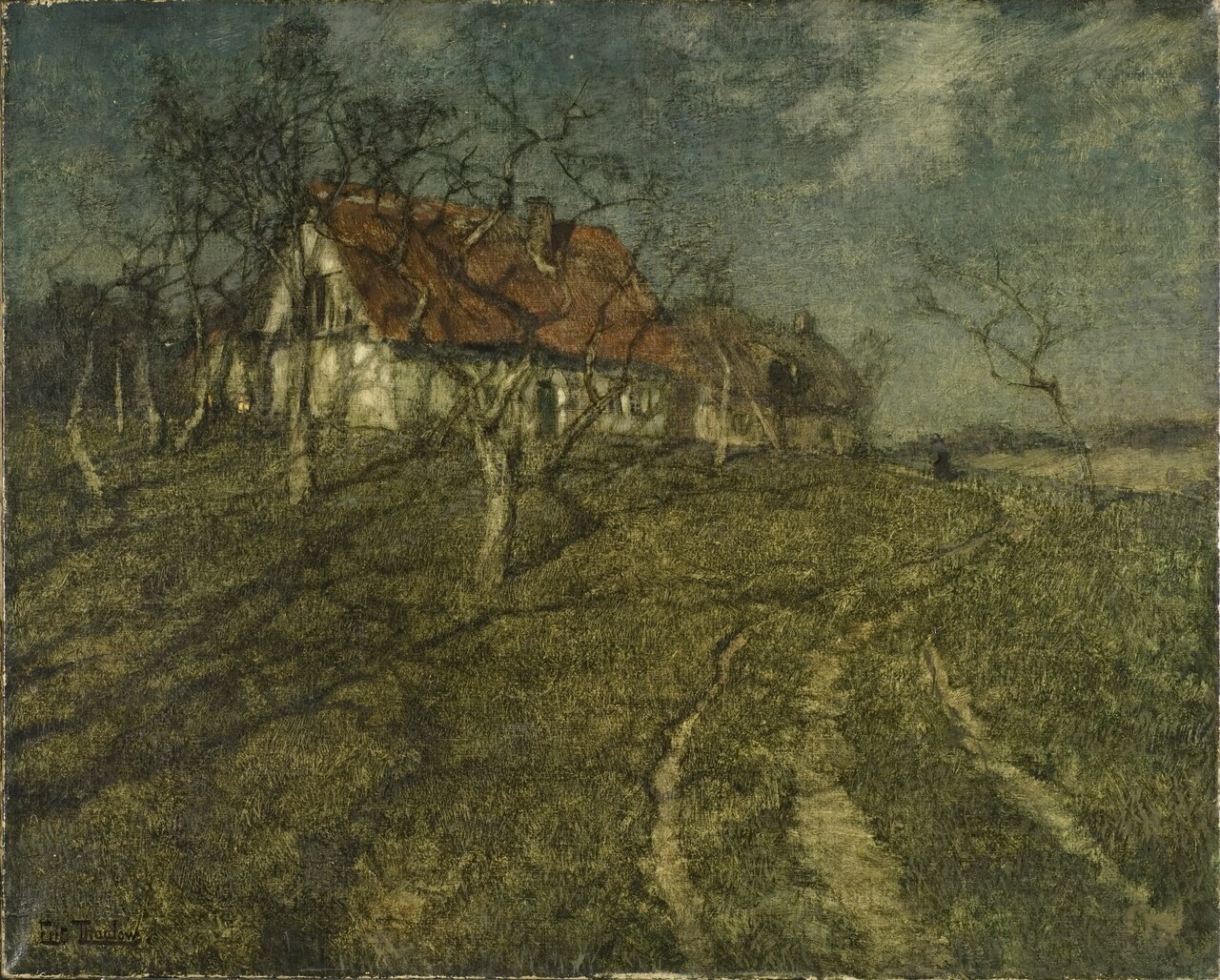
Major works - **Winter in Norway (1886)** – This painting epitomises Thaulow’s fascination with the Norwegian winter. A frozen river winds through a quiet village, its surface broken by faint cracks that catch the pale winter light. The muted palette of whites, blues, and soft browns conveys the chill of the season while the delicate handling of reflections suggests the quiet activity beneath the ice. - **A Stream in Springtime** – In contrast to his winter scenes, this work captures the rejuvenation of water in early spring. Thaulow renders the stream with fluid brushstrokes, highlighting the play of sunlight on rippling water. The surrounding foliage, rendered in fresh greens, underscores the seasonal transition. - **PONTE PIETRA, VERONA** – Painted during a period of travel in Italy, this work showcases Thaulow’s ability to adapt his style to urban architecture. The historic stone bridge is bathed in the golden glow of late afternoon, and the surrounding cityscape is softened by an atmospheric haze, demonstrating his skill in rendering both natural and built environments. - **A January Day in Norway (1892)** – One of his later winter pieces, this painting depicts a snow‑covered landscape under a low, overcast sky. Thaulow’s careful observation of snow’s texture and the muted sky creates a sense of stillness and introspection, reflecting the contemplative mood of the northern winter. - **Shadows** – Though less known than his landscapes, this work focuses on the interplay of light and dark. Thaulow uses a limited colour range to explore how shadows fall across a simple rural scene, emphasizing the subtle tonal variations that give depth to the composition.
Each of these works illustrates Thaulow’s consistent interest in atmosphere, water, and the quiet moments of everyday life. They also reveal his ability to translate the Impressionist concern with light into a distinctly Norwegian sensibility.
Influence and legacy Frits Thaulow played a pivotal role in introducing French Impressionist ideas to Scandinavia. His teaching at the Royal Academy in Oslo influenced a generation of Norwegian painters, including Christian Krohg and Harriet Backer, who adopted his emphasis on light and naturalism. Thaulow’s balanced approach—combining rigorous drawing with impressionistic colour—helped shape the development of modern Norwegian landscape painting.
Internationally, his works were exhibited in major salons in Paris, Berlin, and London, earning him recognition beyond the Nordic countries. Collectors of the late 19th and early 20th centuries prized his paintings for their serene beauty and technical finesse. Today, his paintings are held in the National Museum of Art, Architecture and Design in Oslo, the Musée d’Orsay in Paris, and numerous private collections, affirming his lasting relevance.
Thaulow’s legacy endures in the way contemporary artists approach the depiction of light and atmosphere in northern climates. His paintings continue to be studied for their meticulous observation of natural phenomena and for the subtle way they bridge academic realism with modernist experimentation. By capturing the quiet dignity of Norway’s landscapes, he secured a place as one of the foremost interpreters of Scandinavian scenery in the Impressionist era.
Frequently asked questions
Who was Frits Thaulow?
Frits Thaulow was a Norwegian painter (1847–1906) known for his naturalistic, Impressionist landscapes, especially winter scenes.
What style or movement is he associated with?
He worked within the Impressionist movement, blending French light‑effects with a restrained, realistic palette.
What are his most famous works?
Key paintings include Winter in Norway (1886), A Stream in Springtime, Ponte Pietra, Verona, A January Day in Norway (1892) and Shadows.
Why does Thaulow matter in art history?
He introduced Impressionist techniques to Scandinavia, influencing Norwegian landscape painting and bridging academic realism with modernist approaches.
How can I recognise a Thaulow painting?
Look for serene, muted colour schemes, careful rendering of water or snow, subtle atmospheric light, and a calm, almost lyrical mood.