Oda Krohg
1860 – 1935
In short
Oda Krohg (1860–1935) was a Norwegian painter associated with the Kristiania Bohemian circle. She is noted for her portraits and genre scenes, often reflecting the social milieu of late‑19th‑century Oslo, and she played a key role in Norway’s modernising art scene.
Notable works



Early life Oda Krohg was born Oda Lasson in Oslo (then called Christiania) in 1860. She grew up in a middle‑class family that valued education and the arts, which afforded her early exposure to drawing and painting. After completing her basic schooling, she pursued artistic training at the Royal School of Drawing in Oslo, where she encountered the progressive ideas of the Kristianian Bohemians—a loose collective of writers, musicians and visual artists who challenged conventional social norms.
Career and style Krohg’s professional development was closely linked to her relationship with Christian Krohg, a leading figure in Norwegian naturalism. Under his mentorship she refined a realist approach grounded in observation, yet she gradually incorporated a more intimate, psychological dimension into her work. Throughout the 1880s and 1890s she exhibited regularly at the National Autumn Exhibition in Oslo, gaining recognition for her ability to capture the inner lives of her subjects. Her style is characterised by a restrained palette, careful modelling of light and shadow, and a compositional clarity that foregrounds the sitter’s expression over decorative detail.
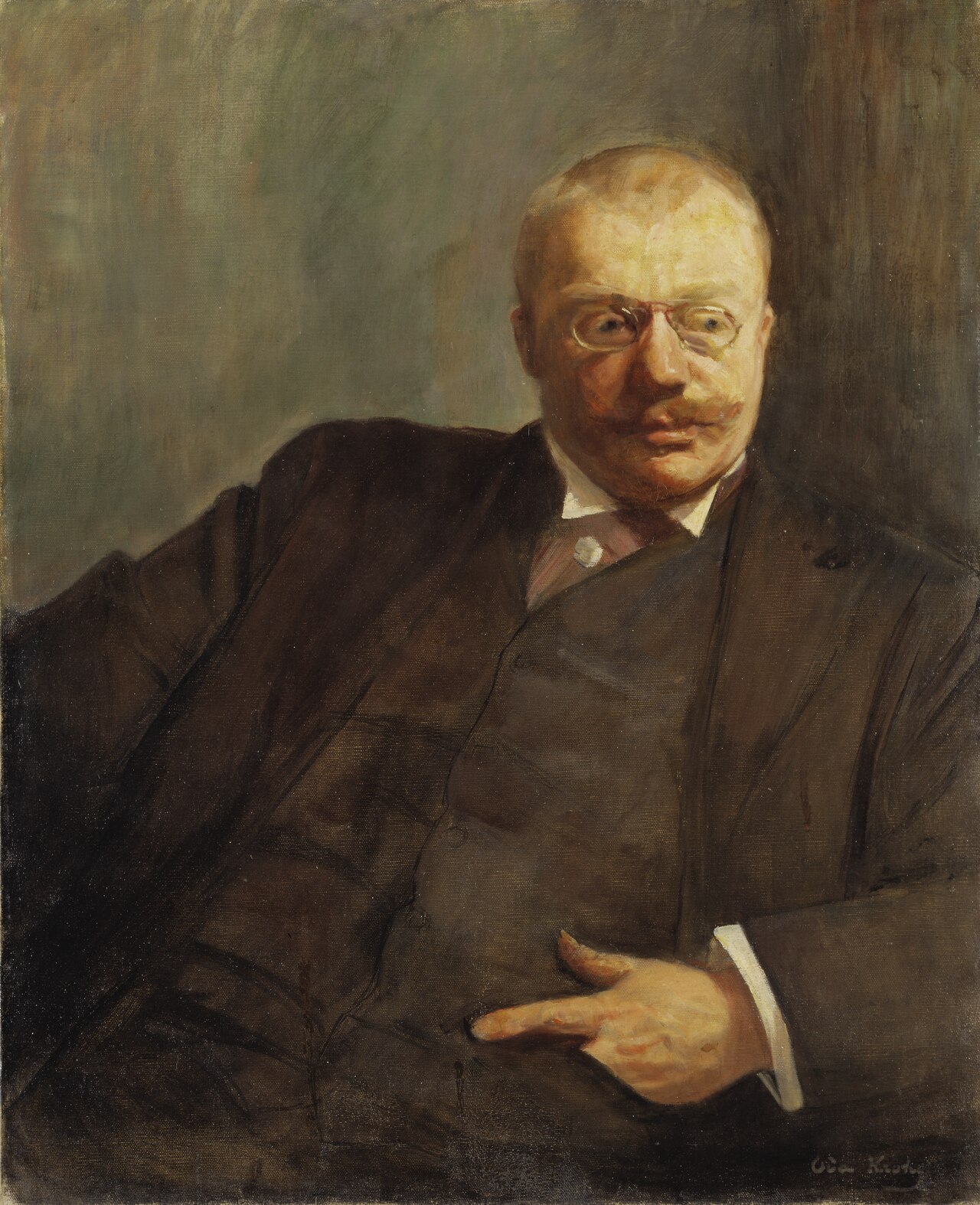
Signature techniques Krohg favoured a modest, yet confident brushstroke that balanced detail with suggestion. She employed chiaroscuro to model faces, allowing subtle gradations of tone to convey mood. In portraiture she often used a limited background, sometimes a simple interior or a muted landscape, to keep focus on the subject’s gaze and posture. Her handling of colour tended toward earth tones and muted blues, which reinforced the naturalistic tone of her images while avoiding the bright flamboyance of contemporary academic painting.
Major works - **A Japanese Lantern (1886)** – This early work reflects Krohg’s fascination with exotic objects that had entered Oslo’s cultural consciousness through trade and exhibitions. The lantern is rendered with delicate attention to texture, and the surrounding interior is painted in subdued tones, allowing the lantern’s lacquered surface to become a focal point. - **En abonnent på Aftenposten (1887)** – Translating to “A Subscriber to Aftenposten,” this genre scene depicts a woman reading the newspaper in a modest domestic setting. The painting captures a moment of everyday life, illustrating Krohg’s interest in the emerging urban middle class and their relationship to the press. - **Gunnar Heiberg, the Author (1900)** – A portrait of the prominent Norwegian playwright and poet, this work showcases Krohg’s skill in rendering intellectual intensity. Heiberg is presented against a simple backdrop, his thoughtful expression highlighted by a soft modelling of light across his face. - **Portrait of the Swedish Painter Ivar Arosenius (1905)** – In this cross‑national portrait, Krohg portrays fellow artist Ivar Arosenius with a calm, introspective demeanor. The work is notable for its subtle colour harmony and the way the painter’s hand is hinted at, suggesting his creative profession. - **Portrait of the Author Rota Margrethe Vullum (1906)** – This painting depicts the writer Margrethe Vullum, emphasizing her literary stature through a poised pose and a dignified expression. Krohg’s treatment of the subject’s attire and the restrained background underline the sitter’s intellectual presence.
Influence and legacy Oda Krohg’s career spanned a period of rapid change in Norwegian art, and she contributed to the shift away from strict academic conventions toward a more personal, realist idiom. As one of the few women to achieve professional recognition in a male‑dominated field, she helped pave the way for subsequent generations of Norwegian female artists. Her involvement in the Kristiania Bohemian circles also linked visual art with contemporary literature and theatre, fostering interdisciplinary exchange. Today her works are held in the National Museum of Art, Architecture and Design in Oslo and continue to be studied for their nuanced portrayal of turn‑of‑the‑century Norwegian society.
Frequently asked questions
Who was Oda Krohg?
Oda Krohg was a Norwegian painter (1860–1935) known for her portraits and genre scenes, and a prominent member of the Kristiania Bohemian artistic circle.
What style or movement is she associated with?
She worked within the naturalist tradition of the Kristiania Bohemians, combining realistic observation with a psychological focus on her subjects.
What are her most famous works?
Key works include *A Japanese Lantern* (1886), *En abonnent på Aftenposten* (1887), *Gunnar Heiberg, the Author* (1900), *Portrait of the Swedish Painter Ivar Arosenius* (1905) and *Portrait of the Author Rota Margrethe Vullum* (1906).
Why does she matter in art history?
Krohg helped modernise Norwegian painting, contributed to the Bohemian cultural network, and broke gender barriers, influencing later Norwegian women artists.
How can I recognise an Oda Krohg painting?
Look for restrained colour, subtle chiaroscuro, a focus on the sitter’s expression, and often a simple interior or muted background that keeps attention on the figure.