Master of Hoogstraeten
1475 – 1510
In short
The Master of Hoogstraeten was a Southern Netherlandish painter active circa 1475–1510, linked to the early‑16th‑century Antwerp Mannerist style. Working mainly in Antwerp, the notname covers either a single artist or a workshop that produced richly detailed religious panels characterised by dynamic compositions and elaborate costume.
Notable works

![Altarpiece showing scenes from the Infancy of Christ: The Adoration of the Magi [center]; The Annunciation; The Presentation of Christ in the Temple; The Flight into Egypt; The Nativity [clockwise from upper left] by Master of Hoogstraeten](https://commons.wikimedia.org/wiki/File:Master_of_Hoogstraeten_-_Altarpiece_showing_scenes_from_the_Infancy_of_Christ,_Inv._60a--e.jpg)


Early life The Master of Hoogstraeten is known only by a notname; no documentary evidence records a personal name, birthplace or family background. Art historians place the artist’s active period between the mid‑late 15th century and the early 16th century, roughly 1475–1510, based on stylistic analysis of surviving works. The lack of archival records means that details of early training remain speculative, though the painter is presumed to have been educated within the vibrant artistic environment of the Southern Netherlands, possibly apprenticing in an Antwerp workshop that catered to the city’s growing demand for devotional art.
Career and style The Master’s oeuvre is firmly situated within the Antwerp Mannerist movement, a transitional style that blended the lingering Gothic sensibility of the late medieval period with emerging Renaissance influences from Italy. Works attributed to the Master display a heightened theatricality: crowded scenes, dramatic gestures, and vivid colour palettes coexist with meticulous attention to surface detail. The artist’s output consists almost entirely of religious subjects—altarpieces, triptychs and devotional panels—catering to both ecclesiastical patrons and private devotion. Though the exact number of paintings remains debated, the consensus places the Master among the most prolific creators of the period, contributing to the visual culture that defined Antwerp’s golden age of painting.
Signature techniques A number of technical hallmarks help scholars identify the hand of the Master of Hoogstraeten. First, the painter employs an intricate rendering of textile drapery, with sharply delineated folds that emphasize the opulence of ecclesiastical vestments. Gold leaf is frequently applied to halos and decorative elements, lending a luminous quality that interacts with the oil glaze layers. The artist also favours a bright, saturated palette—deep ultramarine, vermilion and lead‑white—combined with subtle chiaroscuro to model figures in a three‑dimensional fashion. Perspective is used selectively, often to guide the viewer’s eye toward the central narrative while maintaining a shallow, decorative space typical of Antwerp Mannerism. Finally, the Master’s works are noted for their densely packed compositions, where saints, angels and narrative episodes coexist within a single frame, creating a sense of visual abundance.
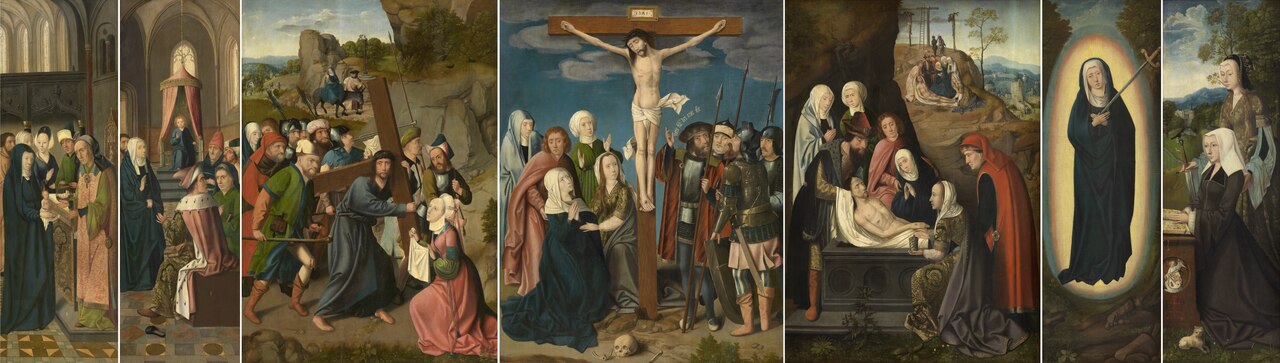
Major works The most securely attributed pieces illuminate the breadth of the Master’s output. **Madonna and Child with Sts Catherine and Barbara (c.1500)** presents the Virgin enthroned, flanked by the two saints, each rendered in sumptuous costume; the delicate modelling of the figures and the gilded halos exemplify the artist’s decorative flair. **Triptych with the Adoration of the Magi (1507)** and the later **Triptych of the Adoration of the Magy (1512)** both depict the biblical episode with an expanded cast of onlookers, exotic gifts and a richly ornamented setting, underscoring the Master’s skill at narrative complexity. The **Altarpiece showing scenes from the Infancy of Christ**—including the Adoration of the Magi, the Annunciation, the Presentation, the Flight into Egypt and the Nativity—demonstrates a multi‑panel approach where each episode is rendered in a distinct yet harmoniously integrated visual language; the date traditionally given as 1600 likely reflects a later re‑dating or restoration rather than the artist’s own chronology. **The Seven Sorrows of Mary (1440)** is an outlier in terms of dating; scholars treat the attribution with caution, suggesting either a misreading of the inscription or the presence of an earlier model that the Master re‑interpreted. Together, these works illustrate a consistent thematic focus on Christological narratives, executed with the ornamental richness that defines Antwerp Mannerism.
Influence and legacy The Master of Hoogstraeten occupies a pivotal position in the development of early 16th‑century Flemish painting. By synthesising Gothic devotional intensity with the burgeoning naturalism of the Renaissance, the artist helped to shape the distinctive visual vocabulary of Antwerp Mannerism, influencing contemporaries such as the Master of the Antwerp Adoration and the so‑called ‘Little Masters’ who followed. The richly detailed altarpieces provided a template for later workshops that sought to combine liturgical function with visual spectacle. Modern scholarship continues to refine the attribution of works to the Master, employing technical analysis and comparative stylistic study. Although the notname obscures personal biography, the surviving paintings remain valuable primary sources for understanding the religious, cultural and artistic currents that animated the Southern Netherlands on the cusp of the Dutch Golden Age.
Frequently asked questions
Who was the Master of Hoogstraeten?
The Master of Hoogstraeten is a notname for a Southern Netherlandish painter, active around 1475–1510, whose work is associated with the Antwerp Mannerist movement.
What style or movement is the Master of Hoogstraeten linked to?
The artist is linked to Antwerp Mannerism, a style that blends late Gothic decorative richness with early Renaissance spatial experimentation.
What are the most famous works by the Master of Hoogstraeten?
Key works include the *Madonna and Child with Sts Catherine and Barbara* (c.1500), the *Triptych with the Adoration of the Magi* (1507), the *Triptych of the Adoration of the Magi* (1512), and a multi‑scene altarpiece depicting the Infancy of Christ.
Why is the Master of Hoogstraeten important in art history?
The Master exemplifies the transition from Gothic to Renaissance art in the Low Countries, influencing later Flemish painters and helping define the visual language of early 16th‑century Antwerp.
How can I recognise a painting by the Master of Hoogstraeten?
Look for elaborate, gilded drapery, bright saturated colours, densely populated religious scenes, and a decorative use of perspective typical of Antwerp Mannerist works.