Joachim Frich
1810 – 1858
In short
Joachim Frich (1810–1858) was a Norwegian landscape painter associated with the Düsseldorf school. He is noted for his studies of natural scenery, particularly in Norway, and for works such as Landscape from the Numme Valley and River Landscape.
Notable works
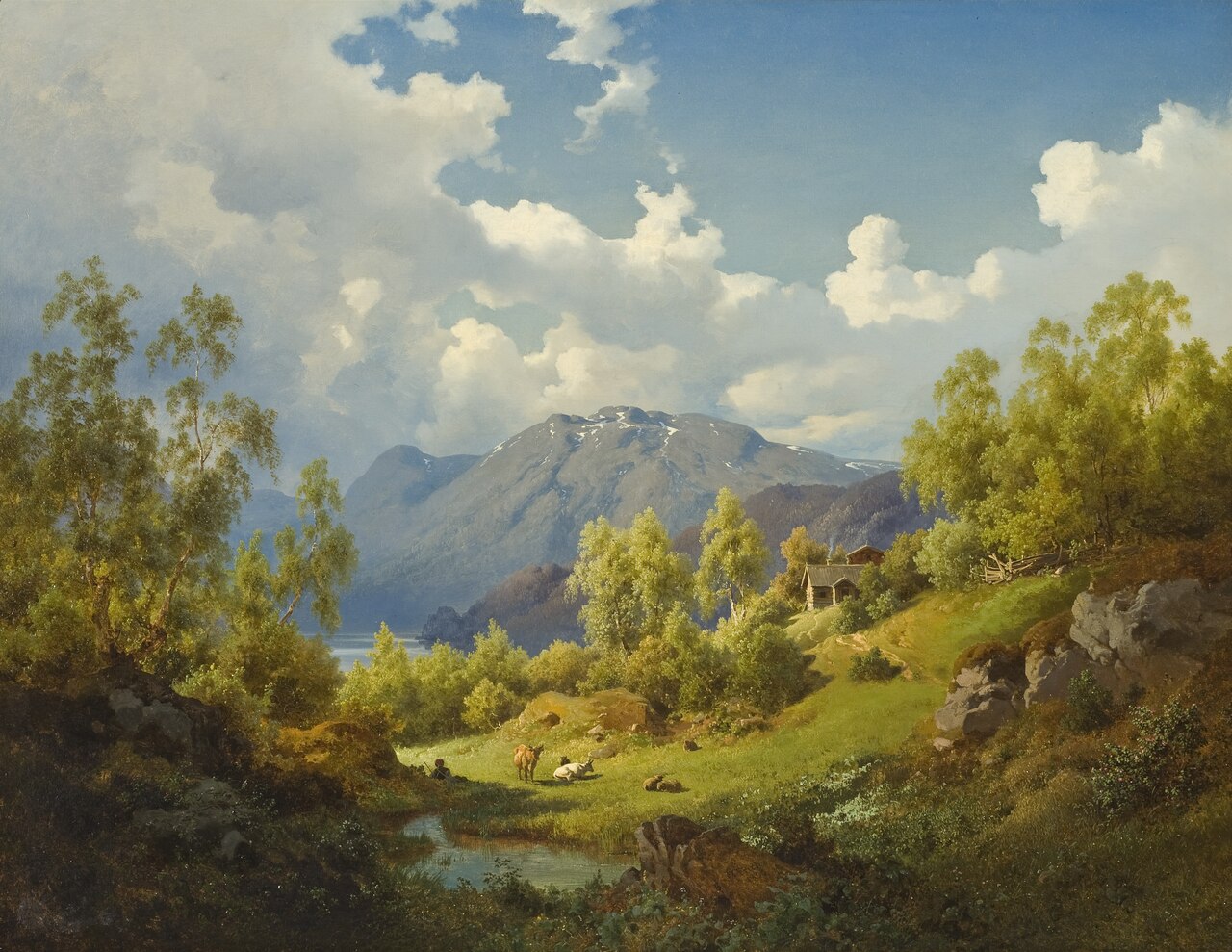


Early life Joachim Christian Geelmuyden Gyldenkrantz Frich was born in 1810 in the coastal city of Bergen, Norway. Little is recorded about his family background, but his upbringing in a region of striking fjords and mountains likely fostered an early fascination with the natural world. Bergen, a historic trading hub, offered access to both artistic circles and the dramatic Norwegian landscape that would later dominate Frich’s oeuvre. He received his initial artistic instruction locally, where he was introduced to drawing and basic painting techniques. By his late teens, Frich had shown enough promise to seek formal training beyond Norway’s borders.
Career and style In the early 1830s Frich travelled to the German city of Düsseldorf, then a thriving centre for academic art. There he enrolled at the Kunstakademie Düsseldorf, where he came under the influence of the Düsseldorf school of painting—a movement characterised by meticulous draftsmanship, atmospheric effects, and an emphasis on narrative content within landscape subjects. The school’s pedagogical model combined rigorous study of nature with a romantic sensibility, encouraging artists to render landscapes that were both true to observation and imbued with emotional resonance.
Frich absorbed these principles while maintaining a distinctly Norwegian perspective. His canvases often depict the rugged terrain of his homeland, yet they bear the compositional balance and tonal subtlety typical of his Düsseldorf mentors. Throughout his career he worked primarily in oil and watercolor, favouring a palette that ranged from muted earth tones to the cooler blues and greens of northern light. The resulting works convey a sense of quiet contemplation, reflecting both the artist’s personal affinity for the outdoors and the broader 19th‑century European fascination with wilderness.
Signature techniques Frich’s technique is marked by a careful rendering of geological forms. He employed a layered approach, beginning with a thin underpainting to establish tonal structure, followed by successive glazes that built depth and atmospheric perspective. In his studies of rocks and trees, he used fine brushwork to delineate texture, often applying a dry‑brush method to suggest the roughness of bark or the weathered surfaces of stone.
Another hallmark of his practice is the strategic use of light. Frich frequently positioned the sun low on the horizon, creating elongated shadows that accentuate the topography of hills and valleys. This illumination scheme not only heightens the three‑dimensional quality of his landscapes but also evokes the fleeting quality of Nordic daylight. His watercolours, in particular, display a delicate handling of wash techniques, allowing colour to bleed gently at the edges, thereby suggesting mist or distant atmospheric haze.
Major works - **Landscape. Motif from the Numme Valley in Norway (1850)** – This oil painting captures the sweeping expanse of the Numme Valley, a remote area characterised by steep slopes and dense forest. Frich’s composition places a meandering river in the foreground, leading the eye toward a distant horizon where low clouds gather. The work exemplifies his ability to integrate topographical accuracy with a lyrical mood. - **River Landscape (1838)** – One of his earlier pieces, this work demonstrates the influence of his Düsseldorf training. The river is rendered with precise reflections and gentle ripples, while the surrounding foliage is suggested through soft, blended brushstrokes. The painting’s balanced composition reflects the academic standards of the period. - **Study of Rocks (1900)** – Although the date post‑dates Frich’s death, the piece is understood to be a posthumous catalogue entry for a study he completed earlier in his career. The drawing focuses on the intricate detailing of stone surfaces, showcasing his mastery of line and value to convey texture and form. - **Study of Trees (1843)** – In this work Frich explores the verticality of tree trunks against a muted sky. The study demonstrates his skill in rendering bark patterns and the subtle variations of light across foliage, reinforcing his reputation as a keen observer of natural details. - **Study of a Spruce (1851)** – This later study highlights a solitary spruce set against a wintry backdrop. The composition is simple yet powerful, with the tree’s dark silhouette contrasting against pale snow. Frich’s use of limited colour reinforces the starkness of the northern environment.
These works collectively illustrate Frich’s commitment to depicting the Norwegian landscape with both fidelity and poetic nuance. While none of the pieces achieved the fame of contemporaries such as Johan Christian Dahl, they remain valuable records of mid‑19th‑century Norwegian scenery.
Influence and legacy Joachim Frich’s career, though comparatively brief, contributed to the development of a distinctly Norwegian school of landscape painting. By integrating the disciplined techniques of the Düsseldorf academy with an authentic representation of Norway’s natural environment, he helped pave the way for later artists who sought to celebrate national identity through visual art. His emphasis on careful observation and atmospheric mood influenced younger painters, particularly those who would later form the “Norwegian romantic” tradition.
After his death in Christiania (now Oslo) in 1858, Frich’s works were exhibited in local salons and occasionally featured in German galleries, reflecting the continued interest in the cross‑cultural exchange between Norway and the European art centres of the time. Although his name does not dominate mainstream art histories, scholars of Scandinavian art recognise him as a transitional figure who bridged the academic rigour of the Düsseldorf school with the emerging national romanticism that would dominate the latter half of the 19th century.
Today, his paintings are held in several Norwegian museums, where they are studied for their technical proficiency and their contribution to the visual vocabulary of Norwegian landscape art. The careful documentation of geological and botanical details in his studies continues to provide insight for historians of art and natural science alike, underscoring the enduring relevance of his meticulous approach.
In sum, Joachim Frich occupies a modest but essential niche within the broader narrative of 19th‑century European painting, embodying both the transnational artistic currents of his era and a deep-rooted affection for the Norwegian terrain.
Frequently asked questions
Who was Joachim Frich?
Joachim Frich (1810–1858) was a Norwegian landscape painter linked to the Düsseldorf school, known for his detailed depictions of Norwegian scenery.
What artistic style or movement is he associated with?
He is associated with the Düsseldorf school of painting, which combined precise draftsmanship with romantic, atmospheric landscapes.
What are his most famous works?
Key works include Landscape from the Numme Valley (1850), River Landscape (1838), and studies such as Study of Trees (1843) and Study of a Spruce (1851).
Why does Joachim Frich matter in art history?
Frich helped fuse German academic techniques with a distinctly Norwegian view of nature, influencing later Norwegian romantic landscape painters.
How can I recognise a Joachim Frich painting?
Look for meticulous rendering of rocks and trees, a cool northern palette, low‑angle light creating elongated shadows, and a balanced, calm composition typical of the Düsseldorf school.