Hendrik Frans van Lint
1684 – 1763
In short
Hendrik Frans van Lint (1684–1763) was a Flemish landscape and vedute painter who spent most of his career in Rome, becoming one of the city’s leading landscape artists of the early 18th century. He catered to aristocratic patrons and Grand Tour travellers, producing works that combine meticulous topographical detail with a lyrical atmosphere.
Notable works


_Piazza_del_popolo_Roma.jpg)

Early life Hendrik Frans van Lint was born in Antwerp in 1684, a city that was then a major hub for Flemish art and training. Little is recorded about his family background or his apprenticeship, but the artistic environment of Antwerp—home to the Guild of Saint Luke and a thriving market for painters—provided the foundation for his development. Like many of his contemporaries from the Southern Netherlands, van Lint would have been exposed to the works of earlier Flemish masters such as Jan Brueghel the Elder and the vedute tradition that was gaining popularity among Dutch and Flemish artists.
In the early 18th century, a wave of Northern European painters travelled to Italy to study its classical heritage and the luminous landscape of the Italian countryside. Van Lint joined this migration, moving to Rome where a vibrant expatriate community of Flemish and Dutch artists had already established studios, workshops, and a supportive network of patrons.
Career and style Once settled in Rome, van Lint quickly positioned himself within the niche of landscape and city‑view painting, known in Italian as *vedute*. His work reflects a synthesis of Northern precision and Italian sensibility. He favoured a clear, almost photographic rendering of architecture and topography, yet infused his scenes with a warm, atmospheric light that softened the strictness of the depiction. This blend appealed to both local aristocratic families, who valued accurate portrayals of their estates and urban settings, and to foreign visitors on the Grand Tour, who sought visual souvenirs of their Italian journey.
Van Lint’s clientele included members of Rome’s old aristocratic families, who commissioned views of their villas and gardens, as well as European travellers who purchased his scenes as part of their travel diaries. His reputation grew through the 1730s and 1740s, and he became recognised as one of the leading landscape painters active in Rome during the first half of the century.
Signature techniques Van Lint’s paintings are characterised by a disciplined compositional structure. He often employed a foreground‑middle‑background hierarchy that guided the viewer’s eye from detailed figures or objects in the immediate foreground, through a richly rendered middle ground, to a distant horizon that conveyed depth. His brushwork varies according to the subject: architectural elements are painted with crisp, fine strokes that capture stone texture and shadow, while foliage and water are rendered with looser, more fluid applications that suggest movement and light.
Colour in van Lint’s work tends toward a restrained palette of earth tones, muted greens, and warm ochres, punctuated by occasional highlights of blue or gold to accent sky and reflective surfaces. He frequently used atmospheric perspective—softening colours and reducing detail in distant elements—to enhance the illusion of depth. Light is often depicted as a diffused, golden glow, reminiscent of the Mediterranean sun, which lends his scenes a timeless, idealised quality.
Major works Among van Lint’s documented works, several stand out for their compositional ambition and the insight they provide into his artistic concerns.
- A lady with children visiting a village vegetable stand (1738) – This genre scene, unusual for a painter primarily known for landscapes, showcases van Lint’s ability to integrate human narrative within a rural setting. The composition balances the bustling activity of the market stall with a gentle countryside backdrop, illustrating his skill at combining figural detail with landscape.
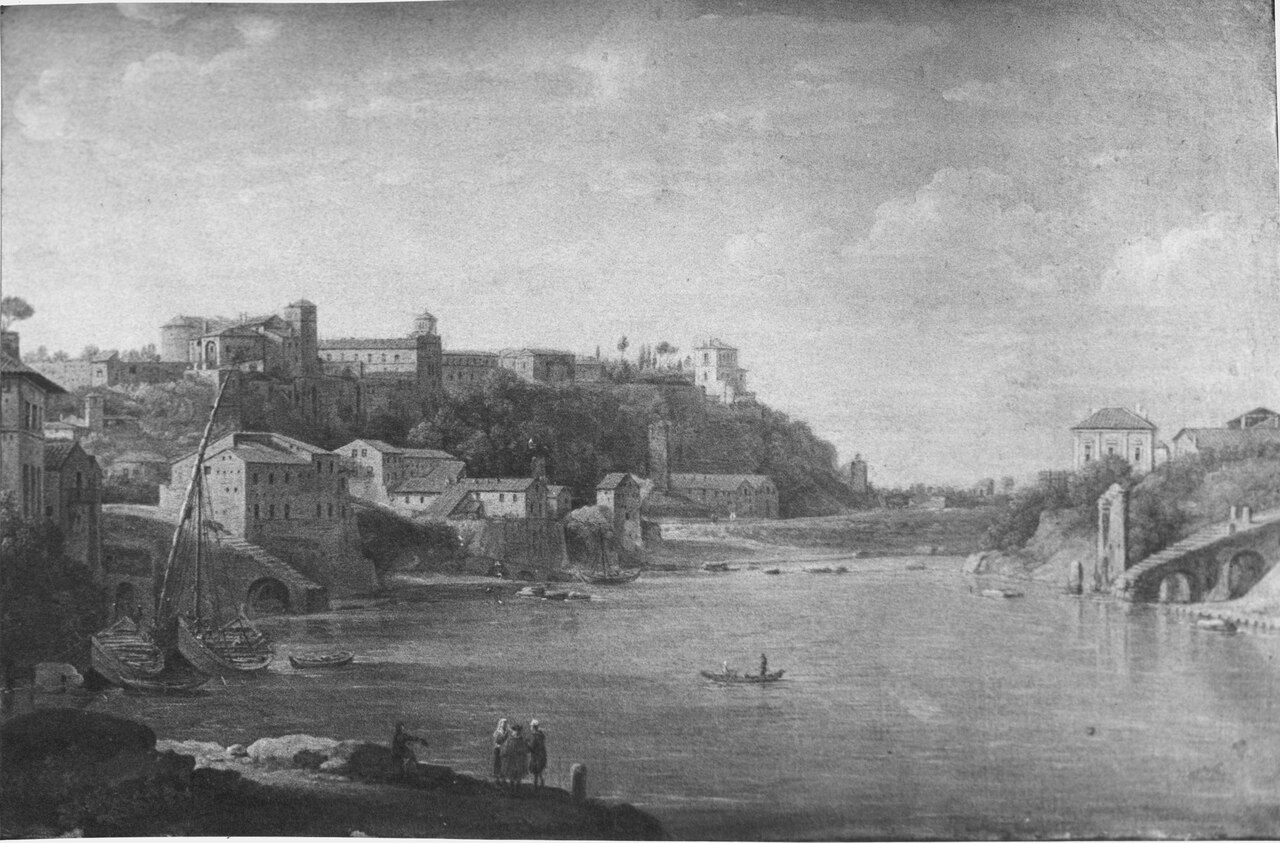
- View of the Monte Aventino in Rome (1741) – In this veduta, van Lint captures the iconic Aventine Hill with exacting topographical accuracy. The painting emphasizes the hill’s terraced gardens and the sweeping view over the city, highlighting his talent for rendering Roman topography with both precision and atmospheric warmth.
- View of Rome (1741) – This broader cityscape presents a panoramic vista of Rome’s skyline, featuring recognizable landmarks such as the Pantheon and the Tiber River. Van Lint’s careful treatment of architectural detail, coupled with his characteristic light, creates a document of the city that would have appealed to Grand Tourists seeking an authentic visual record.
- Piazza del Popolo in Rome (1750) – This work depicts the bustling public square, with its colonnades and the twin churches of Santa Maria in Montesanto and Santa Maria dei Miracoli. Van Lint’s composition captures the interplay of light and shadow across the marble façades, while figures populate the space, providing a sense of daily life.
- Giacomo van Lint (1750) – Although the title suggests a portrait, the work is understood to be a representation of his son, possibly intended as a familial record. The piece reflects van Lint’s capacity to render intimate subjects with the same compositional care he applied to his larger city views.
These works collectively demonstrate van Lint’s versatility—ranging from intimate genre scenes to grand city panoramas—while maintaining a consistent visual language that blends meticulous observation with a lyrical atmosphere.
Influence and legacy Hendrik Frans van Lint’s contribution to 18th‑century Roman art lies in his role as a bridge between the Northern European tradition of detailed landscape painting and the Italian penchant for atmospheric, idealised vistas. His paintings served both as accurate topographical records and as aesthetic objects that catered to the tastes of an increasingly mobile European elite.
While van Lint did not found a distinct school, his approach influenced younger Flemish artists who arrived in Rome, encouraging them to adopt a similar balance of precision and mood. Moreover, his works remain valuable to art historians and cultural scholars as visual documentation of Roman urban and rural environments before the extensive urban redevelopment of the 19th century.
Today, van Lint’s paintings are held in several European collections, and they continue to appear in exhibitions focused on the Grand Tour, vedutisti, and the exchange of artistic ideas between the North and Italy. His legacy endures as a testament to the cross‑cultural fertilisation that defined the artistic landscape of 18th‑century Rome.
Frequently asked questions
Who was Hendrik Frans van Lint?
Hendrik Frans van Lint (1684–1763) was a Flemish landscape and vedute painter who spent most of his career in Rome, becoming a leading figure in early‑18th‑century Roman landscape art.
What artistic style or movement is he associated with?
He worked within the vedute tradition, combining Northern European precision with an Italianate atmospheric light, but he is not linked to a specific formal movement.
What are his most famous works?
Key works include ‘A lady with children visiting a village vegetable stand’ (1738), ‘View of the Monte Aventino in Rome’ (1741), ‘View of Rome’ (1741), ‘Piazza del Popolo in Rome’ (1750) and the portrait ‘Giacomo van Lint’ (1750).
Why is Hendrik Frans van Lint important in art history?
He exemplifies the successful integration of Northern landscape techniques into the Roman vedute genre, providing valuable visual records of 18th‑century Rome and influencing later Flemish artists in Italy.
How can I recognise a van Lint painting?
Look for meticulous architectural detail, a clear foreground‑middle‑background structure, a restrained colour palette with warm golden light, and a blend of precise topography with a lyrical atmosphere.