Henry Herbert La Thangue
1859 – 1929
In short
Henry Herbert La Thangue (1859–1929) was a British realist painter noted for his rural landscapes and association with the Newlyn School. He combined French naturalist techniques with English subjects, producing works such as The Return of the Reapers and A Sussex Autumn.
Notable works


_-_The_Man_with_the_Scythe_-_NG1605_-_National_Gallery.jpg)
_-_Study_of_a_Boy_in_a_Black_Hat,_before_a_Cornfield_-_1214784_-_National_Trust.jpg)
Early life
Henry Herbert La Thangue was born in London in 1859. He grew up in a middle‑class family that encouraged his early interest in drawing. After completing his basic education, La Thangue entered the Royal Academy Schools in the late 1870s, where he received formal training in drawing, anatomy, and composition. Seeking broader artistic exposure, he travelled to Paris in the early 1880s and enrolled at the Académie Julian, studying under Léon Bonnat and absorbing the naturalist approaches of French painters such as Jules Bastien‑Lepage. This continental experience sharpened his commitment to painting directly from life and laid the groundwork for his later focus on rural England.
Career and style
Returning to England in the mid‑1880s, La Thangue quickly established himself as a prominent exhibitor at the Royal Academy and the New English Art Club. He became loosely affiliated with the Newlyn School, a collective of artists who settled in the Cornish fishing village of Newlyn to work en plein air. Though not a resident there, La Thangue shared the school's dedication to truthful representation of everyday labour and landscape. His style is characterised by a restrained palette, careful observation of light, and a lyrical rendering of the English countryside. He blended the French naturalist emphasis on atmospheric effect with a distinctly British sensibility, favouring pastoral subjects that conveyed both social realism and quiet beauty.
Signature techniques
La Thangue’s technique rested on three pillars: plein‑air observation, layered glazing, and subtle tonal modulation. He would often sketch outdoors to capture the exact colour and quality of light, then return to his studio to develop the composition with thin glazes that built depth without sacrificing luminosity. His brushwork is generally soft and blended, avoiding the harsh outlines favoured by academic painters. He also employed a modest underpainting, usually in earth tones, which helped unify the surface tones and gave his canvases a warm, cohesive glow. These methods allowed him to render the delicate interplay of sky, field, and foliage that defines his most celebrated works.
Major works
- The Return of the Reapers (1886) – This early masterpiece shows a group of harvesters walking home across a golden field, their silhouettes set against a muted sky. The painting demonstrates La Thangue’s ability to convey narrative through landscape, and it was exhibited at the Royal Academy to considerable acclaim.
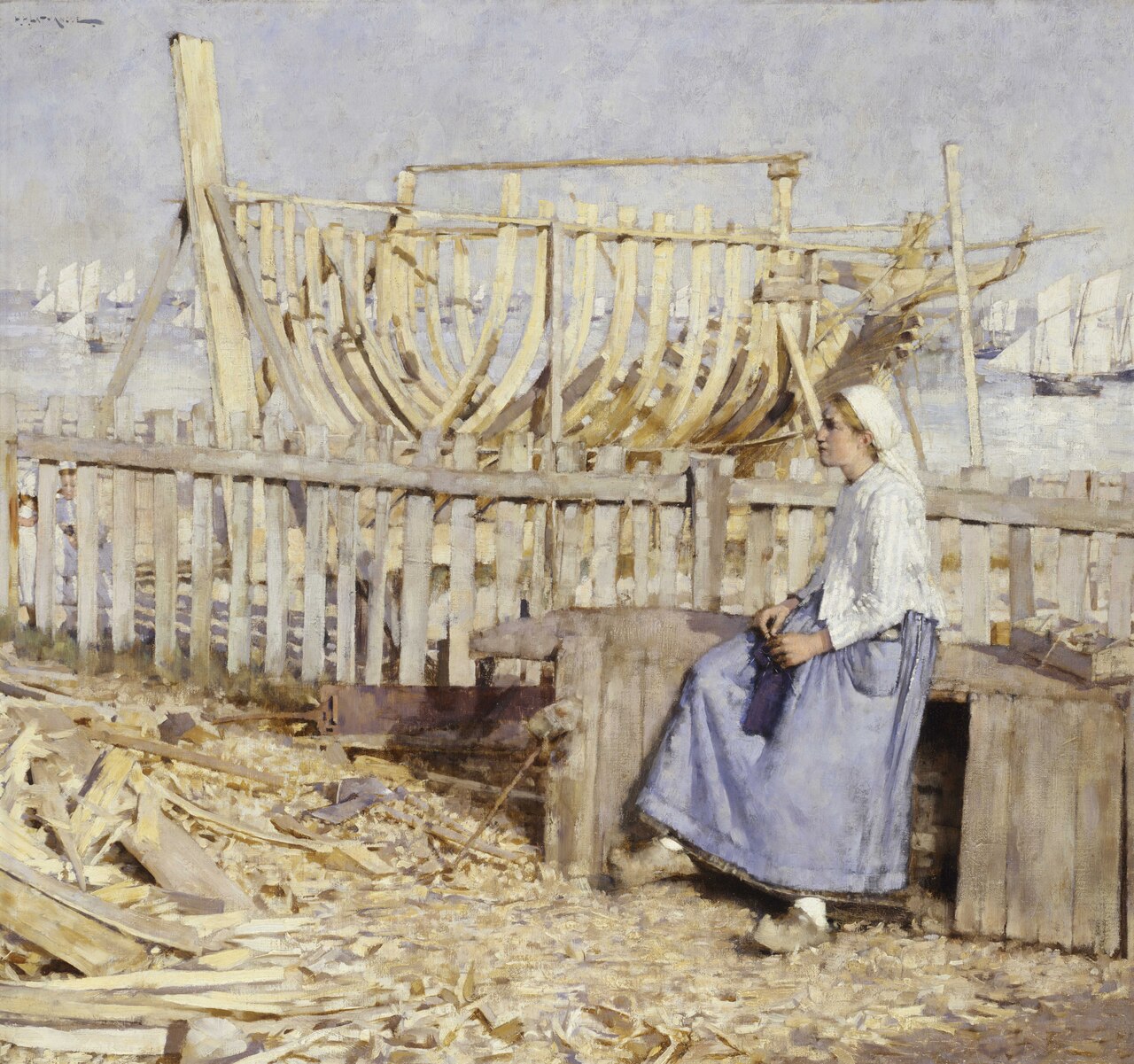
- The Boat Builder's Yard, Cancale, Brittany (1881) – Produced during his Parisian period, the work captures a bustling Breton shipyard with a keen eye for atmospheric humidity and the muted blues of the harbour. It reflects his fascination with foreign rural life and his skill at rendering industrial activity within a natural setting.
- The Man with the Scythe (1896) – Featuring a solitary figure cutting wheat, this canvas highlights La Thangue’s continued interest in agricultural labour. The composition balances the figure’s strong diagonal pose with the horizontal sweep of the field, creating a sense of both tension and harmony.
- Study of a Boy in a Black Hat, before a Cornfield (1904) – A preparatory study rather than a finished picture, this work illustrates his meticulous approach to portraiture within a landscape context. The boy’s dark hat provides a focal point, while the surrounding cornfield recedes in soft tones, demonstrating his command of depth.
- A Sussex Autumn (1907) – Perhaps his most celebrated later work, it depicts a late‑summer field in Sussex bathed in amber light. The painting’s subtle colour shifts and delicate handling of foliage reveal La Thangue’s mature mastery of atmospheric effect and his enduring affection for the English countryside.
Influence and legacy
Beyond his canvases, La Thangue contributed significantly to British art education. From 1905 to 1912 he served as a professor at the Slade School of Fine Art, where he mentored a generation of artists who would carry forward his realist principles. In 1906 he was elected an Associate of the Royal Academy, attaining full Academician status a few years later. His leadership extended to the Royal Society of British Artists, where he held the presidency from 1919 until 1927, advocating for the exhibition of contemporary landscape painting. La Thangue’s synthesis of French naturalism with British subject matter helped broaden the visual vocabulary of late‑Victorian and Edwardian art. His works remain in major public collections, including the Tate, the Victoria and Albert Museum, and several regional galleries, ensuring that his contribution to the development of modern British landscape painting continues to be recognised.
Frequently asked questions
Who was Henry Herbert La Thangue?
He was an English realist painter (1859–1929) best known for rural landscape works that combined French naturalist techniques with British subjects.
What artistic style or movement is he associated with?
La Thangue is linked to the Newlyn School and the New English Art Club, working within a realist tradition that emphasized plein‑air observation and social realism.
What are his most famous works?
Key works include The Return of the Reapers (1886), A Sussex Autumn (1907), The Man with the Scythe (1896), The Boat Builder's Yard, Cancale, Brittany (1881), and Study of a Boy in a Black Hat, before a Cornfield (1904).
Why does La Thangue matter in art history?
He helped bridge French naturalism and British landscape painting, influencing later British artists through his teaching at the Slade and his leadership in national art societies.
How can I recognise a painting by La Thangue?
Look for softly blended brushwork, a muted but warm palette, careful rendering of natural light, and subject matter that focuses on everyday rural labour or countryside scenery.