Ding Yunpeng
1547 – 1628
In short
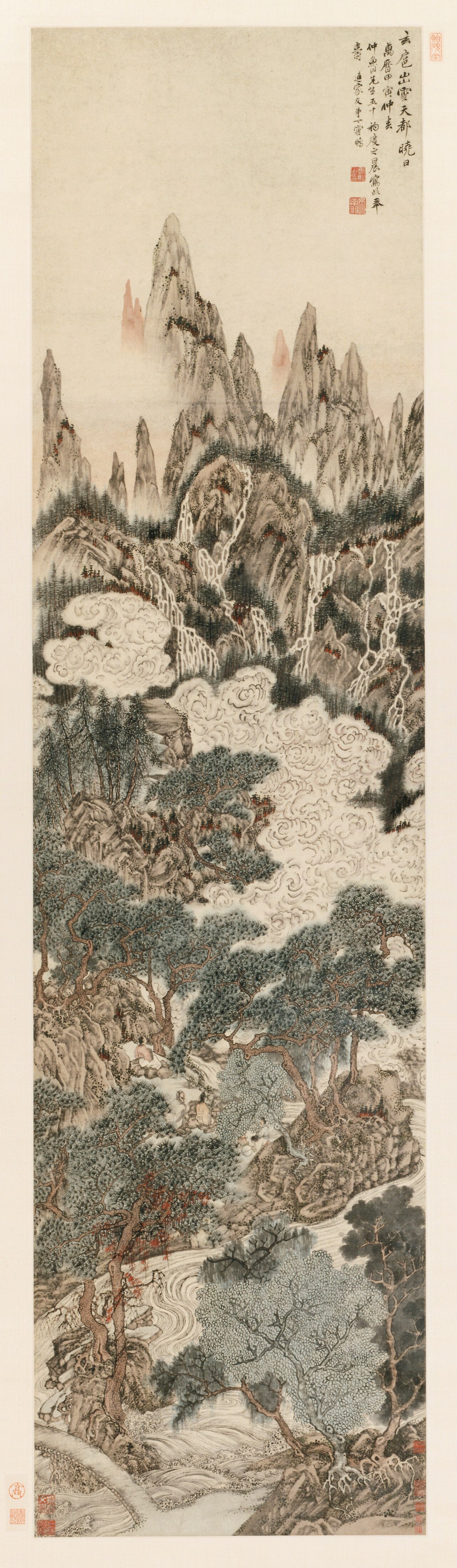
Ding Yunpeng (1547–1628) was a Ming‑dynasty Chinese painter renowned for his skill in rendering human figures and landscapes, especially Buddhist subjects, and is celebrated for works such as the Eighteen Luohans and Morning Sun over Heavenly Citadel Peak.
Notable works




Early life Ding Yunpeng was born in 1547 in the province of Anhui, a region that produced a number of notable literati and artists during the late Ming period. Little is recorded about his family background, but the local tradition of brushwork and calligraphy would have provided a fertile environment for his early artistic education. Anhui’s scholarly culture, combined with the flourishing of Buddhist patronage, likely introduced Ding to both secular and religious visual vocabularies at a young age.
Career and style Ding entered the professional art world in the latter half of the 16th century, a time when the Ming court and private collectors were eager for paintings that combined technical virtuosity with moral and spiritual content. He specialised in figure painting, particularly depictions of Buddhist monks and arhats, as well as expansive landscapes that placed these figures within idealised natural settings. His style reflects the mature Ming aesthetic: a balanced composition, fine brushwork, and a subtle use of colour that enhances narrative rather than overwhelms it. While he did not belong to a formally named movement, his work aligns with the broader literati‑painting tradition, where scholarly ideals and personal expression were paramount.
Signature techniques Ding Yunpeng’s paintings are distinguished by several recurring techniques. First, he employed the “cun” (texture) strokes of the Northern school to model the folds of robes, giving figures a sense of volume and weight. Second, his landscapes often feature layered brushwork that creates atmospheric depth; misty mountains recede behind sharper foreground rocks, a visual device that underscores the Buddhist concept of impermanence. Third, he favoured a restrained palette of ink, light washes of blue‑green, and occasional touches of vermilion to highlight focal points such as the eyes of a monk or the crest of a distant peak. Finally, his compositions frequently use a diagonal thrust—often a winding path or a line of figures—to guide the viewer’s eye through the narrative scene.
Major works Among Ding’s most celebrated pieces is the **Eighteen Luohans**, a series that portrays the legendary disciples of the Buddha with individualised expressions and postures. Though the exact date of the original series is uncertain, the surviving copies demonstrate Ding’s ability to blend realism with spiritual symbolism. Another notable work, **Arhat removing his skin**, traditionally dated to 1501, is widely accepted as a later attribution; the subject matter—a monk shedding his earthly skin to achieve enlightenment—exemplifies Ding’s fascination with ascetic devotion. The **Morning Sun over Heavenly Citadel Peak** (1614) showcases his landscape prowess: a luminous sunrise illuminates a towering cliff, while distant clouds suggest the infinite. **Song of the Lute** (1585) diverges from his Buddhist repertoire, depicting a courtly musician in a tranquil garden, and reveals Ding’s versatility in handling secular themes. Finally, the **Eighteenth Luohans** dated 1849 are later reproductions that attest to the enduring popularity of his compositions, rather than works created by Ding himself.
Influence and legacy Ding Yunpeng’s paintings occupied a crucial position in the transmission of Buddhist iconography during the late Ming and early Qing periods. His realistic yet reverent treatment of arhats set a visual standard that was copied by workshop studios and later artists seeking to convey spiritual gravitas. Moreover, his landscape techniques contributed to the evolution of the “literati‑style” scenery that dominated Chinese painting in the 17th century. Contemporary scholars regard Ding as a bridge between the courtly sophistication of early Ming masters and the more introspective approaches of later scholars. While the precise details of his death remain unknown, his oeuvre continues to be exhibited in major Chinese museums, and his works are frequently cited in academic studies of Ming‑dynasty figure painting.
Overall, Ding Yunpeng’s blend of meticulous figure work, atmospheric landscapes, and subtle colour use secured his reputation as a master of both devotional and secular subjects, ensuring his lasting relevance in Chinese art history.
Frequently asked questions
Who was Ding Yunpeng?
Ding Yunpeng (1547–1628) was a Ming‑dynasty Chinese painter known for his figure and landscape paintings, especially Buddhist subjects such as the Eighteen Luohans.
What artistic style or movement is he associated with?
He is linked to the mature Ming literati tradition, combining refined brushwork, subtle colour, and a focus on moral and spiritual narrative rather than belonging to a specific named movement.
What are his most famous works?
His best‑known pieces include the Eighteen Luohans, Arhat removing his skin, Morning Sun over Heavenly Citadel Peak (1614), and Song of the Lute (1585).
Why is Ding Yunpeng important in art history?
He set a visual benchmark for Buddhist figure painting, influenced later landscape techniques, and helped bridge early Ming court aesthetics with later scholarly styles.
How can I recognise a genuine Ding Yunpeng painting?
Look for finely rendered robes using Northern‑school texture strokes, a restrained ink‑and‑light‑wash palette, and compositions that guide the eye with diagonal pathways or mist‑filled mountains.