Wang Shimin
1592 – 1680
In short
Wang Shimin (1592–1680) was a Chinese landscape painter of the late Ming and early Qing periods, renowned for his scholarly approach and mastery of classical brush techniques. He is best known for works that echo ancient masters, such as his Landscape Album after Ancient Masters and the Album after Du Fu's Poems.
Notable works


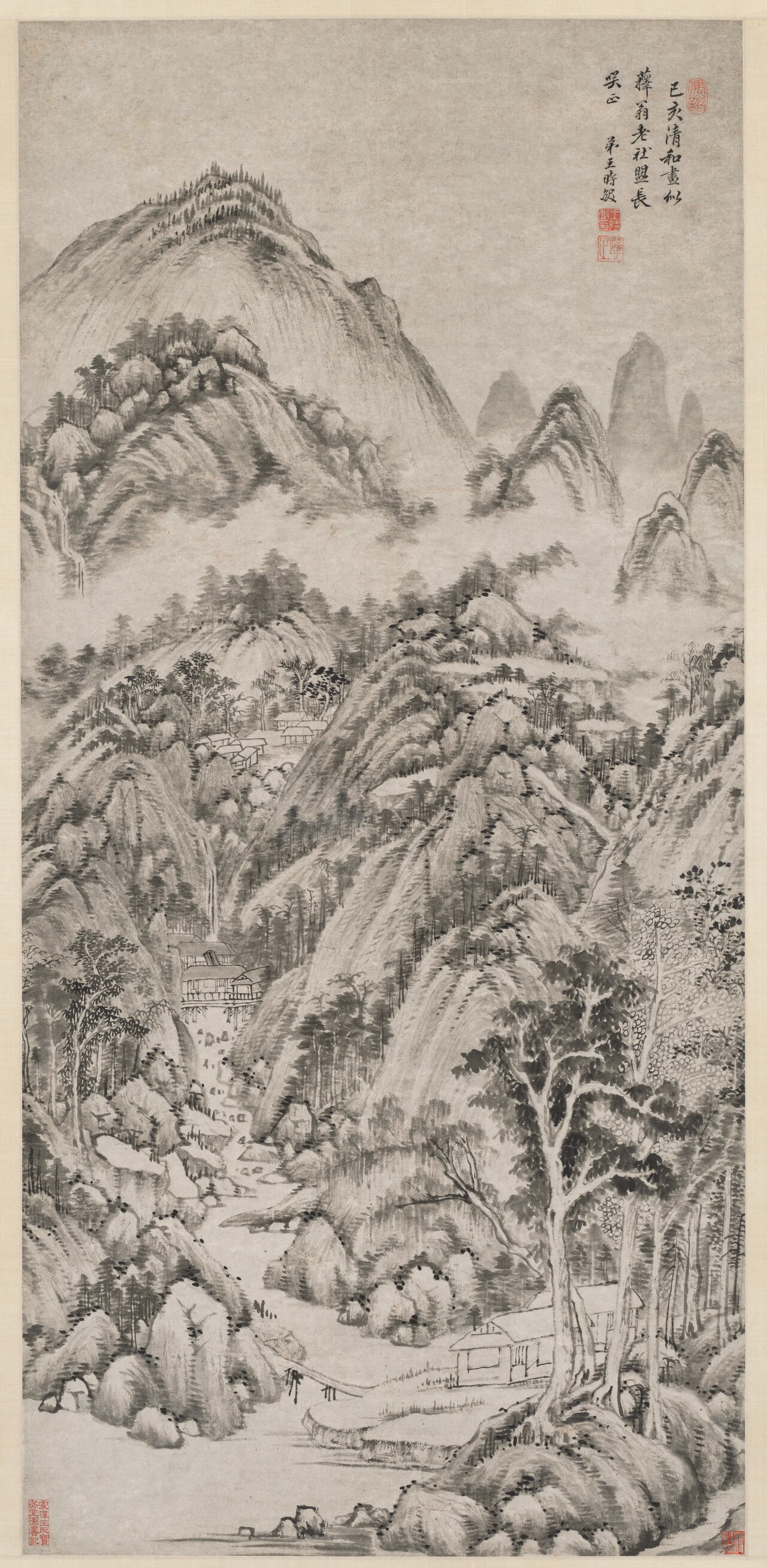
Early life Wang Shimin was born in 1592 in Taicang, a town in the Jiangsu province of the Ming dynasty. His family belonged to the educated gentry, which gave him access to classical literature and the traditional training of a scholar‑artist. From an early age he studied the Confucian canon and the poetry of the Tang dynasty, both of which would later inform his artistic vision. The turbulent final decades of the Ming court, marked by political corruption and external threats, formed the backdrop of his formative years, instilling in him a sense of cultural preservation that would become a hallmark of his work.
Career and style During the 1620s and 1630s Wang Shimin established himself in the capital, Beijing, where he joined a circle of literati painters who sought to revive the aesthetic principles of the Song and Yuan masters. He aligned himself with the so‑called Orthodox School, a movement that emphasized fidelity to ancient models, especially the works of the Four Masters of the Yuan dynasty (Huang Gongwang, Wu Zhen, Ni Zan and Wang Meng). Wang Shimin’s style is characterized by restrained brushwork, subtle tonal variation, and a compositional emphasis on atmospheric perspective. He preferred monochrome ink on silk or paper, using the gradations of black to suggest depth and texture rather than relying on colour.
Signature techniques Wang Shimin’s technique combined several distinctive elements: - **Dry‑brush strokes**: He employed a lightly loaded brush to render rocks and cliffs, creating a textured, almost calligraphic effect that conveys solidity without heavy ink. - **Layered washes**: By applying successive, translucent washes of ink, he achieved a sense of mist and distance, a hallmark of the Chinese landscape tradition. - **Emphasis on void**: Large areas of untouched paper serve as atmospheric space, allowing the viewer’s eye to wander and complete the scene mentally. - **Re‑creation of ancient models**: Rather than copying directly, he internalised the compositional logic of earlier masters, producing works that echo their spirit while bearing his own subtle variations. These techniques made his landscapes appear both timeless and personal, bridging the historic with the contemporary of his era.
Major works Wang Shimin’s extant oeuvre includes several key albums and paintings that illustrate his reverence for the past: - **Landscape Album after Ancient Masters** – A collection of ink paintings that reinterpret the seminal works of Yuan‑dynasty masters. Each piece demonstrates his ability to capture the structural rhythm of the originals while infusing a softer, more lyrical quality. - **Album after Du Fu's Poems (1665)** – Created late in his career, this album pairs visual landscapes with excerpts from the Tang poet Du Fu. The paintings echo the emotional tone of the verses, using muted washes to evoke melancholy and contemplation. - **Landscape in the style of Huang Gongwang (1638)** – This work directly references Huang Gongwang’s celebrated *Dwelling in the Fuchun Mountains*. Wang Shimin adopts Huang’s sweeping brushstrokes and layered clouds, yet his composition is more restrained, reflecting his personal aesthetic. - **Landscape after Wang Meng (1636)** – Here Wang Shimin engages with the complex, dense compositions of Wang Meng. He replicates the intricate rock formations and tangled foliage, but simplifies the palette, focusing on tonal harmony. - **Mountain Village Embraced by the Summer (1659)** – One of his most celebrated single paintings, it depicts a tranquil village nestled among verdant peaks under a summer sky. The piece showcases his mastery of atmospheric perspective, with distant mountains fading into mist and foreground foliage rendered in crisp, dry brush.
Influence and legacy Wang Shimin is frequently grouped with the “Four Wangs” – a lineage of painters who dominated Qing court art. His commitment to the classical idiom helped cement the Orthodox School’s dominance throughout the 17th and 18th centuries. Later artists, such as Wang Yuanqi and Wang Hui, directly inherited his compositional strategies and brush techniques. Moreover, his albums served as pedagogical models for generations of scholar‑painters, illustrating how to balance reverence for antiquity with personal expression. Although his exact death place remains undocumented, his artistic legacy endures in museum collections worldwide and in the continued study of Chinese landscape painting.
Frequently asked questions
Who was Wang Shimin?
Wang Shimin (1592–1680) was a Chinese landscape painter of the late Ming and early Qing periods, known for his scholarly approach and faithful reinterpretations of ancient masters.
What artistic style or movement is he associated with?
He is linked to the Orthodox School of Chinese painting, which emphasized adherence to the techniques and compositions of Yuan‑dynasty masters.
What are his most famous works?
His notable works include the Landscape Album after Ancient Masters, the Album after Du Fu's Poems (1665), Landscape in the style of Huang Gongwang (1638), Landscape after Wang Meng (1636), and Mountain Village Embraced by the Summer (1659).
Why is Wang Shimin important in art history?
He helped shape the dominant aesthetic of the Qing court, influencing subsequent generations of painter‑scholars and preserving the classical Chinese landscape tradition.
How can I recognise a painting by Wang Shimin?
Look for restrained ink washes, dry‑brush rock textures, expansive voids of untouched paper, and compositions that echo ancient masters while maintaining a subtle, lyrical atmosphere.