Carl Sundt-Hansen
1841 – 1907
In short
Carl Sundt-Hansen (1841–1907) was a Norwegian‑Danish genre painter who worked in a Romantic‑Nationalist idiom. Based in Stavanger, he is best known for narrative works such as Confrontation (1878) and Burial at Sea (1890).
Notable works
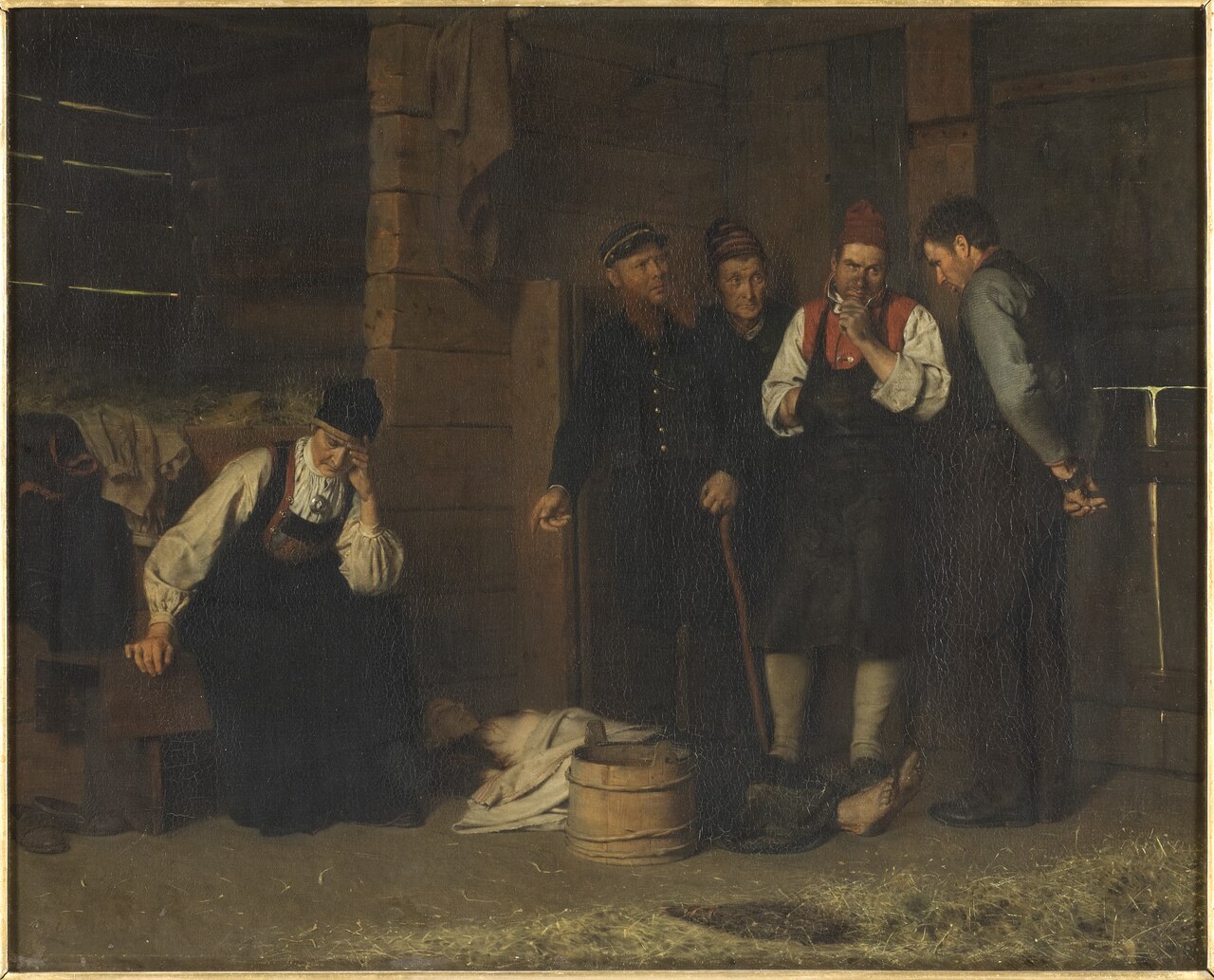


Early life Carl Fredrik Sundt-Hansen was born in 1841 in the coastal town of Stavanger, Norway. His family maintained cultural links with Denmark, a connection that shaped his artistic upbringing. Growing up amid the maritime environment of southwestern Norway, Sundt‑Hansen absorbed both the everyday life of fishermen and the broader national narratives that were gaining prominence in the mid‑nineteenth century. He received his first artistic instruction locally before moving to Denmark for formal training, a path common among Norwegian artists seeking academic instruction at the time. This cross‑national experience laid the groundwork for his later synthesis of Norwegian subject matter with a Romantic‑Nationalist visual language.
Career and style Returning to Stavanger after his studies, Sundt‑Hansen established himself as a genre painter. His oeuvre is characterised by a focus on narrative scenes that capture moments of moral tension, social observation, or historic resonance. Working within the Romantic‑Nationalist tradition, he combined a lyrical, often idealised vision of the past with a meticulous attention to contemporary detail. The artist favoured subjects drawn from rural life, maritime folklore, and small‑town moral episodes, aligning his work with the broader European fascination with national identity that flourished in the latter half of the nineteenth century. Although he never joined a formal avant‑garde movement, his paintings nevertheless reflect the period’s preoccupation with the heroic and the everyday, bridging the gap between academic realism and the emotive drive of Romanticism.
Signature techniques Sundt‑Hansen’s technique is distinguished by several recurring elements. He employed a restrained yet effective chiaroscuro to model figures, giving his compositions a three‑dimensional presence while preserving atmospheric depth. His brushwork remained tight in areas of narrative focus—particularly faces and hands—allowing subtle expression to emerge, while broader, looser strokes rendered background elements such as sea‑scapes or interior interiors. Colour palettes often balanced warm earth tones with cooler blues, a choice that reinforced the emotional tone of each scene. Moreover, the artist was adept at integrating symbolic objects (e.g., a broken chain, a lit candle) that underscored moral or thematic subtexts without overt didacticism.
Major works - **Old Farmer (1860)** – One of Sundt‑Hansen’s earliest known pieces, this work depicts an elderly agrarian figure against a modest farmhouse backdrop. The painting showcases his early mastery of light and texture, highlighting the weathered skin of the farmer and the rough timber of the building. - **Communion in Jail (1875)** – A poignant scene of a prisoner receiving the sacrament, rendered with solemn dignity. The composition balances the stark confinement of the cell with a soft, almost ethereal light that falls on the figure, emphasizing spiritual hope amid physical restriction. - **Confrontation (1878)** – Often cited as his most celebrated work, this painting captures a moment of intense drama between two male figures, likely representing a clash of moral choices. The tension is heightened by the sharp contrast of light and shadow, and the meticulous rendering of facial expressions. - **After the Fight (1882)** – This canvas portrays the aftermath of a physical altercation, focusing on the wounded and the weary. Sundt‑Hansen’s handling of the wounded body, with careful attention to bruises and blood, reveals his commitment to realistic detail within a narrative framework. - **Burial at Sea (1890)** – A later masterpiece that depicts a solemn maritime funeral. The sea itself becomes a participant in the ritual, its waves rendered with a silvery sheen that mirrors the mournful atmosphere. The painting is noted for its compositional balance between the human figures and the expansive seascape, a hallmark of Sundt‑Hansen’s mature style.
Influence and legacy Carl Sundt‑Hansen’s work contributed significantly to the development of Norwegian genre painting during a period of burgeoning national consciousness. By foregrounding everyday Norwegian life within a Romantic‑Nationalist aesthetic, he helped shape a visual vocabulary that resonated with both local audiences and the broader European art market. Although he never achieved the fame of contemporaries such as Christian Krohg, his paintings remain valuable primary sources for historians studying nineteenth‑century Norwegian society, maritime culture, and the interplay of art and nationalism. In Stavanger, his legacy persists through public collections that display his works, and through scholarly references that credit his narrative approach as a bridge between academic realism and the emerging modern sensibility. Modern exhibitions continue to reassess his contribution, positioning Sundt‑Hansen as a pivotal figure in the transition from Romantic nationalism to more nuanced, socially aware art in Scandinavia.
Frequently asked questions
Who was Carl Sundt-Hansen?
Carl Sundt-Hansen (1841–1907) was a Norwegian‑Danish genre painter known for narrative scenes rendered in a Romantic‑Nationalist style.
What artistic style or movement is he associated with?
He worked within the Romantic‑Nationalist tradition, combining emotive storytelling with realistic detail, without belonging to a formal avant‑garde movement.
What are his most famous works?
His best‑known paintings include Confrontation (1878), Burial at Sea (1890), After the Fight (1882), Communion in Jail (1875) and the early Old Farmer (1860).
Why is Carl Sundt-Hansen important in art history?
He helped define Norwegian genre painting in the late nineteenth century, merging national themes with a refined narrative technique that influenced later Scandinavian artists.
How can I recognise a painting by Sundt‑Hansen?
Look for carefully rendered figures, strong chiaroscuro, symbolic objects, and a balanced composition that often juxtaposes intimate human drama with a broader, atmospheric landscape.