Anders Askevold
1834 – 1900
In short
Anders Askevold (1834‑1900) was a Norwegian painter renowned for his romantic, nationally‑infused landscapes of western Norway’s fjords, often populated with cattle and pastoral scenes. He worked mainly in Düsseldorf, where he died, and his work remains a benchmark of 19th‑century Norwegian naturalism.
Notable works
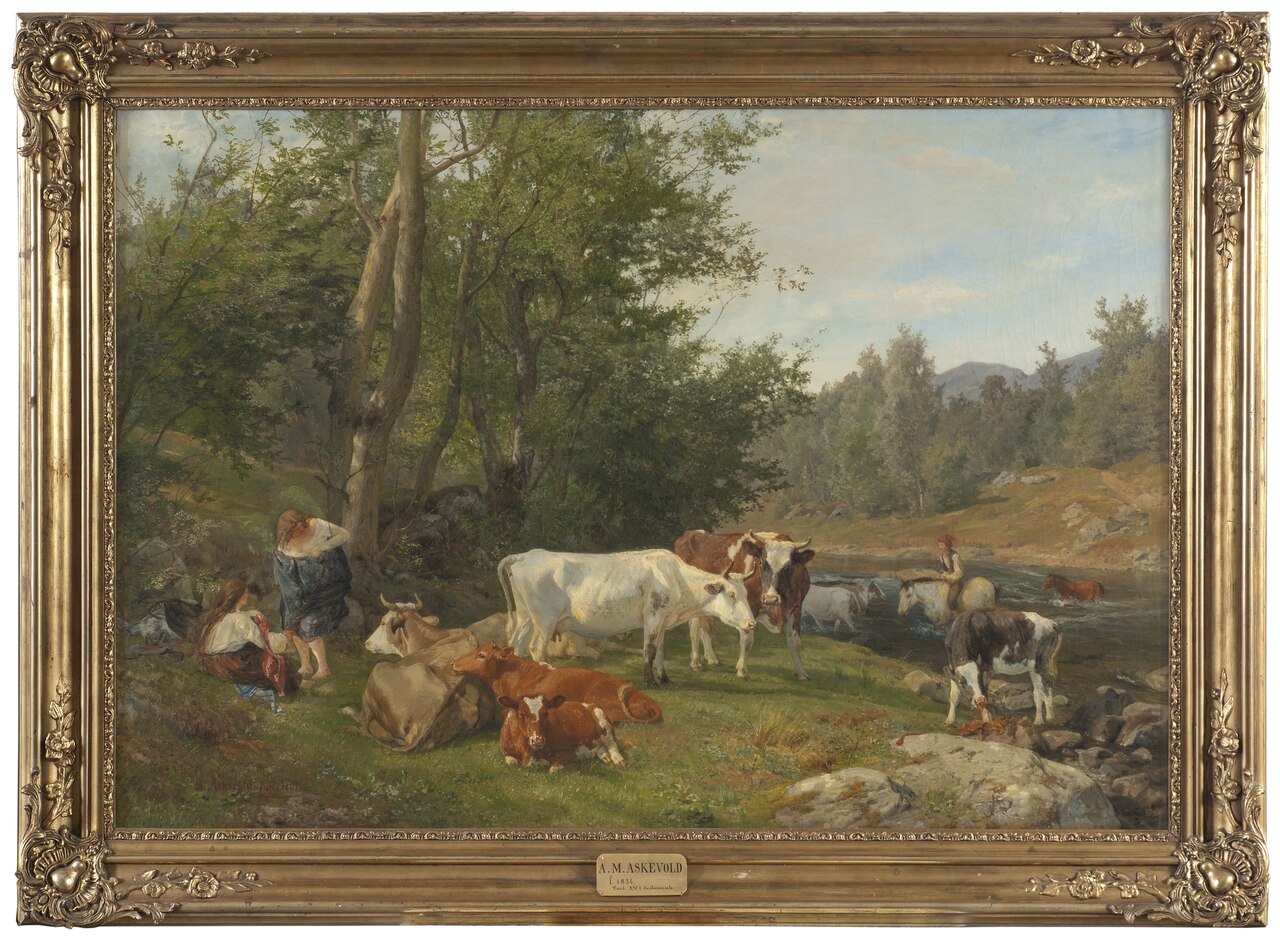


Early life Anders Askevold was born in 1834 in the coastal municipality of Askvoll, situated in the rugged region of western Norway. The dramatic scenery of fjords, mountains and sea that surrounded his childhood would later become the visual vocabulary of his art. Details of his family background are scarce, but the rural environment provided him with an intimate knowledge of the landscape and the agrarian life that featured prominently in his paintings.
Career and style In the mid‑19th century, a wave of Norwegian artists travelled to the German art centre of Düsseldorf to receive formal training. Askevold followed this pattern, establishing his studio there and remaining in the city for the bulk of his professional life. The Düsseldorf school was known for its meticulous draftsmanship and a lyrical approach to landscape, qualities that resonated with Askevold’s own sensibilities.
His style is best described as Romantic nationalism. While he employed the technical precision typical of the Düsseldorf Academy, his compositions celebrate the Norwegian environment as a source of national identity. The colour palette is dominated by cool blues and greys of water and sky, warmed by earthy tones of soil and the flesh of cattle. Light is rendered with a subtle, atmospheric quality that suggests early morning mists or the golden glow of evening, reinforcing a sense of timelessness.
Signature techniques Askevold’s paintings reveal a consistent set of techniques:
1. Structured composition – He often placed a focal element—such as a herd of cattle—against a sweeping backdrop of fjord or river, creating a balanced visual tension between the foreground and the distant horizon.
2. Layered glazing – Thin layers of oil paint were applied to achieve depth and a luminous atmosphere, particularly in sky and water surfaces.
3. Detailed animal study – Even when the overall scene is broad, the anatomy of the livestock is rendered with precise observation, reflecting his interest in figure studies.
4. Soft edge modelling – Edges of distant forms are softened, allowing the eye to move seamlessly from near to far, a technique that underscores the Romantic notion of the sublime.
These methods combine to produce works that are both technically accomplished and emotionally resonant.
Major works
- Landscape with Cattle (1861) – This early masterpiece illustrates Askevold’s mature handling of light and space. A herd grazes on a low plateau while a fjord stretches beyond, its water catching a pale sunrise. The painting exemplifies his ability to integrate human‑controlled nature with the grandeur of the Norwegian landscape.
- Stilleben (1853) – Although the title translates to “still life,” the work reflects his early experimentation with composition and colour. The piece features a modest arrangement of objects, likely fruits or domestic items, rendered with a restrained palette that hints at the natural world he would later depict.
- Evening at the Riverside (1870) – In this work, Askevold captures the tranquil mood of twilight along a riverbank. The fading light creates reflective surfaces on the water, while silhouettes of trees and distant hills frame the scene, demonstrating his skill in portraying atmospheric conditions.
- Study of Two Cows, Seen from Behind (1900) – Produced in the year of his death, this study focuses on the backs of two cows, emphasizing their form and the texture of their hides. The limited viewpoint underscores his ongoing fascination with animal anatomy and his commitment to observational drawing.
- Figure Studies (1900) – A series of drawings or small paintings executed shortly before his passing, these works explore the human figure with the same measured observation applied to his animal subjects. They reveal a late‑career interest in the anatomy of both people and livestock, perhaps intended as teaching material or personal study.
Each of these works contributes to a cohesive picture of Askevold’s artistic concerns: the interplay of light, the dignity of rural life, and the majestic backdrop of Norway’s western coast.
Influence and legacy Anders Askevold occupies a pivotal place in the development of Norwegian landscape painting. By marrying the disciplined techniques of the Düsseldorf school with a distinctly Norwegian subject matter, he helped forge a visual language that celebrated national scenery without sacrificing academic rigour. His depictions of fjords and cattle influenced younger Norwegian artists who sought to articulate a cultural identity grounded in nature.
In the decades following his death, Askevold’s paintings were exhibited throughout Scandinavia and Germany, reinforcing the perception of Norway as a land of pristine wilderness. Museums in Oslo and Bergen hold several of his key works, and his paintings continue to be reproduced in textbooks on 19th‑century art. Contemporary scholars view him as a bridge between Romantic idealism and the more realistic approach that would dominate early 20th‑century Scandinavian art.
Overall, Askevold’s legacy endures through the continued appreciation of his serene yet powerful landscapes, which remain emblematic of Norway’s natural heritage and its artistic representation in the nineteenth century.
Frequently asked questions
Who was Anders Askevold?
Anders Askevold (1834‑1900) was a Norwegian painter best known for his romantic landscapes of western Norway’s fjords, often featuring cattle and pastoral scenes.
What artistic style or movement is he associated with?
His work aligns with Romantic nationalism, combining the precise technique of the Düsseldorf school with a celebration of Norwegian natural scenery.
What are his most famous works?
Key works include Landscape with Cattle (1861), Stilleben (1853), Evening at the Riverside (1870), Study of Two Cows, Seen from Behind (1900) and his Figure Studies (1900).
Why does Anders Askevold matter in art history?
He helped establish a distinctly Norwegian visual identity in the 19th century, influencing later artists and shaping how Norway’s landscapes are represented internationally.
How can I recognise an Anders Askevold painting?
Look for tranquil fjord or river settings, a cool‑toned palette, meticulously rendered cattle or livestock, and a soft, atmospheric treatment of light and distance.